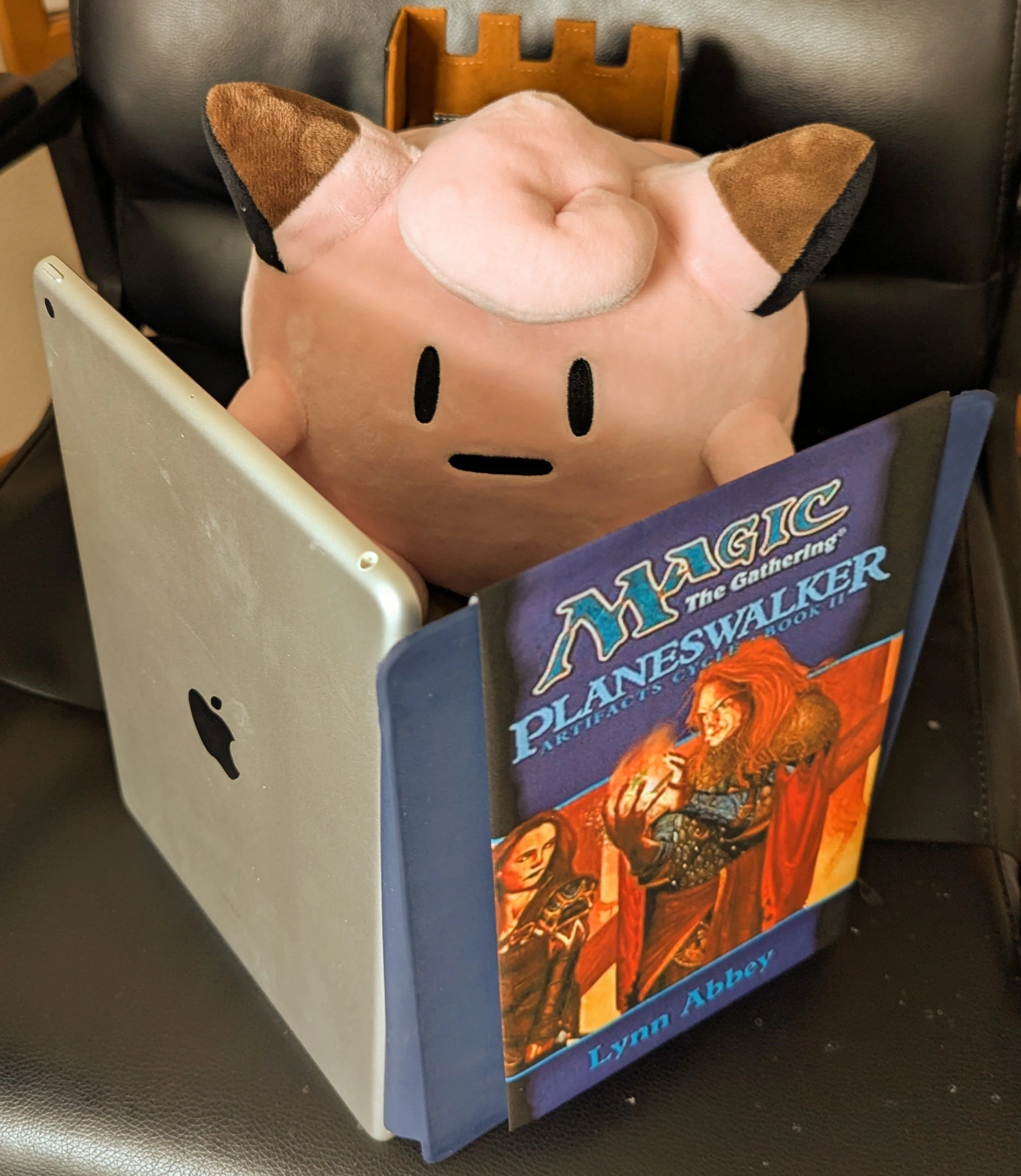
Planeswalker (The Artifacts Cycle, Book 2) (Part 1 - Overview)
Welcome back, everyone, to our ongoing journey through the Artifacts Cycle tie-in novels for Magic: the Gathering (MTG).
This particular book was hard to get through. I started reading it on August 1st, but I didn’t finish it until October 26th. For context, in the intervening period, I read or finished:
The Eisenhorn short stories, plus Hereticus and The Magos.
Ravenor and “Playing Patience” (which we’ll be reviewing in two weeks)
All the Fourth Wing bonus content
The sample chapters for Murtagh 2 and Path to Power
Dragons of a Vanished Moon (incidentally, a book that I also put off reading for many months)
Were it not for my desire to clear my schedule prior to Sky Shielder and The Strength of the Few, I probably still wouldn’t have finished it.
What’s so frustrating about this book is that isn’t a bad story. It isn’t even a good story told badly. It’s an good story that just tries to do too much, and the result is incredibly unsatisfying. What’s more, I don’t think this is due to a failure of the author, Lynn Abbey. Much like The Hero of Numbani last year, I suspect that this book was a victim of the demands placed upon the author by virtue of it being commissioned tie-in fiction.
Let’s get into it.
STATS
Title: Planeswalker
Series: The Artifacts Cycle (Book 2)
Author(s): Lynn Abbey
Genre: Epic Fantasy
First Printing: September 1998
Publisher: Wizards of the Coast LLC
SPOILER WARNING
Mild, unmarked spoilers for Planeswalker will be provided throughout this review. Heavy spoilers will be confined to clearly labeled sections. I will keep the first paragraph of any given section spoiler-free.
Throughout this review, I will also be providing heavy spoilers for later events within MTG canon. While I will be steering clear of details that would spoil the progression of this book specifically, there is a strong chance that you will figure out certain spoilers if you pay attention to these bits of lore. I will confine the heavy spoilers to the Worldbuilding section.
Heavy, unmarked spoilers for The Brothers’ War will be provided throughout this review. I will also assume that you’ve already read my review of that book, though that isn’t essential to understand this one.
STRUCTURE
This 2-part review will be divided up as follows:
Part 1 (Today)
Premise
Timeline
Rating
Content Warning
Part 2 (Friday, April 10th)
Plot
Character
Worldbuilding
PREMISE
From the Amazon product page for the e-book:
Urza Triumphant The war between Urza and Mishra is over. Brooding on the death of his brother at the hands of extraplanar forces, Urza drifts among the planes. But the end of the Brothers’ War has transformed him into something greater. Deep within his heart, a spark has been kindled to a flame that cannot be quenched. Urza has become a planeswalker.
Reaction
This premise is false. If one was supremely charitable, one could call this the premise for the book’s prologue, but it is irrelevant beyond that. This is not an Urza story.
Who this book is really about is Xantcha, a newt (the in-world term for a synthetic humanoid made by the Phyrexians as a blank slate for conversion into a proper Phyrexian lifeform) who rebelled against her master and served as Urza’s companion and confidant for three millennia. The first two-thirds of the book are split between two timelines:
A “past” timeline detailing Xantcha’s origins on Phyrexia, her decision to turn against her master, her rescue by Urza when her rebellion is discovered, and her adventures with Urza across millennia as he plotted ways to take revenge on the Phyrexians for Mishra’s death.
A “present” timeline, set in the last year of the book’s massive span of time, detailing Xantcha’s scheme to kick Urza back into action after he’s devolved into Jack Skywalker.
The last third of the book drops the past timeline and focusses exclusively on the present.
I’ll get into the problems with this in a second. For now, suffice it to say that if you wanted the story promised on the back cover, you are probably not going to be happy with this book.
TIMELINE
I had trouble keeping track of the passage of time in this one, especially with the massive time jumps within the “past” timeline, so I once again returned to this wiki page to get a sense of things.
Chapter 1 of this book, which serves as its prologue, takes place five years after the end of the Brothers’ War, so it must be set in 69 AR.
The “present” timeline of this book begins in 3244 AR and ends in 3245 AR. This tracks with references made within the book of a full year passing across the story.
The “past” timeline begins in 65 AR, when Xantcha is decanted from the vat she was grown in and begins her service as a newt. She is rescued by Urza in 180 AR. They have various adventures over the following centuries before ending up in Serra’s Realm in 880 AR. They then spend thousands of years searching for the plane of Equilor, arriving there in 3110 AR, before returning to Dominaria in 3210 ARC
There is a reason why I went into such intensive detail on this timeline, which I’ll come back to shortly.
In terms of what this book is adapting, this is the tie-in novel of Urza’s Saga, the 15th expansion set of MTG, released in October 1998.
RATING: 5/10
When I initially began to disengage from this book, I thought the problem was the POV. We were promised an Urza story, but what we got was an adventure for a side character. There’s nothing inherently wrong with that, except the book tries to pretend that it is still about Urza, and that disconnect makes it hard to really connect with what’s happening.
However, then I read The Magos. That book is also marketed as following a well-established legacy character, only to really be about a side character who just happens to cross paths with the legacy character, with the legacy character feeling like he’s only in the story to get a plot coupon to go onto the next book where he matters. Why was that book so engaging while this book wasn’t?
I think there are two aspects to this. The first is a matter of character. While I don’t dislike Xantcha, Planewalker does not do as good a job as building her up as a sympathetic POV character as The Magos does for Drusher. Urza is also static in this story, with nothing Xantha does seeming to have any real influence on him, while Eisenhorn clashes with and is affected by Drusher. The second is a matter of plot. The Magos is a dynamic adventure that constantly puts the lead characters in danger. The split timelines in Planeswalker produce a past timeline where there are no stakes, since we know Urza and Xantcha must survive to the present timeline, and a present timeline where no meaningful threat emerges until the final third of the story.
I have not read any of Abbey’s other work, so I’m not in the best position to comment on how much of this is due to flaws in her writing versus the demands of Wizards of the Coast. In this case, though, I’m even more inclined to heap blame on WotC than I was in the case of Blizzard and The Hero of Numbani. This comes down to the handling of the past timeline. Urza’s character development is frozen across this entire timeline - he’s the same person in 180 AR that he is in 3244 AR. I can’t help but wonder if Abbey was instructed to devise filler for this massive gap in time while also being prohibited from evolving Urza’s character. The split timeline and the condensing of genuine threat until the very end make sense as a work-around to try to wring some sort of story out of this massive span of time. What’s more, following a character who isn’t Urza is a way to give the audience something to chew on without having to touch the legacy character.
I don’t think this fully excuses the flaws in the book even if true, but I’m at least willing to give Abbey the benefit of the doubt.
CONTENT WARNING
Nothing much of note here (which is impressive, given the Phyrexian aesthetic). There’s some vaguely described violence and references to sex. It’s very tame, even compared to The Brothers’ War. As with that previous book, I read this when I was 12, and nothing in it shocked me even then.
OUT OF FOCUS
With the big-picture stuff out of the way, we’re going to wrap up Part 1 here. We’ll continue this review next Friday, April 10th, by diving deeper into Plot, Character, and Worldbuilding.
Thank you all for stopping by. Please remember to share and subscribe if you enjoyed what you read here. Take care, everyone, and have a good weekend.

Looking for more Fantasy stories? Check out my free novella, The Unbottled Idol, available over in Tales of the Five Worlds!
Mohsen Yavari's task within the Imperial Inquisition of the Kimian Empire is simple: monitor the gods' activities in the mortal world. However, when a diplomat is killed by a goddess, a maverick inquisitor recruits him for her investigation. Their search for answers will lay bare sinister truths, with a child’s soul hanging in the balance.
Join me on this adventure of intrigue, martial arts, and divine assassination!