Rath and Storm (Anthology Introduction, Schedule & Framing Device)
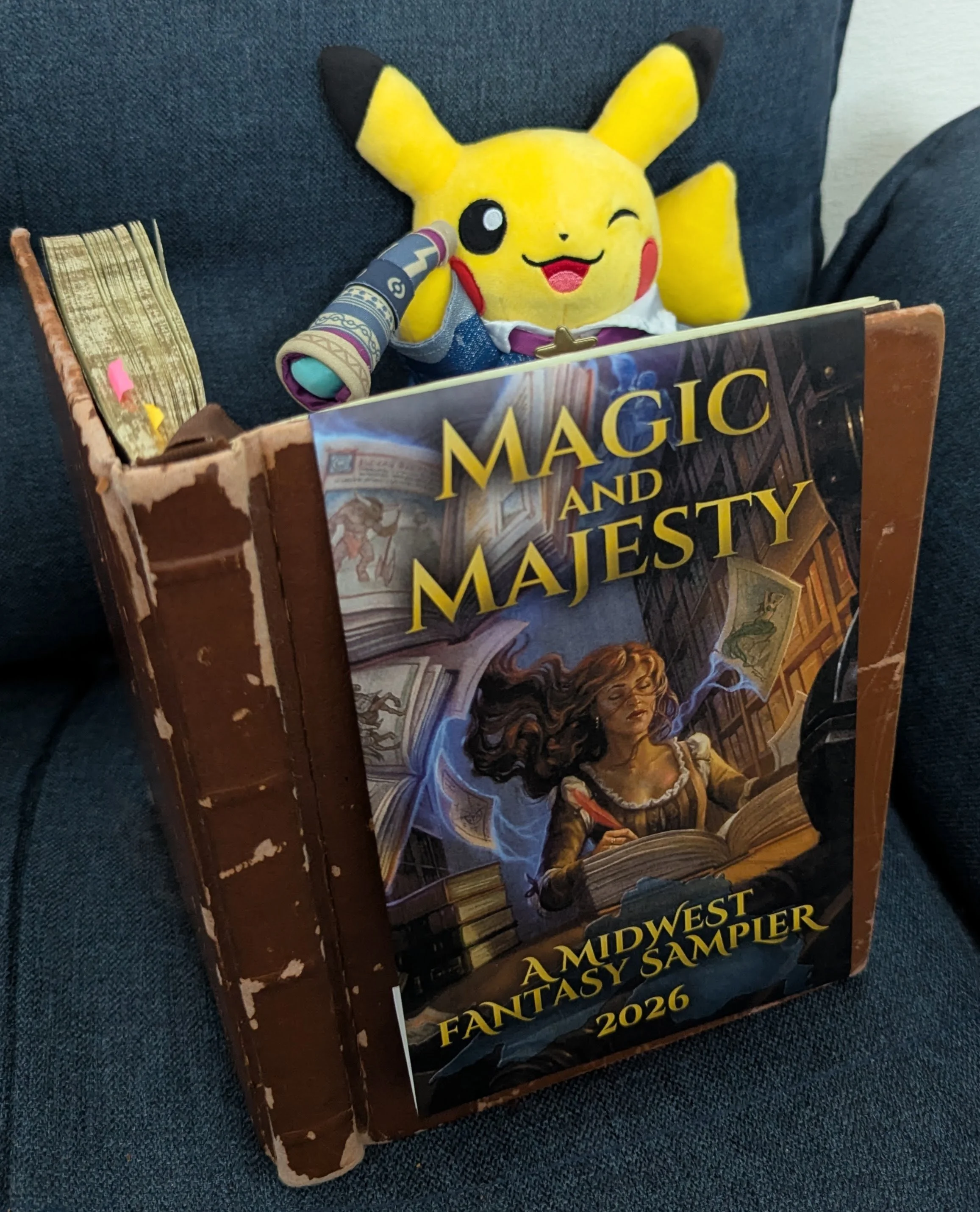
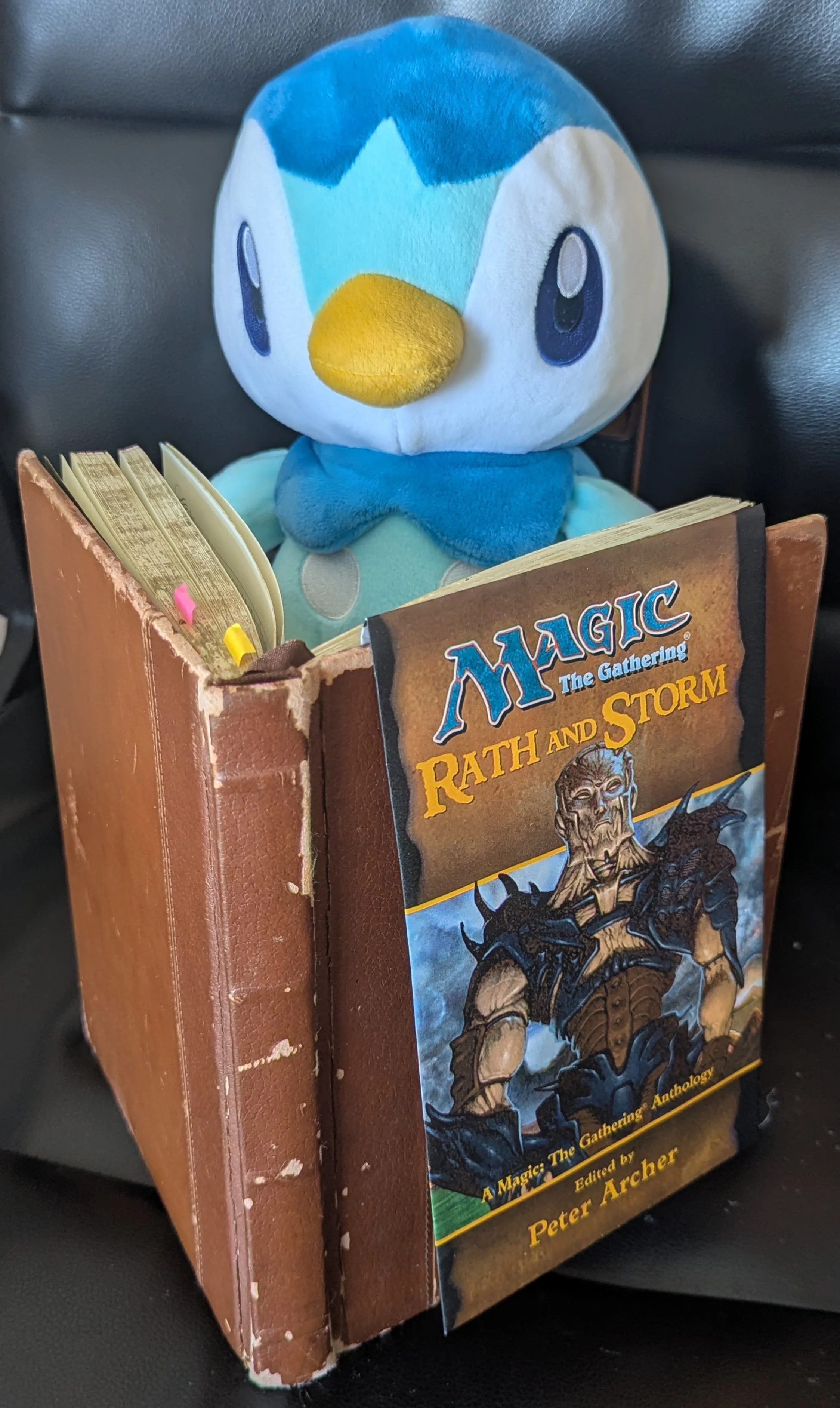
Hello, all. Welcome to our second anthology review series. In this case, we will be reviewing the short stories contained within Rath and Storm, a Magic: the Gathering (MTG) tie-in book that covers the stories of the following four MTG expansions:
Weatherlight
Tempest
Stronghold
Exodus
This is a curious book because of its relationship to the Artifacts Cycle. While all of those books (and, with the exception of The Brothers’ War, the MTG expansions they are tie-ins for) are released after this anthology, the events of the Artifacts Cycle are actually a prequel to this book. The origins of the skyship Weatherlight and the silver golem Karn are covered in the third book of that series, Time Streams; the fourth book, Bloodlines, introduces the artificial plane of Rath and explains the origins of the hero Gerrard Capashen. I’m not sure why Wizards of the Coast decided to spend the second year of a four-year story arc (known collectively as the Weatherlight Saga) on a prequel, but that’s simply how things worked out.
I went back and forth on how best to handle this anthology. I had more to say about most of these individual stories than I did for the individual stories of Magic and Majesty, so I drafted a 12-part series (this introduction, a post for each story, and the retrospective). However, as the release date drew nearer, I released that my schedule backlog issues were at least partially due to this series taking up so many Sundays. So, we’re going to do something experimental.
Starting today and continuing over the next two weeks, we will do one part of this anthology review each day except Fridays, following this schedule:
Monday, July 6th: “Gerrard’s Tale”
Tuesday, July 7th : “Tahngarth’s Tale”
Wednesday, July 8th: “Ertai’s Tale”
Thursday, July 9th: “Greven’s Tale”
Saturday, July 11th: “Hanna’s Tale”
Sunday, July 12th: “Starke’s Tale”
Monday, July 13th: “Karn’s Tale”
Tuesday, July 14th: “Crovax’s Tale”
Wednesday, July 15th: “The Weatherlight’s Tale”
Thursday, July 16th: “Mirri’s Tale”
Saturday, July 18th: Anthology Retrospective
Rather than give a ratings for the book up-front, I am going to do individual ratings for each story as we go along. I’ll then give an overall rating for the full anthology as part of the retrospective.
Buckle up, everyone. It’s time to take flight.
STATS
Title: Rath and Storm
Series: Magic Anthologies
Author(s): Various, edited by Peter Archer
Genre: Epic Fantasy
First Printing: July 1998
Publisher: Wizards of the Coast LLC
SPOILER WARNING
Mild, unmarked spoilers for Rath and Storm will be provided throughout this review. Heavy spoilers will be confined to clearly labeled sections. I will keep the first paragraph of any given section spoiler-free.
Throughout this review, I will also be providing heavy spoilers for events at other points within within MTG canon, including events that occur during the Artifacts Cycle. While I will be steering clear of details that would spoil the progression of this book specifically, there is a strong chance that you will figure out certain spoilers if you pay attention to these bits of lore. I’ll confine the heavy spoilers that are relevant to this book into clearly marked sections.
TIMELINE
We have a bit of conflicting information on this one. Nothing that actually affects the narrative, mind. Just a curious change.
Going off the book itself, the first of the insert chapters states that all of the stories in this anthology take place in 4205 AR. This is consistent with the books of the area. The insert chapter also starts that Gerrard Capashen is 26 years old at the time that the anthology begins, which would put his date of birth in either 4168 AR or 4169 AR. The epilogue of Bloodlines (which we will be reviewing by the time this anthology review wraps up) is features Gerrard as a newborn, and it is set in 4169 AR. All that lines up.
For some reason, the timeline on the MTG wiki (which we’re going to be referencing quite a bit while reviewing the Artifacts Cycle) instead puts this story one year earlier, in 4204 AR, and instead has 4205 AR be the year the Phyrexian invasion of Dominaria (or, as I now like to think of it after more recent events in MTG lore, the First Phyrexian Invasion) takes place.
This is obviously a blip in terms of the wider chronology of MTG. I’m sure there’s an easy explanation of the discrepancy. I see the fact that the published books are internally consistent, despite being written by different authors, as a victory for continuity. If some later lore happening to wiggle the calendar a bit, or if whomever edited the wiki took some liberties while trying to make sense of events, that’s not a meaningful issue.
TIE-IN
As stated above, this anthology covers the stories of four consecutive MTG expansions. How is goes about this is rather more blunt than what the Artifacts Cycle did. This isn’t inherently better or worse, but it is noticeable.
Organization
This book is split into four parts, one for each of the sets. The stories are divided among these parts depending on where in the timeline they fall.
Part I: Weatherlight includes “Gerrard’s Tale”, “Tahngarth’s Tale”, and “Ertai’s Tale”.
Part II: Tempest includes “Greven’s Tale”, “Hanna’s Tale”, and “Starke’s Tale”.
Part III: Stronghold includes “Karn’s Tale” and “Crovax’s Tale”.
Part IV: Exodus includes “The Weatherlight’s Tale” and “Mirri’s Tale”.
Memberberries
MTG books are tie-ins for a card game. That means we can expect any number of characters to have one (or more) Legendary Creature or Planeswalker cards within the game (if not at the time the book was written, than across various sets in later years). It means that we can expect important items to be Artifacts cards, specific locations to be Land cards, and magical spells or effects to be Enchantments, Sorceries, or Instants. We can expect specific events to reflect references made in flavor text.
I haven’t talked about this in the Artifacts Cycle because, with how those books are written, it is easy to pretend everything within those books as original inventions of the author. They may not always be well-written. However, they feel like their own entities, rather than being product placement.
In Rath and Storm, this is not the case, at least not for anything beyond the characters themselves. Whenever a new monster or item was introduced, I found myself running a quick search for that entity’s name and pulling up the precise card that is being referenced. Often, the precise mechanics of that card would be folded into the story, such as how aboroths weaken over time and how fog elements die the month they actually engage in combat.
I think this is still done well overall. The fact game mechanics are not only translated faithfully but also help to drive the narratives is honestly a nice touch. My only complaint about this is that it did negatively impact immersion. I feel like there’s a difference between thinking, “Wow, I like this character! I want to build a Commander deck around him,” and thinking, “Huh, that monster is probably a card. Wonder what it does.”
FRAMING DEVICE
The stories of Rath and Storm are divided up by a series of interlude chapters. Most of these bear the title of “A Dark Room”, though the last is titled “Dawn”. The chapters describe a pair of monks - an old master and a boy novice - in the library of some unspecified monastery during a storm. The master relays the story of “the Rath Cycle” to the novice throughout the night. Most of the backstory and the events of the actual MTG sets are expressed through direct exposition. The implication is that the ten short stories of this anthology are the tales where the old master went into greater detail.
I like this framing device in concept. It’s a good idea for condensing a story that could easily be four entire novels down into just one book. It also means that the authors of the individual stories don’t need to rehash the same critical exposition at the start of every short story.
Execution is another matter. A lot of adventures are handwaved through exposition. A few of the stories later in the anthology actually double back and retell the previously exposited events. Furthermore, the logic of which events got stories versus just being exposited isn’t clear. To take just one example, “Karn’s Tale” rehashes events that are exposited as backstory in the very first interlude chapter, yet his encounter with the Sliver Queen (without which, he could not recover the Legacy artifacts, which was the difference between this epic adventure ending in success or failure) is brushed aside with a few lines of dialogue.
Perhaps the worst sin this framing device commits, though, is the climax. Despite being composed of individual stories, the anthology tries to make the two stories in Part IV into a big climax. It just doesn’t work. The effort actually sabotages the best story in the anthology by ramming it into a thematic framework it’s just not suited to support.
I’ll leave off with this for now. Suffice it to say that, as we’ll get into more with the retrospective, this framing device would have worked better if the anthology fully committed to it. Either the short stories should have been entirely about character work, letting the framing device do the heavy lifting of the plot by expositing the main events, or else the short stories should have focused on the highlights of the action.
WEATHERING THE STORM
Tomorrow, we’ll dive into “Gerrard’s Tale”, the first of the stories. While it’s not a remarkable tale, it does a good job of building Gerrard’s character. I’d also say that it does a good job of building off of the framing device. It trusts the reader to remember all the backstory exposition thus far and dives right into the key character decisions needed to kick Gerrard’s quest into gear.
Thank you all for stopping by. Please remember to subscribe and share if you enjoyed what you read here. Take care, everyone, and have a good week.