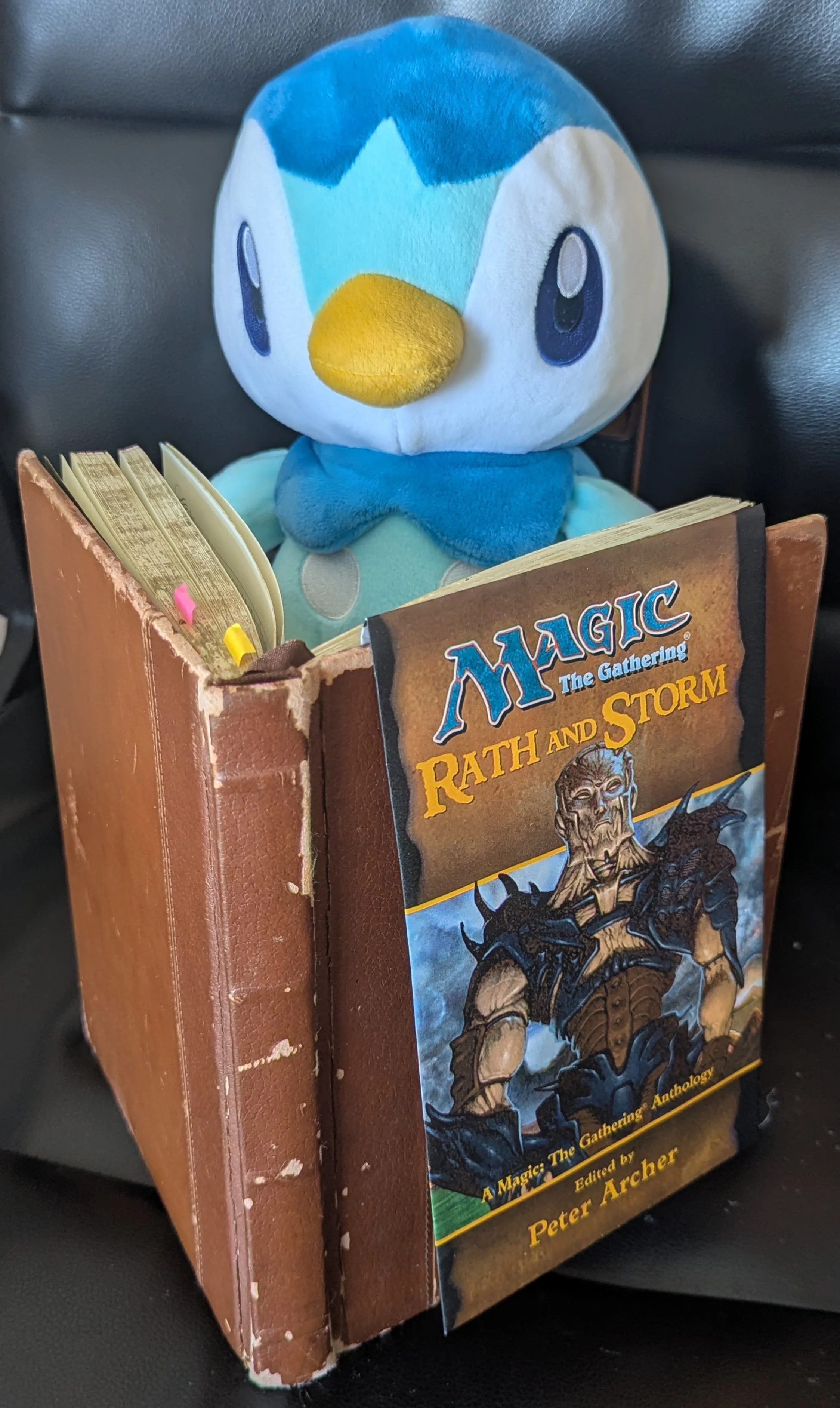
Rath and Storm Anthology Retrospective
Hello, all. Welcome to retrospective of the anthology mini-review series for Rath and Storm.
If you haven’t read the introduction or the reviews of the individual stories, I encourage you to go back and do so. This part will provide my rating for the anthology as a whole and tie up various odds and ends that weren’t covered elsewhere.
Let’s fly one last time.
STATS
Title: Rath and Storm
Series: Magic Anthologies
Author(s): Various, edited by Peter Archer
Genre: Epic Fantasy
First Printing: July 1998
Publisher: Wizards of the Coast LLC
SPOILER WARNING
Heavy, unmarked spoilers for the entirety of Rath and Storm will be provided throughout this post. I will keep the first paragraph of any given section spoiler-free.
Throughout this review, I will also be providing heavy spoilers for events at other points within within MTG canon, including events that occur during the Artifacts Cycle. While I will be steering clear of details that would spoil the progression of this book specifically, there is a strong chance that you will figure out certain spoilers if you pay attention to these bits of lore. I’ll confine the heavy spoilers that are relevant to this book into clearly marked sections.
OVERALL RATING: 4 / 10
This anthology is a bit of a tricky beast to rate. If the short stories were all stand-alone stories, I could simply average out the scores of the individual stories and then say, “You should pick this book up to read X and Y.” The problem is that these stories are meant to be snapshots of a grander epic. Not only does this impact the framing of multiple stories, but we also have to consider how these meld into this cohesive whole.
Were I to take the stories as standalones, I would give this book a higher rating. Six out of the ten stories range from functional to great when viewed in that way:
Of these, “Ertai’s Tale”, “Crovax’s Tale”, and “Mirri’s Tale” are good enough that I might recommend picking up the anthology just for the sake of reading those (at least, if you’re paying e-book prices).
The sticking point is the grander epic. Both “The Weatherlight’s Tale” and “Mirri’s Tale” are damaged by needing to serve as the climax of this epic. There’s also the matter of the interlude chapters. There are so many epic adventures (the Death Pits, the Sliver Queen, the Dream Halls, and even the final escape from Rath through the planar portal) that we do not get to see. This means that the events we do get Shown need to be worth the price of admission. Unfortunately, none of them are. There’s a reason that I kept making a big deal out of character work throughout this anthology. The events that actually happen during these stories are a lot less interesting that the potential alternatives that are glosses over. (For that matter, “Starke’s Tale” glosses over a potential alternative that happens during the story.)
I think that if Rath and Storm had embraced this and made the anthology entirely about character over plot, that would have redeemed it. The best parts of “Hanna’s Tale” were when they focused on her personal struggles over plot developments, and even “Karn’s Tale”, despite its botched execution, did a better job executing the same concept as “Starke’s Tale” because time was taken to explore Karn’s mindset.
As things stand, the anthology didn’t commit, and those stories focused on plot ended up weakening the whole.
A CURIOUS EXPERIMENT
I’m not an expert on the overall timeline of MTG’s publishing of tie-in fiction. From what I understand (based purely on memory and this timeline on the MTG Wiki), while there were multiple tie-in novels for MTG prior to 1998, The Brothers’ War (released just a few months before Rath and Storm) was the first tie-in published directly by Wizards of the Coast. It was also only the third time that a tie-in was intended to tell the story of a specific expansion within the game (with there previously being a novel for each Fallen Empires and The Dark).
It’s also worth noting that, because of when Rath and Storm released (between The Brothers’ War and Planeswalker), it could be seen as a companion to the Artifacts Cycle. It played catch-up for the portions of the Weatherlight Saga where the game expansion had already released.
Which leads me to my big question: was Rath and Storm merely a rush job to play catch-up? Or was Wizards of the Coast experimenting to see whether they could cut corners and get more success from putting out a single book for multiple sets instead of one book per set?
I don’t have the answer to this question. I just think it’s worth noting that Wizards of the Coast stopped using anthologies to tell the stories of individual sets after this point. During the following decade of them regularly releasing at least three expansion-based novels per year, none of those novels were anthologies. Of the multiple anthologies that were released, they abandoned the concept of a anthology-spanning framing device and simply went for common themes (The Colors of Magic, The Myths of Magic, The Dragons of Magic, The Secrets of Magic, and The Monsters of Magic).
BETTER IN FULL (?)
Regardless of the reason(s) why Rath and Storm was an anthology instead of a series of novels, I can’t shake the feeling that a quartet of novels would have been a better way to tell this story. So many adventures that get glossed over could have made for entire chapters of struggle and triumph. Then there’s the fact that “The Weatherlight’s Tale” and “Mirri’s Tale”, which should the burden of rushing the climax when they are really just beats within the story of the Weatherlight’s escape from Rath.
More importantly, there is the matter of character. We didn’t get a story for Orim. We didn’t get a story for Sisay. We didn’t even get a story for Squee. Then there are Tahngarth and Gerrard, who did get stories early in the anthology but who had character development later in timeline that demanded further exploration (Gerrard because of the heroism theme foisted upon “Mirri’s Tale”, and Tahngarth because of the big deal made about him being tortured by the Phyrexians in “Karn’s Tale”).
I’m sure this idea was at least considered by Wizards of the Coast before deciding to go with the anthology route. It just seems like the result didn’t really pay off. I suspect Wizards of the Coast also agrees (albeit for more financial reasons). In all the years since Rath and Storm, the closest they’ve come to repeating it are books like Alara Unbroken, In the Teeth of Akoum, and The Quest for Karn, which cover the story of multiple expansions but as singular, cohesive narratives.
TO WAR!!!
As mentioned back when I started the review of The Brothers’ War, only a small selection of tie-in novels got a conversion to e-book format. This means to the only way to read the others is if you track down a used copy of the original mass market paperbacks. Needless to say, this can be difficult and expensive - not only for me, but for any of you who might read these reviews and then want to read these books for yourselves.
Among the books affected by this are the Masquerade Cycle (Mercadian Masques, Nemesis, and Prophecy), which serves as the sequel to both Rath and Storm and the Artifacts cycle. I was blessed enough to find used copies of these books at a reasonable price. We will therefore be able to review all three books. Those reviews have already been drafted, and they’re scheduled for the Wednesdays starting at the end of September. I hope you’ll join me for them.
After we clear the Masquerade Cycle, we will go to the Invasion Cycle. Oh boy, the Invasion Cycle. That one is available in e-book format, and it was a roller coaster in terms of quality. We are going to be diving deep into that one after the Masquerade Cycle reviews are done.
Thank you all for joining me on this adventure to Rath. I hope you’ll join me for the war that follows. Please remember to subscribe and share if you enjoyed what you read here. Take care, everyone, and have a good week.