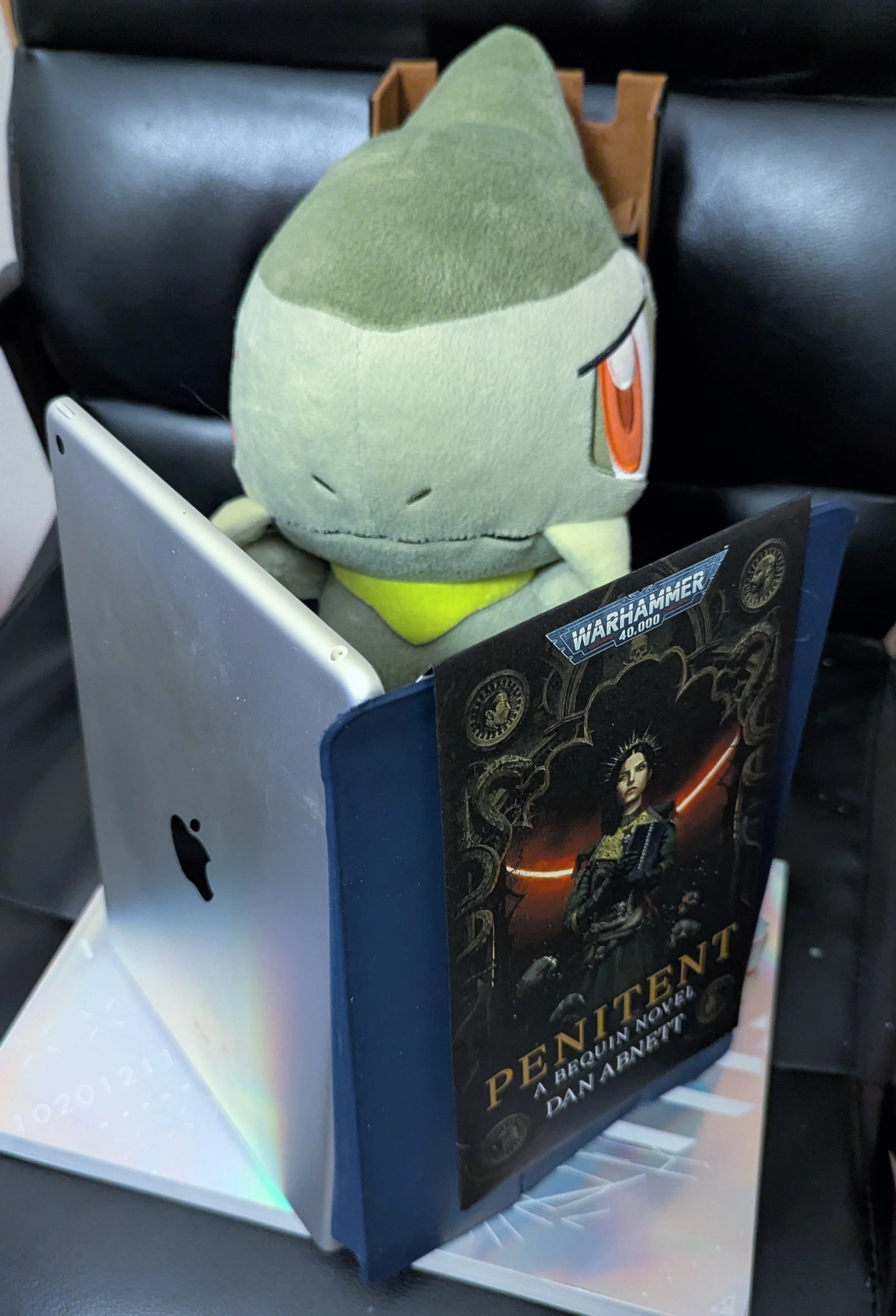
Penitent (The Bequin Trilogy, Book 2) (Part 3 - Characters)
Hello, all. Welcome back to the review of Penitent, the second book of the Bequin Trilogy.
Today, we continue the deep-dive analysis of the book by looking at the characters. If you’re looking for just the overview, please see Part 1; if you want a breakdown of the core features of the plot, we handled that last week in Part 2. We’ll discuss of worldbuilding and fanservice next week, in Part 4.
Limiters off, everyone. There are heretics to hunt.
STATS
Title: Penitent
Series: The Bequin Trilogy, Book 2
Author(s): Dan Abnett
Genre: Science Fiction (Space Opera)
First Printing: February 2021
Publisher: Black Library (Games Workshop Publishing)
Rating: 8/10
SPOILERS
Throughout this review, there will be mild, unmarked spoilers for the events of Penitent. I will keep the first paragraph of each section as spoiler-free as possible. Heavy spoilers will be confined to clearly marked sections.
There will be heavy, unmarked spoilers throughout the review for the events of all the Inquisitor content we have previously reviewed thus far, including the Eisenhorn and Ravenor novels, their associated short stories, and Pariah.
TERMINOLOGY
The Alizebeth Bequin in the story is not the same woman from Eisenhorn’s novels. This Bequin is her daughter (or, at least, a person engineered from the original Bequin’s genetic material). Within the narrative itself, Abnett establishes distance between the two characters as early as Chapter 1, with Bequin operating by the “affectionate contraction” of “Beta”. I’ll therefore be referring to this character as “Beta” throughout this review, while her mother will be referred to as “Alizebeth”.
CHARACTER
Beta
Our protagonist and POV characters has the same strengths as in the last book. She is overpowered, yet her background fully justifies. Her voice enriches the narrative. She makes tough calls that make sense for a character in her circumstances to make. The same could be said about the judgments she makes regarding other characters.
That said, there is an issue in Penitent that wasn’t present (or, at least, that I feel wasn't present) in the last book.
Back when I was trying to figure out the publication timeline of this series, I stumbled across a review that was very critical of Pariah. I only skimmed over it, but from what I saw, the reviewer’s core issue was that Beta reads like a fanfiction character. Her extreme competence was listed as a reason why the reviewer felt this way. (There may have been others, but again, I didn’t read the review in full.)
I don’t think that it would be fair to dismiss Beta as a fanfiction character in Pariah. In Penitent, though? Yeah, I can see how someone would draw this conclusion.
The issue comes down to how other characters react to Beta. It’s one thing for Eisenhorn, Medea, or even Harlon to value and trust her, given their histories Alizebeth. It makes a lot less sense with Ravenor. Yes, he was holding onto Alizebeth’s body, but he only worked with her for a limited time period a the beginning of his career (not to mention the fact that, as a more powerful psyker than Eisenhorn, he should find pariahs even more repulsive). So when he interacts with Beta as an equal instead of a subordinate, it just doesn’t feel earned.
Then there is the manner in which Abnett used Beta to comment upon and critique Eisenhorn and Ravenor. She is set up as this morally pure person criticizing two men who have darkened themselves with countless compromises. This sort of thing worked with Valentin Drusher because Drusher had nothing except the moral high ground; he had no actual power to challenge Eisenhorn beyond calling Eisenhorn out. When hyper-competent Beta does it, the result reads less like a deeper truth revealing itself through a humble messenger and more like a fanfiction character telling off a Canon character.
Beta’s interactions with surviving Cognitae operatives fall into a similar vein. The fact the Cognitae indoctrinated her to serve the God-Emperor, and thus shouldn’t be surprised that she turned against them, is brought up. Again, for a less competent character, this would feel like something deeper is being expressed, but with how competent Beta is, this feels like an assertion of inherent moral goodness.
Abnett does call Beta out for this … but it is never taken seriously. She never has to admit to being wrong. At most, she suffers some passive-aggressive remarks that point out her flaws or hypocrisies, and then the narrativ brushes past them without ever truly engaging with these ideas.
And then there’s Beta’s personal entourage … well. You’ll understand when I get to the analysis of Comus Nocturnus.
Oh, and she is able to effectively use a weapon associated with the Warp, better than anyone else on Eisenhorn’s team. this is a bit of competence that directly contradicts the established lore. How does her nullifying aura not automatically render this weapon useless?
All this is to say that, much like with the unfocussed plot, I would not be surprised if people decided to DNF the book because they found Beta irritating. Her character works within the overall narrative. She just dances far to close to tropes that have become far too common in bad books.
Renner Lightburn
My criticism of Beta’s dynamics with other characters does not extend to the Curst named Renner Lightburn.
Renner in Pariah was a very simple character. He was sent to collect Beta by someone he believed to be her mentor in the Cognitae, with it later being revealed that he was an unwitting pawn for Ravenor. His motivation was simple: as a Curst, he was bound to accept the hardships of others as a lifelong penance. Beta was annoyed by his persistent efforts to get her to come with him despite her having other objectives to resolve first, but she did recognize him as an ally. He exited that story with Ravenor erasing his memory and dumping him back into the street.
Penitent reintroduces Renner as a plot coupon. Beta is worried about his well-being after Ravenor cast him off. She goes on a lengthy side quest to try to find him. When she finally does meet him, he does not recognize her, but he recognizes that she perceives him as a friend, rather than just wanting to use him. This leads to him following her throughout the rest of the adventure.
This is a simple dynamic, yet it feels earned. Beta’s desire to help him makes sense in light of how insistent she was to help her fellow pariahs in the previous book. She has been demonstrated to be a loyal person, rather than loyalty being aggressively pushed as a virtue she possesses. And Renner’s loyalty to her in turn makes sense for his background. That makes their dynamic the most earned out of any in this book.
Comus Nocturnus
Comus is an Astartes, either a Blood Angel or a member of a successor chapter … or, at least, something the Yellow King has made in the image of the Blood Angels’ Primarch.
Beta meets Comus on her side quest to find Renner. She and Renner stumble upon a portal that seems to open into the King’s extimate space. Comus comes flying out of it - because, like Sanguinius, he has wings capable of lifting his massive body - and trying to drink their blood - because, like all Astartes of Blood Angel stock, he has the Red Thirst. Beta’s nullifying aura helps him to shake off the Thirst. Because he has no memory of who or where he is, only a compulsion to obey orders, Comus decides to consider Beta his commander and help her whenever she calls for him, homing in on the smell of her blood.
This whole setup makes rational sense for all the worldbuilding elements at play and the motivations of the characters. That said, it really does not help the impression the Beta is a fan fiction character.
Beta has a follower who is loyal only to her. He can tear apart Traitor Marines in full power armor and go 1-vs-1 with Cherubael (which is why I suspect he’s some kind of cline of Sanguinius, rather than just being a mere Astartes). He can be summoned near-instantaneously to any point in Queen Mab if Beta’s blood is exposed to the air (meaning that any time events escalate to the point she gets a cut, he can swoop in to save her). Abnett manages to juggle this in such a manner that keeps it from breaking the stakes, but it’s still very cringe when, say, Beta decides to blindsided Ravenor by revealing she has an Astartes ready to smash up the inquisitor and his entourage.
The Inquisitors and their Entourages (Heavy Spoilers)
I don’t have a lot to say about Eisenhorn, Ravenor, or their crews. These characters are very much continuations of who they were in Pariah and the previous two trilogies. Abnett does play with internal discord - Patience is very tired of Harlon’s ping-ponging between Ravenor and Eisenhorn, and generally views herself as the only person of Ravenor’s team who has anything resembling a clear hear regarding Ravenor - but this mainly functions as a bit of color to help make the various inquisitorial acolytes more distinct form one another.
As mentioned in Plot, I feel like Eisenhorn and Ravenor’s reconciliation feels rushed. Abnett went out of his way to set up that Ravenor is now fully antagonistic towards Eisenhorn. “Perihelion” not only set this up but also explained it. So for the two of them to hash things out after one conversation feels like an anticlimax. It really makes it seem like they could have resolved things any time in the years between Ravenor arriving in Sancour and the opening of Parish.
That said, I want to give due credit for how Abnett characterizes Ravenor more generally. He comes across as a whole lot colder than he ever did in his trilogy. This can partially be explained as this being Beta’s outsider perspective, but then Patience directly equates Ravenor with Eisenhorn when describing the brutality of inquisitors, which feels a bit at odds with his decision to not execute Zael when he had every reason to do so. The reason this works, though, is because Abnett bridged the gap with “Perihelion”. Ravenor has had a century of suffering the consequences of operating with a softer touch. It does make sense for him to be a harsher man now than he used to be.
A NEW WORLD?
Next Friday, August 7th, we’ll wrap up the review of Penitent with a look at the worldbuilding and fanservice. I shouldn’t have a great deal to comment upon here - Abnett doesn’t introduce all that much in terms of new lore - yet the few things he does introduce have some pretty serious implications. I have no trouble believing that Games Workshop would put this series on ice just to postpone dealing with those lore elements. It also brings into focus how much Abnett relies on other stories to do expositional heavy-lifting.
Thanks for shopping by. Please remember to subscribe and share if you enjoyed what you read here. Take care, everyone, and have a good weekend.