The Elf Tangent (Part 3 - Worldbuilding, Character & Romance)
Hello, all. Welcome back to the review of Lindsay Buroker’s clean Romantasy, The Elf Tangent.
This part will assess the worldbuilding, characters, and of course, the romance. If you’d like to read the overview, please see Part 1. For the plot, see Part 2. The analysis of prose, tone, and theme will wrap things up the week after that.
Let’s get right into it.
STATS
Title: The Elf Tangent
Series: N/A
Author(s): Lindsay Buroker
Genre: Fantasy (Romantasy)
First Printing: March 2022
Publisher: Self-published to Amazon
Rating: 6/10
SPOILER WARNING
Mild spoilers for The Elf Tangent will be included throughout this review, through I will keep the first paragraph of each section as spoiler-free as possible. Heavy spoilers will be confined to clearly labelled sections.
Heavy, unmarked spoilers for the other Romantasy series by Buroker that we’ve previously covered, Fire and Fang, may also be provided as necessary for comparative analysis.
WORLDBUILDING
Much like the plot, the worldbuilding of The Elf Tangent is kept simple. Buroker does hint at greater depths, though. The result is a world that works perfectly for a standalone story: easy enough to understand without multiple books to flesh it out, while still feeling lived in and real.
Geopolitics
There are at least four established nations within this setting:
Aldari’s kingdom
The kingdom whose prince she’s supposed to marry
A militaristic empire that wants to conquer Aldari’s kingdom
The elves’ kingdom, which is technically on the next continent over
The names of these places aren’t particular memorable, yet the concepts are. It’s a very easy situation to keep track of. Aldari’s people need allies, against the empire, and given their poverty, a political alliance through marriage is their only bargaining chip. The elves are sitting the conflict out because their own civilization imploded centuries ago, leaving them as scattered holdouts in a cursed land.
One thing I like about this setup is that Buroker goes a little deeper than the basic antagonism that is often seen in Fantasy stories. The empire doesn’t want to conquer Aldari’s people because they are inherently hostile and obsessed with conquest; they want to the resources of her people’s whaling industry. Likewise, not all elves are ignoring the wars of their neighbors; mercenary bands are coming out into the wider world to seek their fortunes.
Elves and the Twisted
The elves in this setting are surprisingly mundane. Aside from having pointed ears, the only discernable trait that distinguishes them from humans is their ability to use magic. They are explicitly not immortal. In fact, when the Captain’s age is referenced, it turns out that he is in his twenties, rather than merely looking like he is.
The Twisted are elves who have been twisted into vampiric beings that feed upon elf magic - in essence, they were venin a year before venin entered the mainstream. Because the elves’ magic was the foundation of their civilization, the growing numbers of Twisted triggered a near-total collapse of their society centuries prior to the events of this book. The elves have taken refuge in outposts protected by magical barriers to keep the Twisted at bay. Additionally, wherever they travel, elves wear special bracers that “subliminate” their magic (incidentally, a word Buroker would also use to describe Luna’s suppression of her werewolf powers), as otherwise, the Twisted will rapidly home in on their position and even chase them to other continents.
Again, Buroker successfully conveys a sense of history with the elves. Between stories Aldari knows of their history and the power of the bracers, there is a strong vibe of them being a race that would be more than just pointy-earred humans if only the Twisted threat could be eliminated. (Obviously, this much is exposited, but Telling us that fact isn’t the same as Showing us through environmental storytelling.) As for their magic, the Captain is open about the fact that it would take practice to learn even if the elves can defeat the Twisted, mentioning childhood experiments he and his sister attempted to test their abilities. Al the power the elves have left comes from artifacts that even they don’t have the ability to fully understand anymore.
On a related note, we never get any rules for how the magic is supposed to work. I don’t think that’s a narrative issue in this case. Buroker clearly outlines why magic can’t be used to solve every single problem in the story, so there’s no need to micromanage the situations where or can’t be a viable solution.
Feminism
This is a fairly minor point, but I’m going to be hitting on certain ideas when discussing the themes, so I really should cover this.
Aldari’s kingdom - and, it’s implied, all of the human kingdoms - are highly patriarchal, with political power explicitly passing down through male heirs. Aldari’s father’s heir is her significantly younger brother (who is about 10 years younger than her, if I recall correctly). Her father also refuses to accept her counsel on economic matters because she is a woman. Additionally, because power is passed down through the male line, Aldari needs to be a virgin when she is married off so as to ensure her children are also her future husband’s children.
All this is fine. My biggest issues with it actually pertain to how Aldari interacts with the world, which is what needs to be covered in the themes. There is just one other issue that I want to call attention to, as it is a contradiction that I can’t recall ever getting addressed in the narrative.
Aldari’s bodyguard, Theli, is a woman. Already, this calls into question the role of women within their world. Those questions get louder when we get this line of description from Aldari about the elves.
According to legend, their people were the best fighters in the world, the males and females both honed by generations of constant battle.
The “and females both” bit implies a contrast between the elves and Aldari’s kingdom. It seems that women in Aldari’s kingdom are not trained to fight. At the same same, Theli is never treated as something special. I could understand that if she were some sort of graceful combatant who hid her ability to kill behind a veil of graceful femininity (like, say, Yala in the Hostage of the Empire series), but Theli is very openly a bodyguard (thereby implying that she is masculine and physically imposing enough to dissuade attackers even within a fight) and fights with a mace (a weapon that relies on brute strength).
This doesn’t break the world. I just found the contradiction needlessly baffling, and it doesn’t help the thematic confusion we’ll discuss next week.
CHARACTER
Aldari
The Main Character of this story is the second-eldest princess of a kingdom in a deteriorating economic and military situation. Despite being a prodigy with mathematics and economics, her efforts to advise her father has fallen on deaf ears, for the some reason of her being a woman. Aldari therefore published economic treatises in the kingdom’s academic journals to attempt to advise her father and people indirectly. She’s not pleased to be married off to secure a military alliance, but her dedication to the kingdom outweighs her distaste. All her plans to escape the Captain are framed around her following through with the marriage, rather than getting home safely.
Beyond this, Aldari is effectively a palette swap of Syla from Fire and Fang. She has the same modern attitudes and the same quickness towards quips. Just remove Syla’s glasses, slim her down a bit, make her a virgin, and swap medicinal know-how for mathematics - all superficial details, in the grand scheme of things. Maybe Aldari is slightly more anxious than Syla (more on that when we talk about the prose), but that's the absolute limit of diffrrences that I can name. Not saying this is necessarily good or bad. It’s just a very familiar setup.
I had a lot of criticism in the plot analysis for the puzzles Aldari had to solve. That being said, I do feel Buroker successfully characterized Aldari as a smart person. Aldari has multiple opportunities throughout the book to demonstrate her knowledge, whether by solving difficult equations or engineering a glider from available materials. There’s also the discussion of whaling, where she shows at least an awareness of economic realities (i.e. whaling is her kingdom’s only industry, so they can’t simply stop outright) while expressing her desire to put a halt to the practice. The failure to pay off her stated level of intelligence in the climax is purely about the way the plot was constructed, not any failure of her character work.
I have more to say about Aldari’s quipping, but that should wait for the discussion of tone. For now, I’ll just say that every instance of quipping feels justified by Aldari’s characterization and the context. It doesn't come across as if she’s not taking her situation seriously.
Captain Hawk
The Captain is …
…
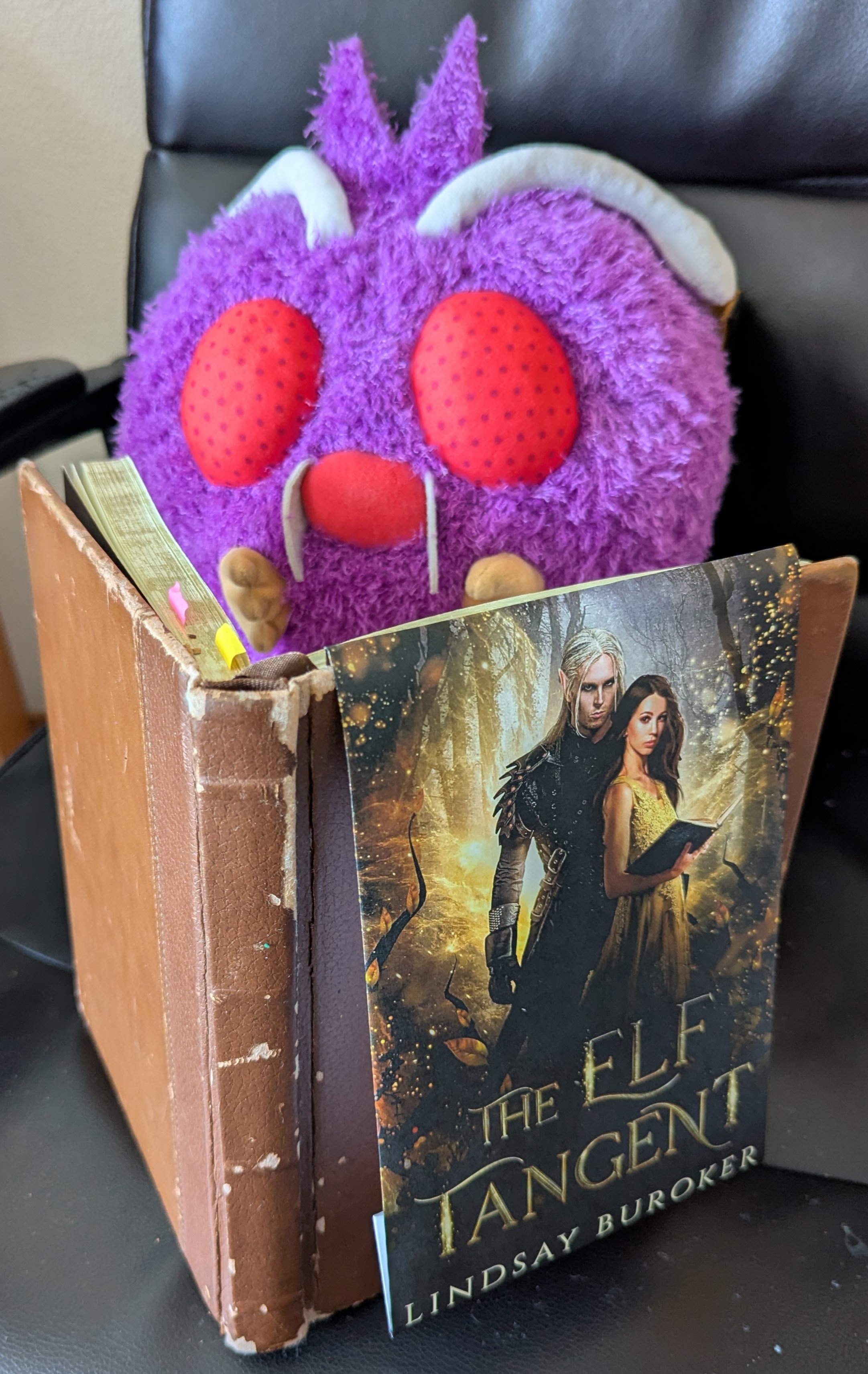
You know what? Just scroll up and look at the cover picture. That is him on the cover. There is very little I can say about him that is not conveyed by the illustration.
The Captain is perfectly functional in his role as the Love Interest of a Romantasy novel. He only needs to be attractive, both physically and emotionally. The plot demands nothing more of him. Buroker only really stores beyond this to implement his twist backstory. As we covered when discussing the plot, this twist was so obvious that I actually assumed it was the case going into the book, until the buildup to said twist clued me in that this was supposed to be a surprise.
Theli
Aldari’s bodyguard is primarily in the narrative to serve as her foil and remind her of her duties. Where Aldari loves numbers and economics, Theli loves ballads and mystery stories; when Aldari shows any hint of empathy or attraction towards the Captain, Theli is ready to nettle her with reminders that the politically arranged marriage her kingdom needs to survive cna only go through if Aldari is still a virgin. Theli is also the one urging Aldari to jump on every potential opportunity to escape from the mercenaries.
Theli occupies an interesting space in terms of characterization. She exists to be the angel on Aldari’s shoulder and as someone for Aldari to quip with. This should make her as bland as any of Violet Sorrengail’s accessories. Instead, she has enough of a concrete identity that this pervasive, subordinate functionality feels like an extension of who she is as a character.
Lieutenant Setvik
Setvik is the Captain’s subordinate. He visibly chafes at the Captain’s leadership and is not happy about the abduction plan. Aldari suspects him first when the Captain falls ill, and Setvik in turn suspects her.
Setvik is another functional character. He exists to generate tension and drama during the journey to the elves’ kingdom. He also has an arc of sorts with the Captain across the story, with the tensions between the two rising until they openly argue about their differences.
ROMANCE
Main Couple
The romantic pairing of Aldari and the Captain feels organic and believable.
On Aldari’s side of things, the Captain gives her more reasons to be attracted to him than just being hot. He is sympathetic towards her kingdom’s plight and outright apologetic about interfering in her political marriage, explaining the situation to her in full and promising to return her to her betrothed as soon as she has helped the elves. When his men mistreat her and Theli, he exerts his authority to protect them. He gives Aldari an ancient elvish puzzle artifact that functions like a calculator, thereby engaging with her interests. For that matter, the fact that he deciphered Aldari’s identity from the pen name on her journal articles and recognizes her mathematical talents (something other men gave not appreciated) flatters Aldari. All together, Aldari’s attraction to him feels like natural character growth.
On the Captain's side … well, the whole story is in Aldari’s POV, so we can’t be exactly certain why he is attracted to Aldari, but given that she’s cooperative once she understands the elves’ situation, there an element of appreciation that could evolve into attraction.
Pair the Spares
I have less nice things to say about the fact that Theli gets paired with a different elf at the end of the book.
You might reasonably think, given that Setvik was the only other elf character worth discussing after the Captain, that there would be enough interactions between him and Theli within the story to make an obligatory romance between them make some sense. That’s not actually the case. The pair barely interact. Almost all of that interaction is hostile. Then suddenly, at the end of the book, the two are ramming their tongues down each other’s throats while Setvik gropes her.
What makes this obligatory romance particularly weird is that there’s actually another elf in the group whom Theli has more of an arc with. One of the mercenaries, whose name is Pheleran, gropes her early in the abduction. This leads to the Captain flexes his authority to punish Pheleran and prevent any other mercenaries from doing the same. Later, at the climax Pheleran partially redeems himself by saving Theli, and she says she’ll give him a kiss if they survive.
Sure, Theli getting together with this guy would have felt a bit off after the groping, but it’s not like Setvik is any better. If anything, if we take the groping incident into account, he’s actually worse. He was fully prepared to pardon Pheleran for the groping, first because he didn’t believe Theli and then because he didn’t think a human woman deserved the same respect as an elf woman. So Theli choosing Setvik after all this feels less like spontaneous passion and more like an imposed obligation.
ROOM TO LAUGH
I’ve criticized Buroker’s latest Romantasy series for tonal dissonance. The stakes of the plot lean on elements that demand to be taken seriously, yet so much humor is forced into the text that it’s hard for the audience (and, seemingly, the characters) to fully engage with that emotion. Here, though, that problem does not exist. Through moderation and good characterization, Buroker reins things in.
Also, while this book doesn’t have any outright commentary or strong theme that I could name, there were a few moments adjacent to such commentary. In a few weeks, I want to do an editorial on the effect of modern social commentary in the Fantasy landscape; there are a few points within this book that are valuable points of comparison.
It’s coming your way next Wednesday, July 1st. Thank you all for joining me today. Please remember to subscribe and share if you enjoyed what you read here. Take care, everyone, and enjoy the rest of your week.