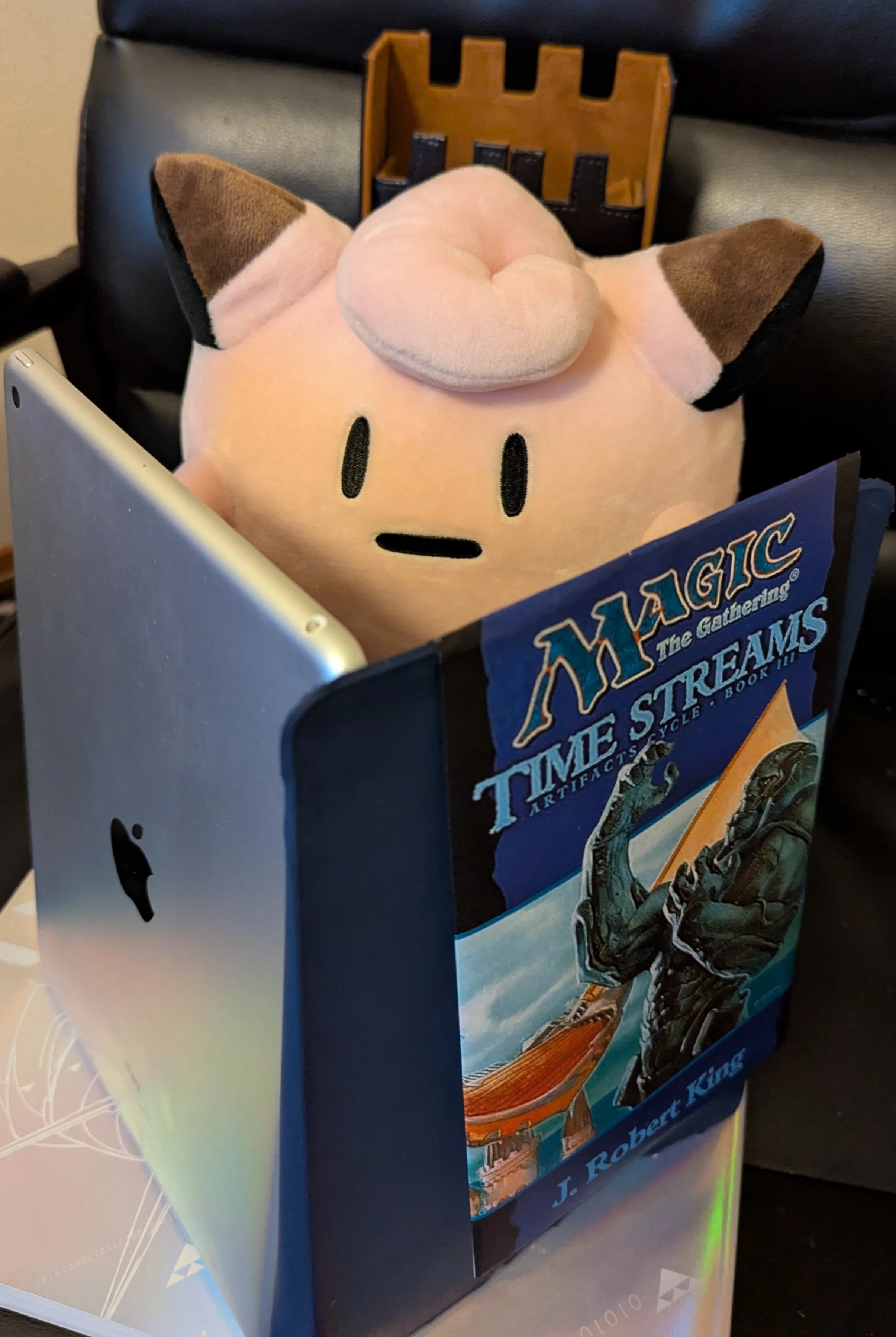
Time Streams (The Artifacts Cycle, Book 3) (Part 1 - Overview, Plot & Worldbuilding)
Welcome back, everyone, to our ongoing journey through the Artifacts Cycle tie-in novels for Magic: the Gathering (MTG).
Not going to lie: after Planeswalker, I was apprehensive about continuing this series. Nostalgia was the strongest motivator to keep to going. I’m happy that it did. While the third book in this series is not without its problems, it does feel like a more worthy follow-up to The Brothers’ War, and it once again reignited my interest in the series.
Please feel free to check the previous reviews if you need a refresher. Otherwise, let’s go for a ‘walk.
STATS
Title: Time Streams
Series: The Artifacts Cycle (Book 3)
Author(s): J. Robert King
Genre: Epic Fantasy
First Printing: March 1999
Publisher: Wizards of the Coast LLC
SPOILER WARNING
Mild, unmarked spoilers for Time Streams will be provided throughout this review. Heavy spoilers will be confined to clearly labeled sections. I will keep the first paragraph of any given section spoiler-free.
Throughout this review, I will also be providing heavy spoilers for later events within MTG canon. While I will be steering clear of details that would spoil the progression of this book specifically, there is a strong chance that you will figure out certain spoilers if you pay attention to these bits of lore. I’ll confine the heavy spoilers that are relevant to this book into clearly marked sections.
Heavy, unmarked spoilers for The Brothers’ War and Planeswalker will be provided throughout this review. I will also assume that you’ve already read my reviews of those books, though they aren’t essential to understand this one.
STRUCTURE
Today we’ll be covering the following.
Part 1 (Today)
Premise
Timeline
Rating
Content Warning
Plot
Worldbuilding
Prose
Part 2 (May 29th)
Character
PREMISE
Per the e-book product page on Amazon, we get:
Urza’s Legacy Unfolds
Urza Planeswalker has enlisted the most brilliant minds from across Dominaria to study at his academy on Tolaria. Together they work to bring to life the greatest artifact weapon Urza has ever devised, hoping to use it to defend their home from an imminent Phyrexian invasion. But treachery and tragedy stalk the tiny island, as Urza and his followers seek to manipulate time itself.
Reaction
This description really only captures the events leading up to the inciting incident of the book: the destruction of the Tolarian Academy when Urza’s time machine explodes. This is only the first quarter of the book. That said, the rest of the book (save for the last 20%, but we’ll get to that) is all about the consequences of this inciting incident. I think that makes this premise quite accurate.
It was as I was drafting this review that it occurred to me that maybe the reason the premise for this book (and the other books of the Artifacts Cycle) is so vague is that it was drafted up by the Wizards of the Coast marketing team long before they saw the finished novel. This series was cranked out by four different authors with a very tight release schedule. There probably wasn’t time (or the financial incentive) for the marketing department to rework them, especially when these books are written for the built-in audience.
TIMELINE
We once again turn to the trusty wiki timeline to get our dates.
This story begins in 3307 AR with the awakening of the silver golem Karn, and it spans all the way to 3360 AR. This creates some problems for the aging of the characters. Karn and Urza are ageless, but all of the other characters are mortal (even Teferi, who is not a planeswalker at this stage in this life). However, this is address within the story by the introduction of “slow time” waters, which are affected by the temporal disaster and halt aging if drunk in moderation. As a result, all of the mortal characters age up to middle age and then stop there, continuing the story in that state
This tie-in novel is for Urza’s Legacy, the 16th MTG expansion set, released in February 1999.
RATING: 6/10
I really wish that I could rate this one higher. I remember J. Robert King as being one of my favorite authors among the regular contributors to the MTG tie-ins. Unfortunately, while I find the story to be competently written, it leans far too much on character while not actually putting in enough time for the character work.
To be clear: I’m not saying there is no character work. Prior to the inciting incident, when King is taking his time, there are some great character beats that are Shown to us through pivotal decisions in relatively quiet moments. The issue is that, the moment that time machine explodes, the plot speeds up, and King stops Showing us things and starts Telling us them. He has so many ideas for wonderful character arcs, but he’s not taking time to give any of them emotional weight. We need to have our hands held and be walked through how characters are feeling or how they’ve changed, because it would be really hard to tell otherwise.
CONTENT WARNING
There’s some gory imagery from people being ripped apart by time storms, Urza being graphically disemboweled to incapacitate him, and general Phyrexian body horror, but it is all very light. This continues to be a series a preteen could read without being bothered by.
PLOT
The plot of this book is oddly intimate.
War in the Backyard
My memory of Urza’s conflict with Phyrexia was that it was one long, slow build up to their grand Invasion (now the first of three, by this point in the lore), but there were actually a lot of smaller strikes. The inciting incident of this book is triggered by a Phyrexian sleeper, K’rrick, leading an attempt to assassinate Urza. The next 55% if the book is about Urza mopping up the fallout from that one attempt, battling K’rrick’s forces as the Phyrexian rapidly spawns new forces from within a bubble of distorted time. This is a full-scale war that spans decades, but it affects just one island. It’s barely a battle within the scope of the full conflict.
Most of the war itself isn't shown. The story instead cascades between smaller conflicts that pop up as Urza and his followers devise new strategies and weapons to fight K'rrick. It’s in these moments when the story finds its strength - or at least, would have found its strength, if time has been taken to properly develop the characters involved in the smaller conflicts.
Obligatory Pit Stop in Serra’s Realm (Heavy Spoilers)
In Planeswalker, Serra’s Realm felt like it was included out of a sense of obligation. The same could be said in this book. The problem is less damaging to the narrative, but it’s even more obvious.
This book’s plot introduces new locations in a sequence that loops around the MTG color pie.
Blue: the Tolarian Academy
Black: the pit of distorted time where K’rrick and his Phyrexian forces are trapped
Red: the volcanic hellscape of Shiv, where Urza goes to acquire Thran metal for weapons to use against K’rrick’s Phyreixans
Green: the mythically oversized forests of Yavimaya, where Urza goes for magical wood to pair with the Thran metal
That leaves white. Serra’s Realm is a logical location for this, since it is an artificial plane suffused with white mana by the planeswalker who made it. The problem is that, much like a novel in The Empyrean, Time Streams exhausts its story before it reaches its conclusion.
One of K’rrick’s last acts is to mock Urza for “leading” the Phyrexians for Urza’s realm. After that, Urza is like, “Oh, right, I guess we did sort of set that up on the last book. Better go snip that loose plot thread!” The book is effectively over with K’rrick’s defeat and the purging of the Phyrexians from Tolaria, but now we have to read through post-game content.
The final 20% of the book that’s sunk into saving (or, at least, repurposing) Serra’s Realm isn’t terrible. It just feels like it was glued onto the end from a complete different book. Maybe the character arcs that are touched by this post-game content might have redeemed it, but as we’ll now explore in more detail, this book wasn't able to fall back on its characters.
WORLDBUILDING
Time Zones
When Urza’s time machine explodes, it rips apart the fabric of time across Tolaria. These pockets of “fast” and “slow” time not only make the island incredibly dangerous - crossing between zones of sufficiently different speed will rip a mortal body apart - but also become one of the chief sources of conflict. K’rrick and his Phyreixans are trapped in a bubble of fast time, giving them 10 years for every 1 in the rest of the world. They utilize this to rapidly adapt to every new weapon brought to bear against them and to evolve into progressively more lethal forms.
I really like how the zones of differently-paced time are utilized. While this element is utilized less and less as the story progresses, King never forgets either its potential or its limitations. The accelerated speed at which K’rrick’s army develops is one of the main sources of tension; the waters from slow zones explain how the same cast of characters remains active for the whole story; the challenge of physically crossing between areas of different times creates an obstacle to spread out forhe conflict. K’rrick’s forces are explicitly described as less mechanical than normal Phyrexians because the time zone they are trapped in limits their access to metalz forcing them to scavenge it from Urza’s various weapons. This even ripples out into a constant through line about how locations are described, such as how fast time zones tend to be dark, cold deserts (since the rare at which water and sunlight comes in from the outside world is divided across the increased time within the zone) while slow time zones become hot and swampy (for the opposite reason).
Balance of Mana
This isn’t so much a new detail as a nice bit of continutiy that shows some level of coordination was indeed happening between authors on this team.
In Planeswalker, it is established that natural planes maintain an equal balance of the five colors of mana. Artificial planes do not. Phyrexia is suffused with overwhelmingly black mana. By contrast, Serra’s Realm is overwhelmingly white.
Here in Time Streams, is imbalance is why Serra’s Realm is so important. The Phyreixans, who are associates with mana that is antagonistic to white, want to harvest and corrupt its mana. Urza insteads wants to use it to charge the Weatherlight's core to fight the Phyreixans with that white mana.
Limits of a Planeswalker
It is hard to properly handle planeswalkers pre-Mending. They are godlike characters. The Mending did more than just a nerf them so that MTG could implement the Planeswalker card type into the game. It made it possible to regularly tell stories where planeswalkers were the main protagonists without automatically breaking the narrative.
See, the magic system of MTG relies on “memories of the land” to fuel spells. (In the card game, that’s what Land cards reflect - the “memories” of places the player visited to build up a reserve of mana.) The ability of planeswalkers to easily hop around a world or to entire different worlds allows them to build far larger reserves of mana than any normal spellcaster could. They are also functionally immortal, because so long as their consciousness isn’t disrupted, they can shapeshift to erase any and all injuries. (In theory, destroying a planeswalker’s brain will kill that planeswalker, but Urza survives being outright disintegrated a couple of times in this book, so even a head shot isn’t guaranteed to do anything.) This immorality pairs with the ability to teleport to produce spellcasters with unfathomably vast reserves of mana, to the point that the only entities who can hope to defeat a planeswalker in a straightforward battle of raw power are gods and other planeswalkers.
Because Urza is directly invested in the events of this plot, King had to keep his powers in check to preserve stakes. This was a mixed bag.
King did do a good job with addressing Urza’s immortality. Many times, Urza is incapacited by gruesome injuries. These don’t kill him, but the efforts to preserve his consciousness and rebuild his body incapacitate him. Each time this happens, it does feel natural.
The mana supply is another matter. While most instances of Urza getting overwhelmed by enemies are chalked up to the aforementioned incapacitating injuries, there are two different points where is is overwhelmed due to not having enough mana and/or not casting the necessary spells to take advantage of the mana he has. In one of these engagements, we are also shown him anticipating and preparing for the engagement in advance. Him getting defeated like this is simply not believable. Urza should not be getting clowned like a MTG player with a bad hand. He should be the equivalent to a guy in a multiplayer game who was somehow ignored for 30 turns, played every land in his deck, and has two different infinite loop combos locked and loaded.
Thankfully, King mitigates the mana supply issue for most of the book via a very simple solution: he makes it impossible for Urza to directly bring his magic to bear. Once the time distortions are in play, Urza physically can’t access K’rrick and the Phyrexians, not even by planeswalking. So while I did have the chance to roll my eyes at him being nerfed, it didn't happen enough to spoil the narrative.
PROSE
This scale of the typos in this book are utterly absurd. There are capitalization and punctuation errors all over the place. Did WotC not have anyone proofread this before its original publication? Did a file get corrupted somehow when it was converted to an ebook? I’ve read unpolished indie titles that felt less rough than this.
UNFULFILLED POTENTIAL
Next Friday, May 29th, we’ll wrap up the review of Time Streams by focusing just on characters. We’ll be discussing the very promising arcs that King set up for the core cast and how the emotional impact of those arcs wasn’t fulfilled due to the pacing of plot.
Thank you for joining me today. Please remember to subscribe and share if you enjoyed what you read here. Take care, everyone, and have a good weekend.