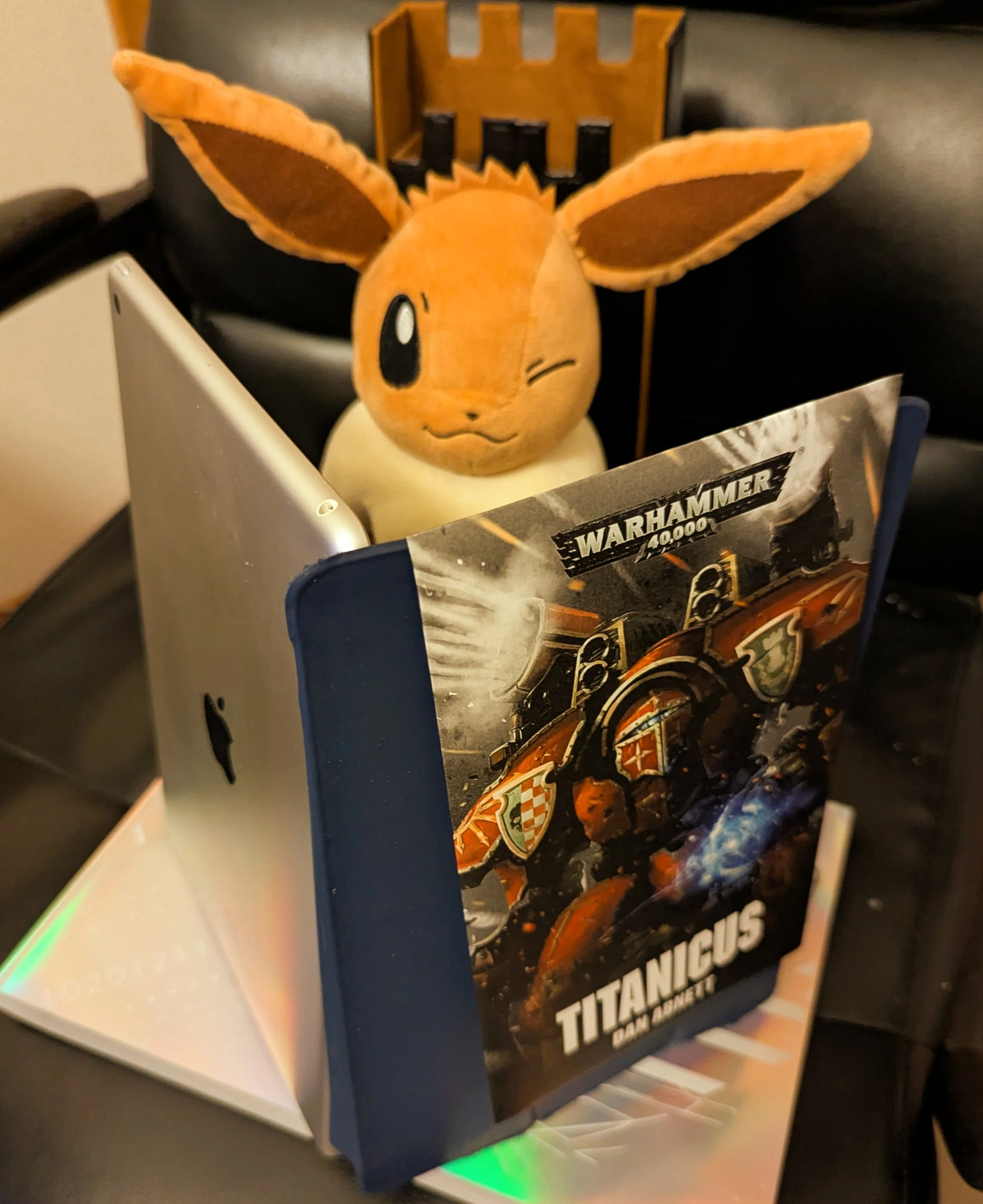
Titanicus (Part 3 - Theme)
Hello, all. Welcome to the conclusion of the Titanicus review.
This part is going to focus purely on the theme. If you’re looking for the general overview of the book and the discussion of characters and worldbuilding, see Part 1. If you instead want a breakdown of main qualities of the plot, see Part 2.
Plug in, everyone, and let’s go for one last walk.
STATS
Title: Titanicus
Series: N/A, but unofficial associated with Sabbat Worlds
Author(s): Dan Abnett
Genre: Science Fiction (Space Opera)
First Printing: November 2008
Publisher: Black Library (Games Workshop Publishing)
Rating: 7 / 10
SPOILER WARNING
For this part of the review, I am going to be providing heavy, unmarked spoilers for Titanicus throughout. Heavy, unmarked spoilers may also be provided for any and all of the Warhammer 40K content we’ve covered thus far.
THEME
As the events of Titanicus build towards the climax, Abnett ups the stakes by introducing a massive destabilizing element, one that could destroy the unite of the defenders of Orestes and allow Chaos to claim an easy victory: heresy.
Setup
Those of you already familiar with this setting can probably imagine exactly what sort of heresy might pop up on a forge-world like Orestes, but for those not in the known, a quick refresher.
The Mechanicum (or Adeptus Mechanicus) is technically not a part of the Imperium of Man. They exist in symbiosis with it, ensuring that ancient technology is maintained and sustaining the Imperium’s industry. Neither can survive without the other, but neither does either party mistake the other as being 100% on the same page.
This goes back to the Mechanicum’s religious beliefs. By the time the Emperor of Mankind united the galaxy, the Mechanicum had developed into a distinct theocratic culture, worshipping a machine-god that they called the Omnissiah. This posed a problem for the Emperor. He wanted to impose the Imperial Truth, a secular doctrine that vehement condemned and discredited any shred of religion, upon the galaxy, but he also recognized that humanity could not succeed without the expertise of the Mechanicum. The compromise was that the Mechanicum would be allowed to preserve their religious beliefs so long as they acknowledged that the Emperor of Mankind was the Omnissiah. The tech-priests of the day agreed to those terms. Thus, when the Imperial Truth gave way to the Imperial Cult and the Emperor became the God-Emperor, the Mechanicum continued to refer to the god of the Imperium of Man as their own god.
The thing is, the original beliefs never went away. Elements of the Mechanicum continued to quietly maintain that the God-Emperor was not the Omnissiah, and that this heretical claim would only be recognized so long as it was in the Mechanicum’s interest to do so.
While this is common background lore, Abnett did take care to reestablish it. We quickly learn that a significant faction of the tech-priests and adepts on Orestes (including the Titan crews of Legio Tempestus) have ardently clung to the old belief. When Legio Invicta arrives, there is some friction, and Invicta very passionately supports the theology that keeps Imperium and Mechanicum united.
At first, this seems like a minor detail that will be used to introduce some character drama. Then someone digs a bit too deeply.
Story
Adept Feist’s POV details his efforts to assess weaknesses in the Chaos Titans that are invading Orestes. When the available data fails him, he requests access to sequestered databases from millennia ago. This initially is a great boon to the defenders of Orestes. We get to see how the Titan fights tilt in their favor as weaknesses identified in millennia-old records are targeted.
Unfortunately, Feist also stumbles upon an ancient record from before the Mechanicum joined with the Imperium. It explicitly spells out that the God-Emperor is neither the Omnissiah nor a god in general. Though he tries to cover this up, it is found by an ambitious adept working under him, one who is an ardent adherent to the old beliefs. She releases the text to the public.
As one might expect for Warhammer 40K, this kicks off shockwaves. The hive-cities erupt into chaos as factions form within the Mechanicum and Imperium citizens turn on the Mechanicum in general. The two Titan legions are at each other’s throats. As the final battle approaches, tech-priests devoted to the old beliefs attempt a coup and call upon Legio Tempestus to join them in battle.
In the end, only two things save Orestes from tearing itself apart and being overwhelmed by Chaos. The first is that Lord Gearheart, the master of Invicta, talks Tempestus out of joining the uprising, thereby robbing the usurpers of the much-needed support of the Titans without a shooting war erupting between the Titan legions. The second is the reveal that certain data related to this record had been doctored, meaning that even if the document itself was genuine (and, this being Warhammer 40K, it probably was), it was “impeachable”. These two factors rob the coup of its momentum.
Upping the Stakes
I mostly like this aspect of the story. It was an organic way to ratchet up the stakes before the final battle. The conflict plays into existing aspects of the lore, and both sides have principled reasons for it. While it’s clear that only one outcome will allow Orestes to survive, the grimdark nature of Warhammer 40K means that there was no guarantee the planet would survive, so it really did feel like things could go either way.
Overcomplicated
An important element that is revealed when the coup begins is that Feist did not find the information by accident. The conspirators behind the coup had been aware of the document for nearly a decade, and they had be leaking related texts to the Adept Seniorus (the head Mechanicum priest) of the planet for years to see whether he would try to disseminate or destroy the information. When Chaos invaded Orestes, the conspirators found an unwitting adept (Feist) whom they could nudge into requesting sequestered data, thereby allowing it to be “discovered”. They also planted another unwitting adept (the one who ends up releasing the information) with the mission of spying on Feist for political reasons. Their ultimate goal was a regime change that would nominally serve the theological interests of the Mechanicum while putting themselves in power.
I also want to like this devious plan, but it does feel like it requires a lot of leaps of faith. I know that the war was a perfect excuse to reveal the data, yet it didn’t seem like they really had a plan for dealing with Legio Invicta (whom they had to know wouldn’t just go along with it). Plus, multiple characters brush off the document as propaganda planted by Chaos agents to sow discord. For all the conspirators knew when they set this into motion, Chaos might still win the war, so even if their coup could survive Invicta and whatever the Imperium or loyalist Mechanicum forces threw at them, how were they planning to keep Chaos out once their former allies were dead?
I don’t think this is a plot hole. I just think that, in trying to make this heresy seem like a devious scheme, Abnett pushed things into eye-rolling complexity. This coup would have been a lot simpler and made a lot more sense if it ended with, “Use the war as an excuse to un-sequester the information we need,” with the actual takeover being an improvisation when the document was found and released sooner than intended.
Messages
I can actually see two potential themes within this conflict.
Theme 1 - Unite for the Greater Good
When the coup kicks into gear, the final battle (or, rather, what the Titan legions think will be the final battle, as the open-field engagement hasn’t happened yet) is underway. Neither Invicta or Tempestus can disengage from fighting Chaos. However, each legion does take time to assess their surviving assets and prepare targeting solutions to shoot the other legion’s Titans.
Gearhart then has to bring Tempestus to heel after the battle. Throughout the book, Gearhart has been set up as a wrathful man whose mind is beginning to give out due to his immense age. It seems probable that he might just resort to using his numerically superior force to gun down the Tempestus Titans. Instead, he tries to talk Tempestus down, then intimidate them, and when Chaos reinforcements (the ones in the actual final battle) are detected), he orders Invicta to drop their target locks on Tempestus and asks Tempestus to join with him against a common enemy.
I’m not going to pretend like this scenario is anything groundbreaking. It’s a message you’ve probably read many times before, playing out in a very similar way. In fact, if we’re being entirely fair, I don’t think it’s any better-written than Violet’s speech in Chapter 6 of Onyx Storm.
What makes this scenario compelling, though, is how it plays out within the cockpit of a single Titan.
You may recall me mentioning that Tarses’s Titan - an Invicta Titan - receives a new princeps from Tempestus. The princeps in question tries to order to crew to turn the Titan against their brethren. Tarses ends up leading a mutiny, knowing full well that doing so will properly doom his career and probably end his life (remember, this princeps is the one who will rule on whether he gets to live after this battle). He pulls a gun from the Titan’s weapon’s locker and puts it to the princep’s head.
Crucially, though, he does not pull the trigger. He gives this young, zealous princeps and chance to come to the decision to unite against a common enemy on his own. Granted, we don’t see the decision take place, but it clearly did, because we see Tarses and the princeps working together seamlessly in that final battle.
Again, nothing groundbreaking, but there is a palpable sense of weight to this altercation that didn’t exist when it was just a bunch of officers having a Skype call and establishing target locks. Shooting nearly erupted because of one foolish youth who ultimately submitted. So even if the theme or its delivery aren’t that deep, there’s still a sense that the message was earned.
Theme 2 - Truth vs. Pragmatism
The two factions in this ideological disagreement are fairly straightforward:
Adherents to the old belief maintain that truth must come first. The Mechanicum should seize upon this revelation and use it as the driving forward to finally shake off the Imperium and rule the galaxy.
Aderents to the status quo (and, of course, their Imperium allies) want to sustain worship of the God-Emperor as the Omnissiah. Truth is secondary to survival, and since either the Imperium nor the Mechanicum can survive without the other in this hostile galaxy, that means burying the truth to preserve the symbiosis between the two.
This being Warhammer 40k, it really shouldn’t surprise anyone that “truth is secondary to survival” wins out. The nature of this setting as a horrible, grimdark place is that people do bad things for the right reasons. Preserving a heretical belief as the mainstream theology, even when one knows that the proof of the heresy is genuine, is exactly the sort of thing that protagonists in this setting would do.
Again, I don’t find this message particularly deep or groundbreaking. I actually feel like it’s an example of a rhetorical argument going too far. The theme is correct within this setting where it is objective, irrefutable reality that humanity is surrounded by hostile alien empires that what to enslave, torture, kill, and/or eat them and hordes of dæmons that want to corrupt and torment them. It’s a little hard to claim the same applies in everyday life.
I feel like that’s the important point, though: the theme is correct within this setting. The rhetorical argument of the fiction is internally consistent. So while I can’t praise this message for being a deeply relevant commentary upon the world today (or anything to that effect), I have no trouble pointing to it as a starting point for how a narrative can be crafted to sustain a theme.
SLEEP, MIGHTY ENGINE
Titanicus is a book that I honestly would recommend to someone who wants a science-fiction story about mech warfare. It’s not perfect, but it holds together. The characters aren’t deep, yet the managed tension and escalating stakes keep things engaging. This is the sort of book you can read is you just want to relax and have some fun while leaving your brain switched on. There’s nothing wrong with that.
Our next foray into the grim darkness of the 41st Millennium will be a return to the Bequin Trilogy, as we review the second installment, Penitent. The 3-part review of Bloodlines (Book 4 of the Artifacts Cycle) will come first, so we’ll start the 4-part review of Penitent on July 17th. I hope to see you all then.
Thank you all for joining me for this review. Please remember to subscribe and share if you enjoyed what you read here. Take care, everyone, and have a good weekend.