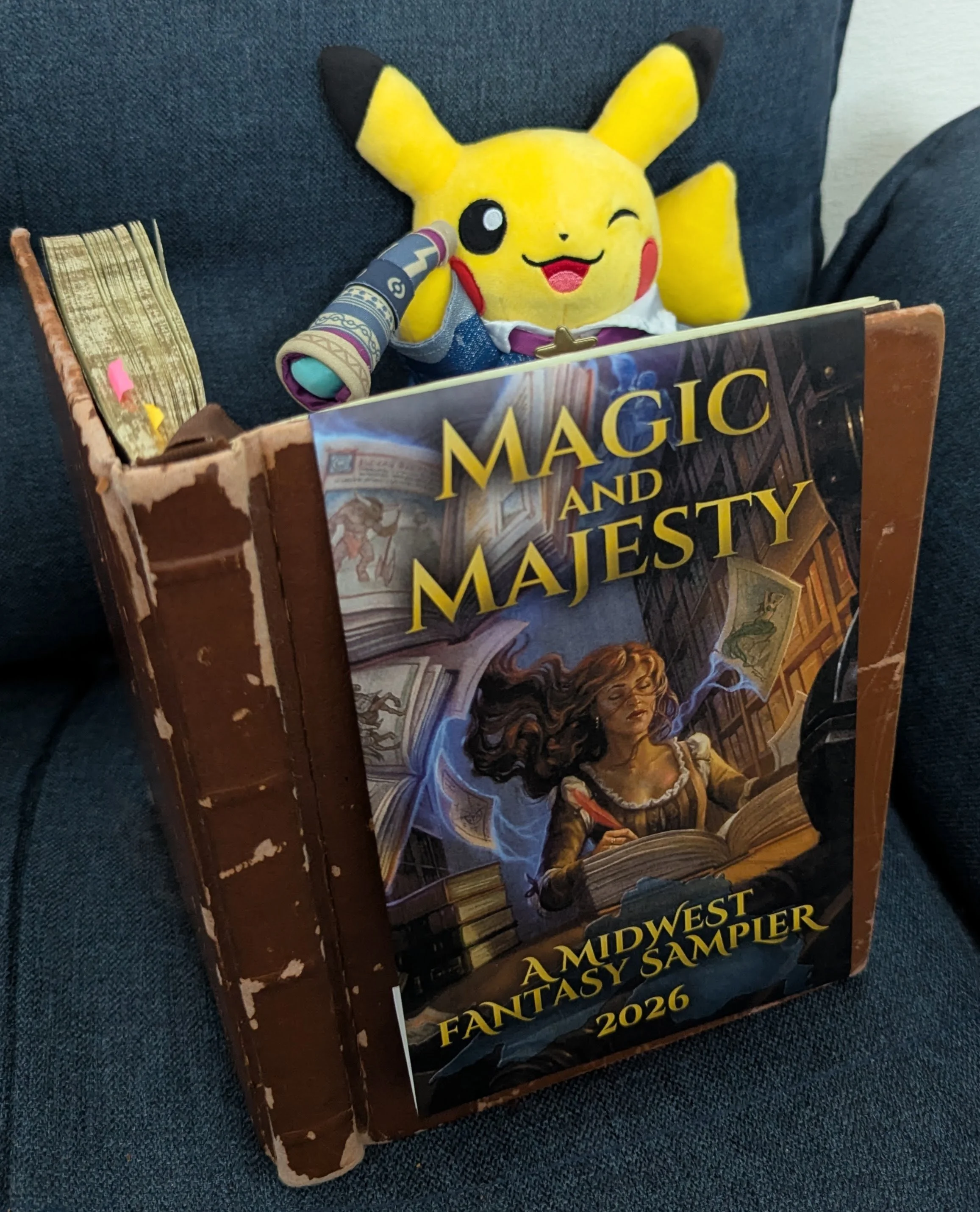
Magic and Majesty: A Midwest Fantasy Sampler 2026 (Part 2)
Hello, all. Welcome back to our ongoing review of the ARC copy of Magic and Majesty.
Today, we’ll be diving into the third through fifth stories of the anthology.
“Gatekeeper” (Keepers of Midgate series), by R. M. Krogman
“Bee’s Tail” (Empire of Ash and Song series), by D. E. Carlson
“Son of the Martyr” (The Palimar Saga series), by K R. Solberg
Let’s get right into it.
ANTHOLOGY STATS
Title: Magic and Majesty: A Midwest Fantasy Sampler 2026
Series: Midwest Fantasy Sampler, Book 2
Author(s): Various, curated by Justin Rose
Genre: Fantasy (various)
First Printing: June 10th, 2026
Publisher: Self-published to Amazon
Overall Rating: 8/10
SPOILER WARNING
Mild, unmarked spoilers for all stories in the anthology will be provided throughout this review. Additionally, the Story section of each review will feature heavy spoilers. I will keep the first paragraph of any given section, including the Story sections, spoiler-free.
“GATEKEEPER”
Stats
Series: Keepers of Midgate
Author(s): R. M. Krogman
Story
Malarain “Mal” is a gatekeeper, a cleric of the Five-Faced God who has the ability to astral project and travel between worlds in her spirit form by opening portals. While astral projecting back to the monastery where she was trained in order to visit her mentor, Father Ander, she overhears a conspiracy to overthrow the ruling monarch. Mal and Ander then need to evade capture and share news of this treason with allies to stop the conspiracy.
The back half of the book is a frantic chase. Mal and her mentor need to portal-hop to avoid being killed by a Gatekeeper tied to the conspiracy. Eventually, Ander is run down. Mal only escapes by trapping their pursuer’s soul in the body of an extradimensional being. She then attacks the high priestess behind the conspiracy and banishes the priestess’s soul to a realm of darkness.
Rating: 5/10
If the previous two stories set a precedent for what qualities make for a strong addition to this anthology, "Gatekeeper" is a warning sign of the qualities that produce a weak addition.
This story goes all-in on plot and worldbuilding. It does okay in this regard. The whole system of astral projection and portals in interesting and makes sense. I wouldn't say that we get enough about the politics and religion for the conspiracy conflict to make total sense, but there is enough to understand why Mal is upset about it. As for the chase that defines the back half of the story, it's fine in so far as action sequences go.
At the same time, character isn't completely neglected. Mal's free-spirited nature is established very well, and her bond with Ander runs deep enough for their dynamic to have meaningful weight.
The issue is that this story isn't long enough to properly set up and pay off its plot. There's a slow buildup to develop Mal's character and exposition dump worldbuilding, an understated inciting incident as she happens upon a conversation she isn't supposed to here, and then a frantic tumble of action beats with little context beyond, "Now that you know, they will try to kill us." And while the foundations for the magic system were set up well, we don't have enough to understand what truly is and isn't possible during the chase sequence, making it feels less like a chain of cause and effect and more like a badly written slasher film. The final, astral brawl behind Mal and the high priestess makes it clear that the high priestess is not a Gatekeeper and is nearly helpless in astral form … yet, for some reason, the high priestess just happens to have a weapon on hand that she can use to incapacitate Mal in an astral duel.
Perhaps the most annoying bit is that Mal ends the story with selective amnesia. She completely forgets the inciting incident, thanks to the blow the high priestess inflicts with aforementioned weapon. I'm guessing that the events of this story would open a plot hole in the Keepers of Middlegate series if Mal had full access to her memories, and amnesia was the solution Krogman chose to reconcile things. That's a functional solution, but it makes this story feel like to was written exclusively to be bonus content, rather than an effective stepping-on point into the series for new readers.
Also, the exposition in this book is handled poorly. It is almost all characters telling each other things the speaker should know that the recipient already knows. I kept expecting twists in the dialogue to lampshade this blunt delivery or else justify it as a character choice, but these never came.
Overall, Gatekeeper is not terrible. It is not disinteresting. It just reads very awkwardly.
“BEE’S TAIL”
Stats
Series: Empire of Ash and Song
Author(s): D. E. Carlson
Story
Bee, a merman who was cast out of his society for having the ability to transform his tail into legs and his gills into air-breathing lungs, returns to the seaside when he needs to conceal a dragon, Aurora, on behalf of an unspecified rebellion that he is a part of. Proximity to the sea leads him to dive into the water, transforming him back into his merman form. Gradually, longing for his old life leads him to revisit his old home, drawing him into a battle for control of the throne even as he grapples with his identity.
Returning to his other hometown reconnects Bee with not only his childhood love but also with the father who cast him out. His is dismayed to learn that his older brother bears the mark of El, thereby making his brother the rightful king of the realm and the betrothed of his childhood love. Upon returning to the land, though, Bee is also marked by El. Bee then has to rush back to the merfolk to stop the wedding and stake his own claim as king.
Rating: 4/10
At it's core, "Bee's Tail" delivers a simple yet effective story of an outcast who becomes a Chosen One. There are some very obvious Christian themes about accepting God's will and making peace with the fact that a life of stigma and alienation played into His grand design. I guess there's also a romance involving reconnecting with a childhood sweetheart, though that works primarily because it's tagged onto the story of acceptance. Overall, this plotkine is simple yet effective. Bee's journey ends in a payoff that feels earned.
I really wish that was all there was to this story. If it was, I would rate it at a 7 or 8. Unfortunately ... the story is bloated, its emotional core diluted, by a bunch of other things.
First, there is the matter if this story being bonus content. The stakes lean heavily on events and characters that are never properly explained. I assume I would understand what this wider conflict is, who these people are, and why I should care about any of it if I had actually read Empire of Ash and Song, but unlike with the previous stories, the audience isn't given the right hooks to make learning more actually seem worthwhile. It just reads like a whole bunch of author notes.
This cascades into the next problem: stakes. It would be one thing if the only conflict were that Bee feels torn between returning to the sea to fulfill his destiny or staying on land to help this rebellion he's part of, but then Carlson tries to kick up the stakes by threatening that the merpeople wl go to war against the land if Bee doesn't intervene to stop it. The story is supposed to be more urgent because people and places we have no reason to care about might be affected by an army that ... is stuck in the ocean. I can't recall if it was ever explained how the merfolk would wage war on the land or why they would want to do so in the first place.
Which brings us to the issue of the antagonist. Bee's father being intolerant of him being able to walk on legs is a simple enough idea to connect with. His father being a high-ranking, warmongering military officer comes completely out for nowhere. The fact his father would commit blasphemous fraud to rule the throne with Bee's brother as a proxy needs more setup still. The end result is that Bee's heartfelt struggle for acceptance is placed alongside a cartoon villain who becomes more excessively evil every time the plot needs a new development.
Also, in terms of prose, it is very hard to keep track of where characters are within a scene. There's a feverish quality to how Bee will be described in a certain position relative to a character or object and then suddenly be close enough to interact, within any acknowledgement of covering the intervening distance. It makes the story feel very unpolished.
On a final assessment, the biggest problem with "Bee's Tail" is that it tries to fit way too much in. If the references to Empire of Ash and Song were trimmed way back, if the looming threat of war were cut, and if the involvement of Bee's father was pared back, I really do think this story would have worked very well. The weight of things that simply weren't necessary dragged the story down.
“SON OF THE MARTYR”
Stats
Series: The Palimar Saga
Author(s): K R. Solberg
Story
A young nobleman named Liiesh is imprisoned on false charges by his great-uncle, the First Lord of Palim, after his father's murder. As the murder of his father catalyzes a rebellion against the First Lord, rebel leaders mobilize to spring him from prison, hoping he will join them and act as a symbol for their movement.
The story is tightly focused on the jailbreak and in Liiesh's decision to join the rebels. There's also a running plot thread about the First Lord being able to see the future and how Liiesh is a prophecied bringer of doom. This doesn't get explored beyind the symbolic value Liiesh offers to the rebellion. The story ends with Liiesh sending a message to the First Lord in which he declares his intention to fulfill his role in this prophecy.
Rating: 6/10
"Son of the Martyr" is an exception within this anthology in that it excels by putting plot before character. I think this is because the story itself is fairly simple. Liiesh begins the story already in prison, mourning (and brooding upon) the death of his father; the rebels become aware of his situation; and then the breakout comes. Solberg does need to Tell us a lot of backstory for this to work, but because the emotional weight of what she feeds us is easily grasped, this doesn't undermine the narrative.
This simplicity aids with the character work. While I wouldn't say Liiesh is as compelling and Modwin or Fylan, his story is easy to connect to and get invested in. All of the secondary characters then plug into functional roles within the plot.
The main weakness of this story, and the reason I think it is good but not great, is the worldbuilding. This is a complex world with a whole bunch of sapient races running around, along with complex political dynamics from their races coexisting. More importantly, there is a magic system that is never properly explained and yet is used to resolve problems within the narrative. I think this is another story that likely makes perfect sense to someone who reads the series it is connected to, but as a newcomer, things come across as needlessly complicated.
Also, on the point of Liiesh being a prophecied bringer of doom, this fact gets a lot of focus yet ends up not mattering to the story. I understand that this likely needed to be referenced to ensure continuity to the Palimar Saga, yet it really could have just been a throwaway line or passing statement. Making it the focus of the opening chapter epigraph and referencing it multiple times as a defining aspect of Liiesh's character sets the expectation that it is going to get some exploration within this story. Not exploring it therefore feels like a let-out.
Overall, this is a fun, straightforward adventure that sets promising expectations for the Palimar Saga.
MAGIC COMES WITH A PRICE
So far, the stories we’ve reviewed have had their lows, but for the most part, they have been highs.
Next Sunday, June 28th, we’ll review “The Butcher of Hudêd”, “Fate of the Nightbloom”, and “The Salted Crown” - the stories where the lows finally drown the hights.
Just to be clear up front: none of the three stories we’ll get into next week are bad in concept. It would not have been difficult to adjust them to cancel out their worst qualities. Still, we can only judge their stories (and the series they represent) by what is actually on the page. What’s on the page is, unfortunately, not very good.
Thank you all for stopping by. Please subscribe and share if you’ve enjoyed what you read here. Take care, everyone, and have a good week.