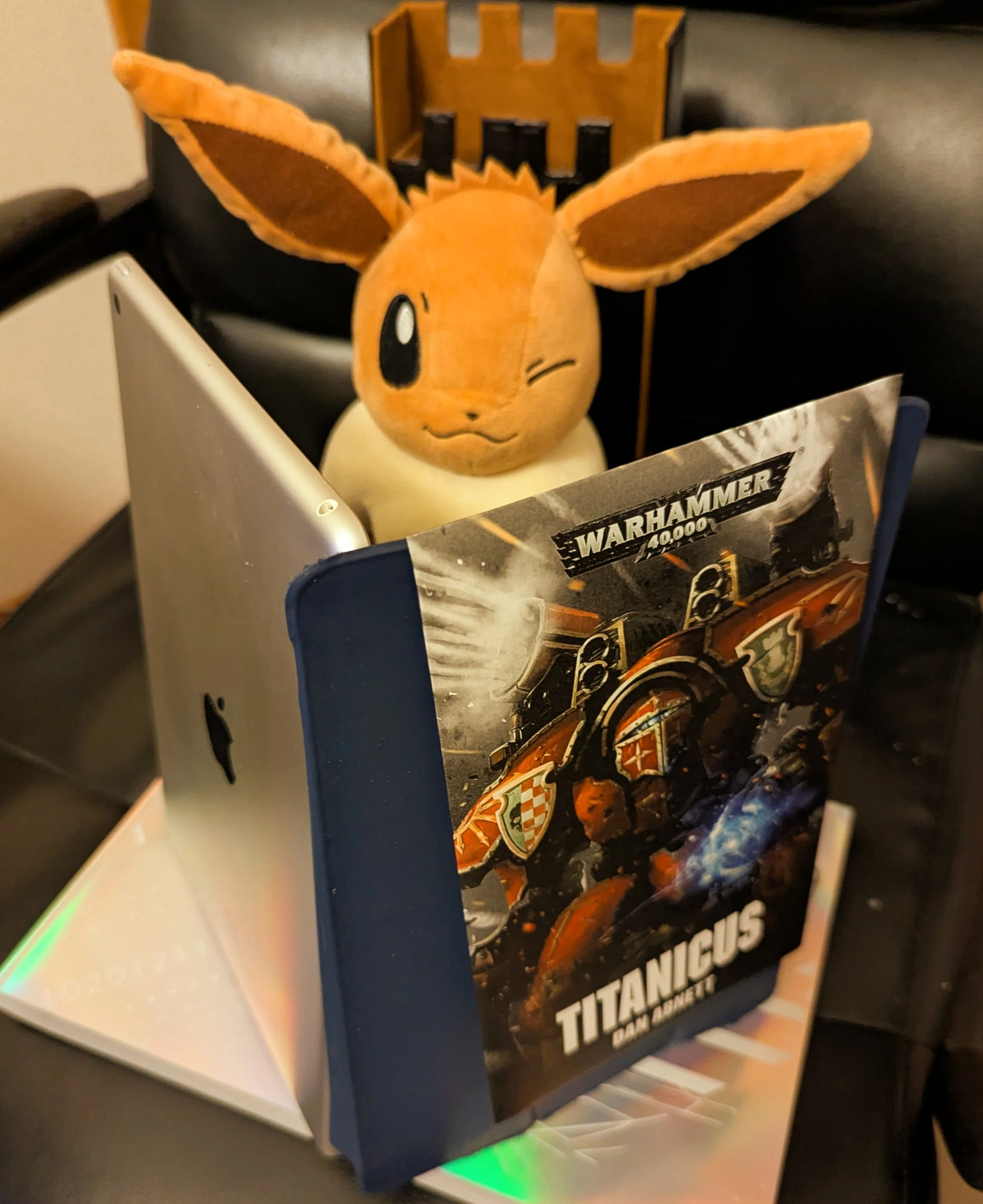
Titanicus (Part 1 - Overview, Characters & Worldbuilding)
Hello, all. Welcome back for another jaunt into the grim darkness of the 41st Millennium.
I was originally going to read Penitent immediately after Pariah. However, when Titanicus popped up in my Kindle recommendations, I realized I was craving some mech action. A story about some robot-on-robot fighting seemed like a good idea.
Admittedly, I was not entirely satisfied by what Titanicus delivered. This is technically not a book about Titans; it’s a story about a war in which Titans participate. That difference may seem subtle, but it does make a different for the overall experience. For a crude comparison, compare any animated Transformers TV show to the Michael Bay Transformers films. The former are usually about the Transformers, with any human characters being supporting cast; the latter are really about the human cast living through conflicts that involve Transformers, with Optimus Prime, Bumblebee, and any other Autobots only really rising above supporting cast during the films’ action scenes.
I’m not equating the quality of Titanicus with the quality of the Bay films. I do still think the story is good. It just needs to be taken on its own terms. Unlike a certain other book where I tried to do this, Titanicus mostly succeeds in fulfilling those terms.
Plug in, everyone, and let’s go for a walk.
STATS
Title: Titanicus
Series: N/A, but unofficial associated with Sabbat Worlds
Author(s): Dan Abnett
Genre: Science Fiction (Space Opera)
First Printing: November 2008
Publisher: Black Library (Games Workshop Publishing)
SPOILER WARNING
Both minor and heavy spoilers for Titanicus will be provided throughout this review. I will try to keep the first paragraph of each section as spoiler-free as possible and will confine heavy spoilers to clearly labeled sections.
Heavy, unmarked spoilers will be provided for any and all of the Warhammer 40K content we’ve covered thus far.
TIMELINE
Titanicus covers the Battle of Orestes, which took place during the Sabbat Worlds Crusade. While I couldn’t find a specific date within the book itself, the Lexicanum wiki claims that the battle occurred in 779.M41. This is centuries after any of the Inquisitor stories we’ve reviewed thus far, even Pariah (all the way back in 500.M41).
STRUCTURE
This will be a 3-part review, divided up as follows:
Part 1 (Today)
Premise
Rating
Content Warning
Prose & Character
Worldbuilding
Part 2 (Friday, June 12th)
Plot
Part 3 (Friday, June 19th)
Theme
PREMISE
Once again looking at Amazon’s Kindle e-book product page, we find:
When the vital forge world of Orestes comes under attack by a legion of Chaos Titans, the planet is forced to appeal for help. The Titans of Legio Invicta, although fresh from combat and in desperate need of refit and repair, respond, committing their own force of war engines to the battle. As the god-machines stride to war, the world trembles, for the devastation they unleash could destroy the very world they have pledged to save.
There’s also the following note added at the end.
Read it because
It's a vision of total war in the 41st millennium, from the smallest soldier to the largest God-Machine.
Reaction
As stated in the introduction, I feel like the premise oversells the Titans. The Titans do drive the narrative, and three of the book’s many POV characters engage with the conflict from the cockpits of Titans, but the book looks at a much bigger picture of the Battle of Orestes.
The added note does a good job of clarifying things. This book exposes us to the Battle of Orestes through various eyes associated with the Imperium / Mechanicus: Planetary Defense Forces, forge adepts, hive citizens, Imperium officials. It’s a collection of smaller stories that are linked together on tentatively at first but gradually merge into a cohesive whole.
RATING: 7 / 10
Taken as a comprehensive picture of a large, planet-side conflict in Warhammer 40K, I think that Titanicus is a good book. Abnett paints a vivid picture of the battles from so many angles, with smaller, human conflicts linking together to influence mighty battles. When Titan action does occur, whether it’s Titan-on-Titan or Titans against ground forces, it’s good action that effectively captures the scale and violence of these massive machines.
At the same time, though, this multi-faceted approach to the story somewhat backfires. There are so many POVs in this book that it’s hard to get invested in the individual struggles. The POVs that aren’t directly associated with Titans feel extraneous for most of the book. As it turns out, some of them are extraneous, to the point that a pair of them seem to only be here as a wholly unnecessary reminder of how grim and dark and the 41st Millennium is. The book doesn’t get properly started until halfway through, and by that time, the extraneous POVs start to bog down the story.
I think that’s a shame, because there are indeed compelling stories among those non-Titan POVs. There’s some interesting thematic stuff, and the non-extraneous ones do end up having a surprisingly large impact on the Titan POVs. I just wish their significant contributions didn’t come so late in the story.
CONTENT WARNING
This is Warhammer 40K, so there is abundant violence, gore, and frightening imagery. There are multiple sequences of war that include wholesale slaughter of both woefully outmatched soldiers and fleeing civilians.
That said, all the dark elements are toned down compared to Abnett’s Inquisitor stories. I think this has to do with the nature of the antagonists. While Chaos is the ultimate enemy here, it manifests through the Dark Mechanicum, rather than directly through cults, Warp sorcery, or dæmons. We are still confronted with the brutality of the setting, but the story isn’t going out of its way to poke into the darkest of corners.
All this is to say that, unless war stories in particular are an issue for you, nothing in this book should be problematic for you if you were able to read either the Eisenhorn or Ravenor novels.
PROSE & CHARACTER
The obvious difference between this book and the Inquisitor novels is that there is no 1st Person POV. There are a wide array of POV characters, all in 3rd Person, showcasing the Battle of Orestes from a variety of perspectives.
With this wide range of perspectives, though, comes a homogeneity of narrative voice. This doesn’t surprise me. Something I didn’t touch upon in the Ravenor novels is that, while Abnett is good at giving 1st Person POVs a distinct voice, the voices of his 3rd Person POVs are interchangeable. I don’t think this is inherently an issue. This is a story driven by plot, not character. Don’t get me wrong, it would have been fascinating if Abnett instilled this wide range of POVs with distinct voices, but it really wasn’t necessary for this particular story. The characters are a means by which we experience the various aspects of the battle.
As an extension of this, though, we do encounter another problem: the characters themselves are interchangeable. Rationally, yes, Captain Erik Varco could not take the place of Adept Feist or Moderati Tarses or Etta Severin, and his presence would fundamentally shift the course of Cally Samstag’s story, but that’s because of what he is , not who he is. The same goes for any other hypothetical character swap. These characters fulfill narrative roles and drive the plot forward because they have a collection of skills and background details that make them suitable for those roles, not because they have any particular traits that prompt story-altering decisions. I think the closest the story comes to a meaningful character decision that actually impacts the wider narrative is Varco making several leaps of faith involving a Mechanicus cog icon, using it as a talisman to help guide his choices, but even that doesn’t get much exploration.
All of this is still fine for a plot-driven story. The story is still fun without it. I just think it’s why this story is only good, not great. Without strong characters, it’s just not satisfying or deep as the breadth of the narrative might otherwise suggest.
WORLDBUILDING
Abnett puts the variety of POVs to good effect. We are able to see the contrast between Imperium and Mechanicus forces, as well as the differences between Legio Tempestus (the Titan legion native to Orestes) and Legio Invicta (the Titan legion dispatched to lend aid to Orestes). We also experience this conflict at various levels throughout the hive cities and out on the battlefield: the opportunistic shopkeeper, the moderati and princeps of a titan crew, the tank crew, PDF infantry, etc. It paints in the world in much the same way as the drawn-out setting descriptions from the Ravenor novels and in Pariah.
While I expected the complexities of Titan combat to get the most exploration - and, to be fair, Abnett takes time to Shown up the intricacies of the mechs’ operations - it was actually the noosphere that colored the story the most. This augmented reality interface is used for data exchange among the Mechanicum members, being applied to everything from communication to interaction with computers to sensor systems aboard the Titans. It serves as the closest thing this story has to distinct narrative voices, making scenes with Mechanicum characters stand out from those of Imperium characters.
PERSPECTIVES OF WAR
Titanicus is a plot-driven narrative. It does this well. I admittedly have a lot more to say about the weaknesses of the plot than the strengths, but that’s only because the weaknesses need a bit more explanation. Overall, the story works well, and we’re going to talk about why next Friday, June 12th.
Thank you all for stopping by. Please remember to subscribe and share if you enjoyed what you read here. Take care, everyone, and have a good weekend.