Penitent (The Bequin Trilogy, Book 2) (Part 2 - Plot)
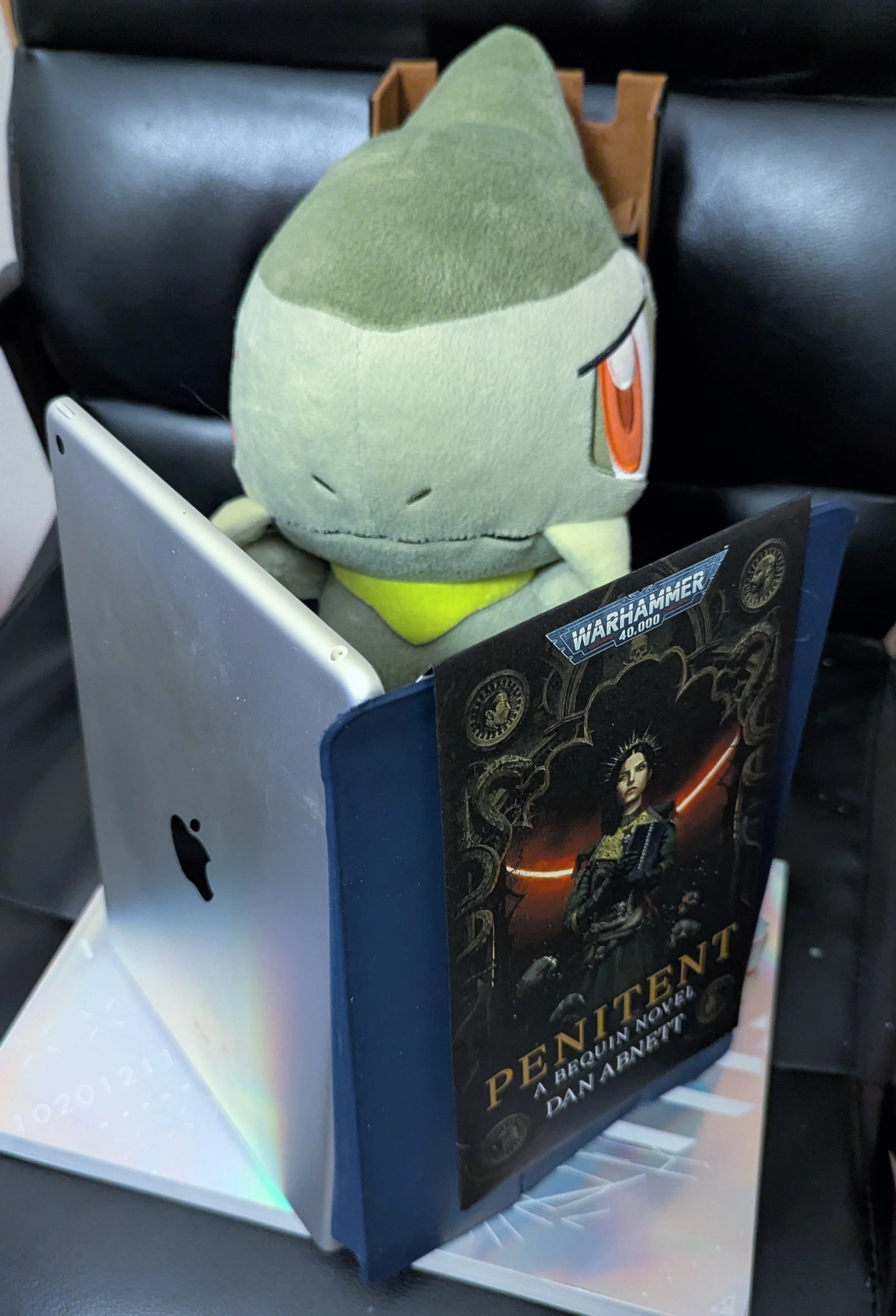
Hello, all. Welcome back to the review of Penitent, the second book of the Bequin Trilogy.
Today, we begin the deep-dive analysis of the book by looking at the plot. If you’re looking for just the overview, please see Part 1. We’ll cover characters next week in Part 3 before wrapping up with the discussions of worldbuilding and fanservice the week after.
Limiters off, everyone. There are heretics to hunt.
STATS
Title: Penitent
Series: The Bequin Trilogy, Book 2
Author(s): Dan Abnett
Genre: Science Fiction (Space Opera)
First Printing: February 2021
Publisher: Black Library (Games Workshop Publishing)
Rating: 8/10
SPOILERS
Throughout this review, there will be mild, unmarked spoilers for the events of Penitent. I will keep the first paragraph of each section as spoiler-free as possible. Heavy spoilers will be confined to clearly marked sections.
There will be heavy, unmarked spoilers throughout the review for the events of all the Inquisitor content we have previously reviewed thus far, including the Eisenhorn and Ravenor novels, their associated short stories, and Pariah.
TERMINOLOGY
The Alizebeth Bequin in the story is not the same woman from Eisenhorn’s novels. This Bequin is her daughter (or, at least, a person engineered from the original Bequin’s genetic material). Within the narrative itself, Abnett establishes distance between the two characters as early as Chapter 1, with Bequin operating by the “affectionate contraction” of “Beta”. I’ll therefore be referring to this character as “Beta” throughout this review, while her mother will be referred to as “Alizebeth”.
PLOT
My impression of the plot of Penitent definitely evolved as the story did.
In terms of the broad strokes, this story does work as a progression of the previous. It still has mystery, a frenetic energy, and multiple factions acting at odds with each other. I also think the ending of this book is far more satisfying than the ending of Pariah. It’s still abrupt, but at least there’s a definite sense of resolution.
However, as one is actually readying through it, the story feels unfocused. Moments that should be impactful feel forced because, while Abnett does Show us the necessary details to make the moments make sense, he doesn’t Show or Tell us nearly enough to justify the level of emotion he’s trying to wring out of them. And as for the ending, while it does feel like a definite conclusion, it’s a little too definite, if that makes sense. It feels a bit like Abnett was trying to write himself a graceful exit from the series, so that the trilogy can function like a duology if Games Workshop cancels the last book … and that would be fine, except everything in the book up until that point was building up to a third installment.
Dances with Chaos
Pariah ended off with Cherubael rescuing (or abducting - the framing is unclear) Bequin from out of Ravenor’s custody. Penitent begins months later, with Beta already being an integral part of Eisenhorn’s retinue. Their objective is to find a way into the “extimate space” (pocket universe between real space and the Warp) where the Yellow King makes his lair. Beta also has the sub-objective of deciphering an encoded tome once owned by Lilean Chase, the founder of the Cognitae (an element that was introduced in the previous book, though it did not end up impacting the story of that book). To that end, Beta and Eisenhorn are searching for Fredrik “Freddy” Dance, a mathematician whom they believe has already found a way into this extimate space.
The story the follows is a cascade of decisions and consequences. Each step in the investigation triggers fallout that either directly propels Beta to the next step or reveals a clue that she later figures out and uses to move the investigation further forward. The one exception to this is the side quest that Beta goes on to retrieve Renner Lightburn, the Curst who helped her in the previous book. However, even in this case, her sneaking away from Eisenhorn to collect Renner means she is not present for a step in the investigation, and her absence ends up forcing her to make a pivotal decision.
Master and Apprentice (Heavy Spoilers)
This book continues the conflict between Eisenhorn and Ravenor, with Beta being a pawn caught in the middle. That is fine in concept, but the execution feels a bit off.
At the start of the book, Beta is worming with Eisenhorn. However, after Eisenhorn is seemingly killed during an auto-séance, Beta sees no way to continue the investigation except to surrender herself to Ravenor and work with him. (This is where the book’s title comes from: Beta refers to herself as a “penitent” when she meets with Ravenor, and he assigns that to her as her code-name is encrypted communications in Glossia.) Thus far, everything works out.
However … Ravenor then quickly promotes Beta after just one mission. He gives her a rosette, and while not stated explicitly, it's implied that he’s elevated her to the rank of Interrogator (since she’s later given authority over other operatives). At the same time, Beta ends up acting as a mediating force between members of Ravenor’s retinue, advocating for Eisenhorn and those formerly loyal to Eisenhorn. None of it feels natural or earned.
At the end of the book, it is further revealed that Eisenhorn is alive. He faked his death to embed Beta in Ravenor’s retinue, to … I’m honestly not sure why Beta was necessary for this plan. He could have used Harlon Nayl for this job (and, indeed, Harlon is alive and rejoins Ravenor with Beta), but Eisenhorn makes it seem like Beta is the core component to deliver key Intel to Ravenor and set up their reconciliation.
To be clear, I don’t hate these developments. They could have worked. It just feels like Abnett was trying to speed-run a stand-alone story about Eisenhorn and Ravenor reconciling in the middle of this trilogy about Beta. Maybe this would have felt more earned if this was an Alizebeth book, rather than a Beta book.
Unfocussed
Building stop the Eisenhorn-Ravenor drama, the way the investigation progresses feels very muddled. In hindsight, everything does tie together and make sense. The problem is that is meandering in the moment.
As indicated above, while the overall goal is to find a way into the Yellow King's extimate space, how Beta and her allies try to go about that varies wildly. Originally, Freddy Dance is the way in. Then the focus shifts to other targets … except Freddy is still in the story, with Beta pursuing him with the hope that he can decipher Chase's book. And then, when Beta continues pursuing the Yellow King leads, there’s suddenly urgent Inquisition business elsewhere, and she’s on her own, which all leads to a chaotic fight scene where she seemingly learns nothing to advance the investigation (at least, not until she reflects upon the events later). Also, at one point, there's an Inquisition operative from Ordo Malleus who’s just here now. He doesn’t contribute to this narrative. He just gets revealed to turn an otherwise functional chapter ending into a false cliffhanger.
All these events make sense. Everything pays off (well, except the Ordo Malleus guy - I assume he’ll be relevant to the third book). In the moment, though, I found myself getting frustrated. The chaos that heightened the experience in Pariah here feels like poor developmental editing. I wouldn't blame someone for DNFing around the two-thirds mark and missing out on the payoff at the end.
Speaking of that payoff …
Is it really that big of a deal? (Heavy Spoilers)
Scale of the Threat
Abnett tries really, REALLY hard to set up the Yellow King as the most apocalyptic threat ever (at least by the standards of the Inquisitor novels, which have already dealt with at least four Imperium-ending threats that had nothing to do with the Yellow King).
His effort works to a degree. He does, at least, convincingly sell the idea that we should take the Yellow King seriously as an antagonist. It is confirmed that all of the Traitor Space Marines from Pariah are here because they perceive the Yellow King as a threat. In Penitent, we learn that a member of Eisenhorn’s retinue is actually from the Alpha Legion, which not only builds upon this idea but also shows Eisenhorn (who should know better) is desperate enough to trust the Alpha Legion. This book also introduces us to the Immaterial College, a cabal of Traitor Marines and rogue Loyalist Astartes who seem solely focussed on crushing existential threats that overrule the enmity that should otherwise divide them. For a cherry on top of all this, we learn near the climax that the ældar are also taking the Yellow King very seriously, to the point that they are sending multiple craftworlds to glass Sancour (an action that would trigger a retaliatory war with the Imperium).
This is all fine in terms of establishing the Yellow King as a threat. The problem is that Abnett tries to step things up by having multiple characters insist that he is THE threat. We’re Told that he is the greatest threat to the Imperium and the galaxy. At the end of the book, when we are finally Shown the extimate space where he dwells, we are then Shown Beta's horrified reaction and Told, again, that the King is the greatest of threats.
And all I found myself thinking was: why?
What, in a galaxy that features Chaos, the Necrons, the Dark Ældar, and the Tyranids, makes the Yellow King so remarkable? Because he has a hive-city hidden in a pocket dimension? Because he has access to Enuncia? Because he’s got the graels (which, as we’re Shown in this book, can be killed by psychic weapons)? He really doesn't seem all that special if those are his weapons. Anyone who’s read other Warhammer 40K content (even just Abnett’s other books) has already seen comparable threats introduced and vanquished.
Now, to be fair to Abnett, he does set up an actual threat for the Yellow King. The King is apparently looking for a certain name in Enuncia, believed to be the name of the God-Emperor himself, which would hand him an instant win condition against the Imperium. That's just not what Abnett leans on to make the King formidable. It is established as a reason the King can't be ignored, but it's the King’s shiny and not-so-special toys that are used to push the idea that he is a genuine danger.
I think an apt point of comparison here would be the buildup to the final confrontation with Galbatorix in Inheritance. That book also set up the Name of Names as a threat while putting the focus on Galbatorix’s assets in battle. This worked because Galbatorix’s assets were an unprecedented threat within the series. His fortress was the most formidable the Garden army had yet beseiged. Shruikan was an implausibly huge dragon who would be impossible to take down in a fair fight. His raw magical prowess was augmented by far more Eldunarya than Eragon had access to. So ratcheting up the tension by focussing on these assets made sense.
What Penitent has done would be like is Glabatorix was set up to be of comparable power to Murtagh. Threatening? Sure, but if the goal is to convince the audience he’s the guy with the biggest, scariest stick, it really doesn't land.
It's … the guy!
With the closing line of Penitent, Abnett reveals the identity of the Yellow King.
‘The name of the King is Constantin Valdor,’ I said.
This is the payoff to the mystery of who the King is. Fair enough. Beta chaeed down a lead, and she achieved her goal.
But … when placed against all the effort to build up the King as the ultimate threat … it’s really limp.
How many of you who are not the biggest of Warhammer 40K fans even know who Valdor is? Because I know I had to look him up. I suppose people who are fans of the Horus Heresy specifically will know all about him. For the rest of us, though? I can’t by the only person who finds this reveal as limp as Quixos being the main antagonist of Malleus. He is a character who had zero footprint in this series before the reveal.
Much like with the scale of the threat, Abnett also set up a more impactful reveal. One idea that the characters toy with when trying to decipher the identity of the Yellow King is that he might be one of the two Lost Primarchs. At first glance, this may seem like an equally limo reveal. However, Penitent does take time to explain what the Primarchs are. Confirming that the King was one of them would therefore at least have had weight in terms of paying off a setup.
The Exit Hatch
I’ve spent a lot of words complaining about and critiquing the plot of Penitent. However, I do want to emphasize that this story does, for the most part, work. The ending of the story brings clarity to those elements that previously seemed unfocussed. And while I don’t think the ending had the emotional punch Abnett was going for, it does makes a lot of rational sense. This is a solid sequel overall that builds upon what Abnett established in the previous entry. I’m sure Pandæmonium will allow the series to stick the landing, if and when it gets written and published.
… which brings me to my theory as to why this story is like this.
This series is not stalled by writer’s block anymore. Now, it is the publisher who has put this series on ice. Depending on how Pandæmonium ends, it could have massive implications for Warhammer 40K as a whole. Games Workshop probably won’t let it proceed until they’ve decided on an ending they’re comfortable with Abnett writing.
There’s every chance they may decide just to wash their hands of the lore implications of the Yellow King, Enuncia, the graels, extimiate space, and the Immaterial College by just burying all of it and never speaking of it again.
I have to wonder if Abnett was either told to write Penitent to be the potential end of the series or else saw the writing on the wall and tried to give himself an exit point. Lingering plot threads - both those introduced in this series and that stretch back across the Inquisitor novels - have been tied off. The big reveal of the King’s identity reads more like a resolution than a twist to propel the story forward. One reasonably could leave the Bequin Trilogy here and either never touch it again or use it to jumpstart some new series down the line, when Games Workshop is finally willing to touch this lore.
I hope this isn’t the case. There’s potential for Pandæmonium to be a very satisfying resolution for both the Bequin Trilogy and the Inquisitor novels as a whole. It’s also entirely possible that I’m reading way too much into this and that the flaws we’ve covered have nothing to do with Games Workshop. Abnett’s Inquisitor novels don’t exactly have a great track record for endings that aren't rushed and that take the time to give every plot thread a satisfying resolution.
ORIGINAL CHARACTER, DO NOT STEAL
Next week, on July 31st, we’ll get into a discussion of the characters of Penitent. I feel that the character work in this book, while not fantastic, is still quite good. That said, there is an issue that was set into motion in the last book but blossoms into a more significant problem in this one: Beta reads like a fanfiction character.
Thanks for stopping by. Please remember to subscribe and share if you enjoyed what you read here. Take care, everyone, and have a good weekend.