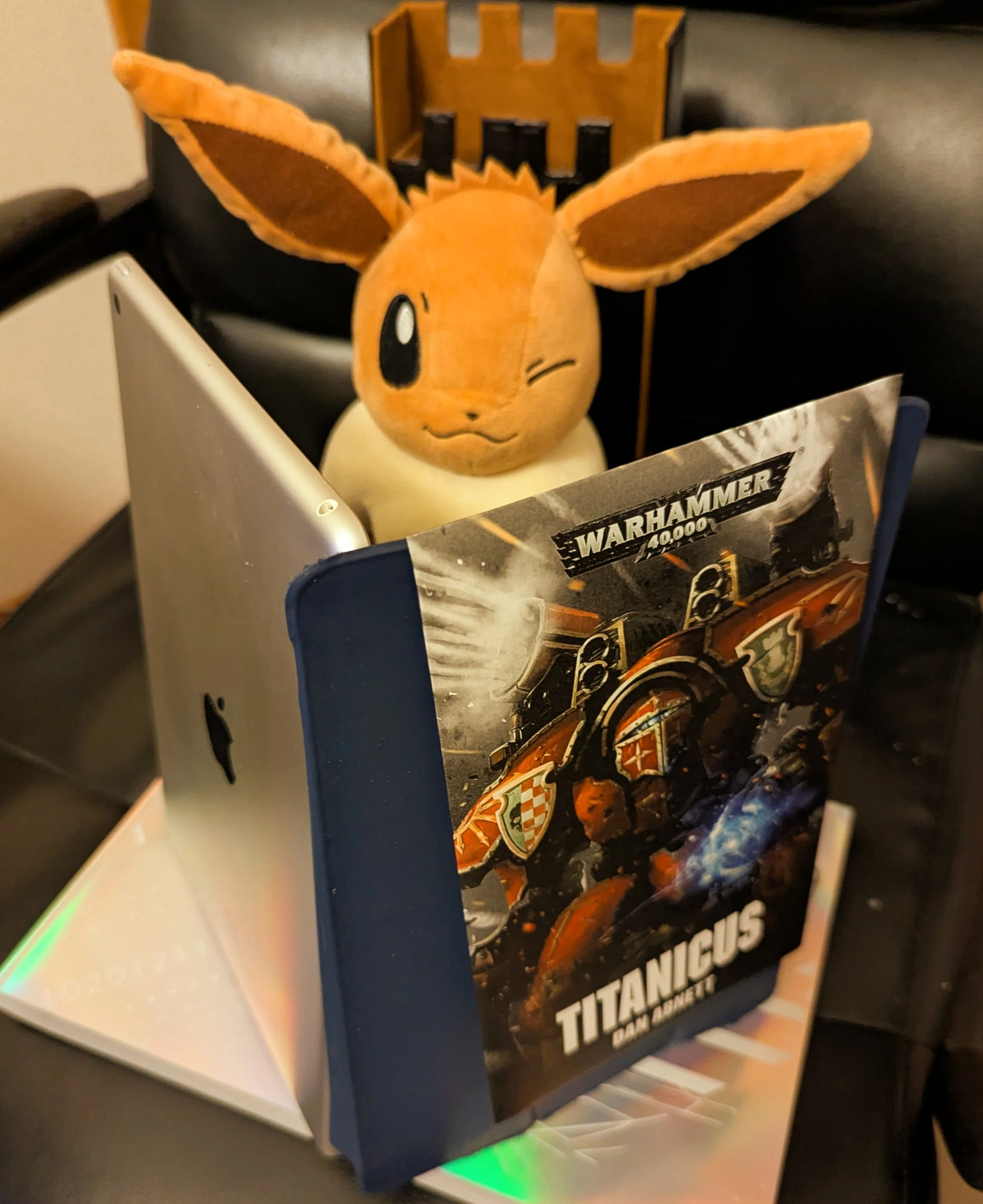
Titanicus (Part 2 - Plot)
Hello, all. Welcome back for our ongoing exploration of Titanicus.
This part is going to focus purely on the plot. If you’re looking for the general overview of the book and the discussion of characters and worldbuilding, see Part 1. We’ll cover the analysis of the theme next Friday.
Plug in, everyone, and let’s go for a walk.
STATS
Title: Titanicus
Series: N/A, but unofficial associated with Sabbat Worlds
Author(s): Dan Abnett
Genre: Science Fiction (Space Opera)
First Printing: November 2008
Publisher: Black Library (Games Workshop Publishing)
Rating: 7 / 10
SPOILER WARNING
Both minor and heavy spoilers for Titanicus will be provided throughout this review. I will try to keep the first paragraph of each section as spoiler-free as possible and will confine heavy spoilers to clearly labeled sections.
Heavy, unmarked spoilers will be provided for any and all of the Warhammer 40K content we’ve covered thus far.
PLOT
Multifaceted, Sometimes Extraneous
As you probably gathered from the whole “exploring the battle from every angle” thing, this book is composed of a collection of vaguely intertwined subplots that all feed into the climactic open-field Titan fight that makes the Battle of Orestes so noteworthy. Not every POV contributes to this conclusion. However, most of them do tie into it in some way, and for most of the ones who don’t, the lack of connection is understandable. I don’t think anyone really thought the toymaker Manfred Zember meant anything more to the story than to provide a street-level view of a hive citizen trying to make a profit off the battle.
I mostly like the way this was executed. The story of Varco’s attempt to keep himself and his men alive after a Chaos Titan obliterates their tank formation works well as its own narrative within the wider story of the battle; when he was able to contribute that final engagement, it gave the actions of him and his dwindling band a sense of cosmic purpose. The story of Adept Feist’s efforts to analyze the enemy Titans by digging into sequestered data has an immediate payoff when it helps the Titan crews in action and then later ups the states when he recovers forbidden knowledge that could undermine the war effort (more on that when we get to the theme). Moderati Tarses of Legio Invicta getting paired with a “boy-princeps” prodigy of Legio Tempestus leads to interpersonal drama during earlier fights and a tense showdown in the buildup to the final fight.
However, there are still some standout problems. Some POVs do not fully resolve the conflicts that were set up for them, while others get way too much focus for stories that don’t actually impact the overall narrative.
Unconcluded Stories
Despite the POVs not being distinct as characters, Abnett did at least try to given each of them a motivation or mission. Not everything that he goes out of his way to set up actually gets used. I’m going to highlight one example where this was most obvious.
Moderati Tarses is part of the Legion Invicta forces that arrive on Orestes at the start of the story. His introduction scene is him murdering the magos who brings him the bad news of his Titan’s princeps’s death. Across the first half of the book (i.e. the half of the book before he is ever deployed to the battlefield), each of Tarses’s scenes make a big deal about how the Mechanicum now see him as an unstable monster, how he should be executed but is having his punishment stalled because he’s needed for the battle ahead, and how the new princeps assigned to his Titan is going to be monitoring his performance and making the final judgment as to whether he gets to live beyond the battle. While the focus on the relationship between Tarses and his new princeps shifts to the dynamic of a veteran sergeant helping a new officer ease into command, this original conflict continues to hang over the story.
One would expect some sort of resolution to this conflict that was set up for the entire first half of the novel. Only … there’s no resolution. This conflict plays a bit into the themes (which we’ll get into next week), but it doesn’t get a proper conclusion and then Tarses’s last appearance is his princeps working like a well-oiled machine in the midst of the open-field Titan engagement. We never learn what happens with the murder case. (Frankly, given what happens in theme-related moment, it really seems like he should have faced some consequences, especially in this grimdark setting where good deeds are not always rewarded.)
Why go out of the way to set up this stay-of-execution conflict? Tarses and his new princeps are already at odds because of the differing theological stances of Invicta and Tempestus. That ends up being way more important to the story (as we’ll get into when we discuss the theme).
It’s not impossible to set up plot elements and then not pay them off. It’s just that, when half a book is invested in defining a POV character by a specific conflict, not paying off that conflict does not read like a deliberate, artistic choice. It reads like negligence. And while Abnett may not have the most airtight plots in this era of his career (remember, this came out only a year after the end of the Ravenor trilogy), this sort of negligence does feel below his usual standard.
Pointless Stories (Heavy Spoilers)
On the flip side of the coin, this book sinks a disproportionate among of time into a pair of POVs that, while well-executed in isolation, are completely pointless to the book.
The PDF-level perspectives of this book are provided by Varco (who represents the tank crews) and Cally Samstag (who represents the infantry reservists). Cally’s story, much like Varco’s, is one of survival. Her unit of butchered by Dark Mechanicum weapons servitors early in the story, and she is forced to take charge, guiding the survivors of her unit to safety. Meanwhile, a separate POV shows Cally’s husband Stefan, who cracks under the pressure of her being deployed and ends up getting himself killed by law enforcement. Their story ends when Cally comes home from the battle with a medal to discover her husband is now dead.
This story was infuriating to read. Not because of how it ended - I was actually expecting Stefan to get recruited by a Chaos cult, so him only getting shot by cops is honestly a happier ending than I’d thought he’d get - but because of what it actually means.
Which is nothing.
As we got scene after scene of Cally wandering through the industrial wastes with her ragged band, I kept expecting her story to contribute something to the wider narrative. That’s what happened with Varco: he spent most of the book just keeping his unit alive, and then at the climax, he is able to provide a pivotal contribution to the final fight. If nothing else, I thought one of the other established POV characters would find Cally’s band and rescue them.
Neither of these things happen. Cally and her band just wander around before getting rescued by some allied skitarii. Her earning a medal pays off an offhand remark by the leader of this skitarii band. Then she goes home, and her husband is dead.
Did we really need to waste so much time on this?
Again, in isolation, I don’t think this plotline is bad. It could have made for a fine standalone novella that captures the hollowness of victories within this grimdark setting of endless war. When folded into this larger work, though, it feels like it was tacked on just to remind us that this is a grimdark setting. That’s rather unnecessary in a book that already explores the willingness of a organized religion to bury a pivotal spiritual revelation in the name of political necessity.
I feel like this wouldn’t have been hard to fix, either. Abnett just had to collapse Cally’s and Varco’s stories into one. If Varco came home after effectively saving the whole planet to discover his wife was dead, that would have had a lot more punch.
I’ve spent a long time complaining about this one subplot, so I’d like to extend an olive branch. This pair of POVs convincingly sells the dynamic of the strong woman and the weak man (something I’ve complained about in the reviews of The Stardust Thief and Planeswalker). The issue in those past two examples is that the authors attempted this dynamic by removing the positive traits of masculinity from the male character, replacing them with all the negative traits of femininity, and then bestowing those positive traits of masculinity onto the female character. Abnett does not make that mistake. In their introductory chapter, Abnett makes it clear that Stefan is a very masculine figure who loves his wife, while Cally is the emotional bedrock of their relationship. Yes, Cally does think that “sometimes [Stefan] could be such a child”, but this makes sense in context. She is is the one being sent into a war zone, who needs comfort, yet she needs to bury her own emotions to comfort her husband. It also comes after we learn, in detail, everything Stefan has done to give them both a better life. This imbalance between them isn’t emasculating Stefan. It’s calling attention to a character flaw (one that will ultimately get him killed) while establishing that Cally is trying to make the best of a bad circumstance.
Action / Tension
Up until this point, I have mostly been complaining about the plot of this book, but it has its moments.
First, the action. Abnett makes great use of those differing POVs. We experience Titan battles at various scales, experiencing clashes between different clashes of Titans, tanks versus Titans, and infantry just doing their best to survive as Titans brawl above him. We experience the complex interactions within the cockpits of these powerful machines as the princeps serve as living computers and the various officers man their stations to reduce the strain on the princeps. Abnett takes time to describe the Titans’ struggles to move through different terrain, how they fight in the open or in ambush, and how they use the weather to their advantage. When Titans get damaged, we are Shown how their performance lags and how the princeps suffer “psychostigmatic” wounds.
Abnett also isn’t afraid to kill POVs. I think he uses a few too many fake-out deaths - Varco alone gets at least two that I can remember - but enough other POVs die to balance this out. One of these POVs is killed after a fight is won, hammering in the unpredictable dangers of war.
The other thing that stands out to me is that Abnett does a wonderful job of gradually building up tension. A scene that really stuck with me was Varco and his band of survivors scavenging resources from an abandoned PDF post. They find a vehicle that works but has no fuel, another vehicle that is crashed but has fuel and ammunition, a locked door inside the post that likely protects weapons and supplies … and get pings for three enemies contacts within a few kilometers of them. What follows is a surprisingly tense sequence of Varco and his men quietly siphoning fuel from the crashed vehicle to refuel the working one while also preparing an improvised bomb to break down the locked door, all while the enemies creep closer, knowing that those enemies will home in on their position the instant they start the vehicle or detonate the bomb.
All this is to say that, while Titanicus is a plot-driven narrative, it leans into the elements that make the plot stronger. There is a palpable sense of danger and risk throughout this book. That makes it easy to stay engaged, even if the characters aren’t emotionally deep.
HERESY
I have more to say about the plot of Titanicus. It’s just that those elements tie into the book’s handling of theme. We’ll therefore go over those details next Friday, June 19th, as the review of Titanicus reaches its conclusion.
Thank you all for being here. Please remember to subscribe and share if you enjoyed what you read here. Take care, everyone, and have a good weekend.