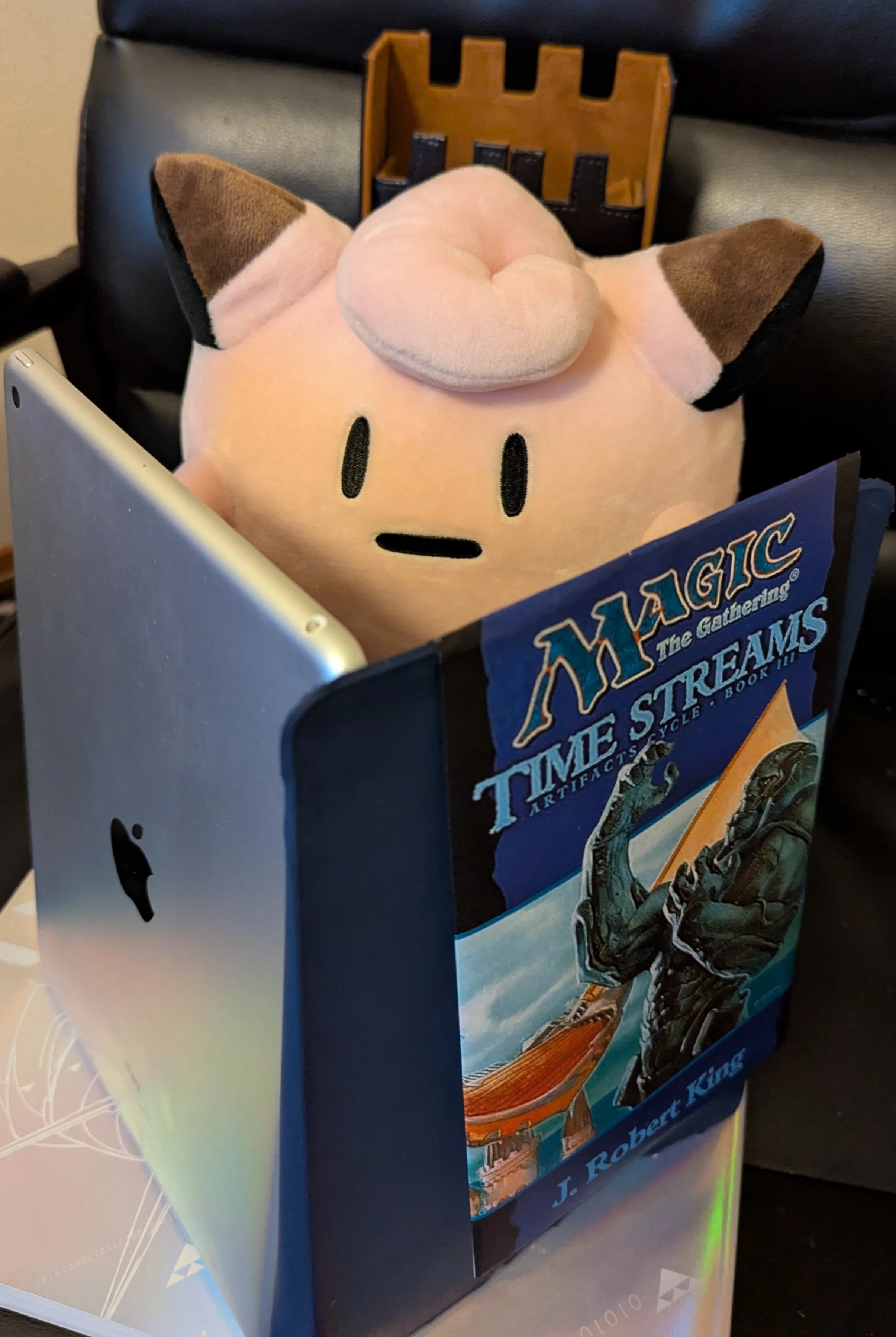
Time Streams (The Artifacts Cycle, Book 3) (Part 2 - Character)
Welcome back, everyone, for the conclusion of our review of Time Streams, Book 3 of the Artifacts Cycle tie-in novels for Magic: the Gathering (MTG).
Today, we’re going to focus on just the character writing, as that is the aspect that truly could have elevated this narrative if given adequate focus on the page. If you’d like the high-level overview of the book and the analyses of the plot and worldbuilding, please see Part 1.
Let’s go for a ‘walk.
STATS
Title: Time Streams
Series: The Artifacts Cycle (Book 3)
Author(s): J. Robert King
Genre: Epic Fantasy
First Printing: March 1999
Publisher: Wizards of the Coast LLC
Rating: 6/10
SPOILER WARNING
Mild, unmarked spoilers for Time Streams will be provided throughout this review. Heavy spoilers will be confined to clearly labeled sections. I will keep the first paragraph of any given section spoiler-free.
Throughout this review, I will also be providing heavy spoilers for later events within MTG canon. While I will be steering clear of details that would spoil the progression of this book specifically, there is a strong chance that you will figure out certain spoilers if you pay attention to these bits of lore. I’ll confine the heavy spoilers that are relevant to this book into clearly marked sections.
Heavy, unmarked spoilers for The Brothers’ War and Planeswalker will be provided throughout this review. I will also assume that you’ve already read my reviews of those books, though they aren’t essential to understand this one.
CHARACTER
Unable to Conserve Momentum
This book has a colorful cast. All of the main cast are introduced prior to the inciting incident, and with one exception, they’re all well-defined and set up for meaningful character arcs right out the gate. The secondary cast who get fed in as the story progresses have less depth and don’t get arcs, but their motivations and decisions still make sense in the context of their backgrounds and the events taking place.
The issue with character that undermines this book is not the cast. It’s the time given to actually earn their development.
Prior to the inciting incident, each member of the main cast is given at least one scene that efficiently tells us everything we need to know about them for the story to make sense. The issues don’t start until the time machine explodes. Once the narrative becomes preoccupied with the rebuilding of Tolaria and the ever-intensifying war from the Phyrexians, we don’t get those characterization scenes anymore. What character development we do get is Told to us, either through characters telling each other about development or the narration explaining things to the audience. If these moments of Telling were removed, I’m not sure how much character development, if any, would be discernable.
And that’s a shame because, much like in The Strength the Few, this isn’t an issue of the development not making sense. There’s a logical flow of cause and effect to all of this. It’s just that, outside of those scenes prior to the inciting incident, the emotional weight to support this development just isn’t there.
What Could Have Been (Heavy Spoilers)
To demonstrate this point, I’m just going to outright explain the main cast’s character arcs in this book in two paragraphs apiece, with one paragraph for what we learn prior to the inciting incident and one to cover the rest of the book. I hope you’ll agree that what I describe here is quite solid. Just bear in mind that what I cover in those second paragraphs is barely a summary. This is the information that is Told to us across hundreds of pages.
Urza
The Urza we see at the start of Time Streams is a man unwilling to accept responsibility for his actions. His renewed resolve to fight the Phyrexians has led him to build a time machine. However, he is still blaming everyone but himself for the Brothers’ War and what happened to Mishra. Rather than planning to go back in time 3,000 years to, say, stop himself and Mishra from reopening the portal from Dominaria to Phyrexia, he plans to go back 8,000 years to stop the Thran from ever becoming the Phyrexians. He also had zero care for the fact that resetting the timeline will effectively kill everyone in Dominaria’s current, present-day timeline. Then there is Karn, a golem granted sapience by Xantcha’s heartstone, whom Urza has no qualms about dismantling if he designs a better model.
The destruction of the time machine is the beginning of Urza’s redemption. Once more, innocent people who out their trust in him (this time, his students) are suffering for his mistakes; once more, a Phyrexian threat is growing exponentially more dangerous because of him. Urza must symbolically undo his mistakes - by saving students still trapped in pockets of slow time, by being a uniter instead of a warlord to acquire the resources his needs, by atoning for the destruction of Argoth. The book ends with Urza reading the in-world account of the Brothers’ War that was written by his wife before taking time off work to join a dance being held by his students.
In concept, Urza’s arc in this book is incredible. It’s just that, outside of the Argoth bit, the steps on this journey are muddled. If Barrin wasn’t there to tell us about Urza’s progress, a lot of this development would be lost in the noise - because, while Urza is a hero, he’s an antisocial and arrogant one. It's really hard to tell the difference between him doing something noble for altruistic reasons and him doing it for selfish ones.
Barrin
Barrin is estsblished prior to the inciting incident as Urza’s partner and conscience (albeit a conscience Urza doesn't listen to). Every chapter in the book ends with “Monologues” where Barrin offers some 1st Person commentary on Urza’s behavior in the story up until that point. He comes across as compassionate but ultimately subservient to Urza.
After the time machine blows up … nothing changes. Barrin is the only member of the main cast to not get an arc. He remains the angel on Urza’s soldier. I don’t think this is a problem, though. He forms a fixed point off of which we can measure Urza’s behavior. The fact he isn't particularly effective in this role reflects the flaws in Urza's writing, not his.
Jhoira
Jhoira begins the story as a starry-eyed young woman who missed her home and longs to meet the man of her dreams. When a handsome castaway washes up on the island of Tolaria, she helps to conceal him from the island’s defenders (since Urza, anticipating that the Phyreixans will eventually strike at him again, has standing orders to kill anyone who arrived on the island without his permission). What she does not realize that this stranger, Kerrick, is actually a Phyrexian sleeper, and her dreams of romance have inadvertently given him a better way into the school that he could ever have dreamed.
After the time machine explodes, Jhoira endures ten years alone on the island before Urza and Barrin return to rebuild. She then integrates into the new academy and aids in the war effort. Her story is about struggling to find a new direction in life as she is sent scurrying this way and that by the war effort against K’rrick. After K’rrick’s destruction, she finally finds that sense of direction as the first captain of the skyship Weatherlight. (I didn't read the serialized fiction on the MTG website that covered the second Phyrexian invasion of Dominaria, but knowing what happens to the Weatherlight in that story, this ending is rather bittersweet.)
Jhoira really got short-changed by the lack of time devoted to character after the inciting incident. Even with the finale of the story spelling out the end of her arc, it’s nearly impossible to make out her trajectory. She just sort of wanders between objectives.
Teferi
Prior to the inciting incident, Teferi is … well, I can’t sugarcoat it. He’s a little shit. He’s an arrogant, obnoxious teenager who loves to antagonize people, dehumanizes and absuses Karn for his own amusement, and thinks he can woo a girl four years older than him (Jhoira) with his antics. His one redeeming moment comes when he finds out about Jhoira and Kerrick. Rather than trying to extort Jhoira with this information, he resolves to prove to her that he is a real man by helping her to keep her secret. Teferi’s one noble act prior to the time machine exploding therefore dooms the entire island.
After the inciting incident, Teferi is … still a little shit, until he gets older and grows out of it. I guess he learned about power and responsibility? The book ends with him in a position of authority in his native Zhalfir.
Teferi’s arc is minimal and mostly implied. Ironically, this makes it the most intact one out of all the dynamic characters. It’s not hard to connect with something so simple.
Karn
The silver golem, originally known only as the “probe” (or, as Teferi mockingly called him, “Arty Shovelhead), awakens as a lonely and confused creature seeking both connection and purpose. Teferi quickly makes him aware of the fact Urza might dismantle him at any time. It isn’t until Jhoira stands up for Karn that he finally makes a friend. Unfortunately, this friendship also leads him to help Jhoira keep Kerrick a secret.
After the time machine explodes, Karn finds himself struggling with connection and purpose once more. He is separated from Jhoira for years at a time. What’s more, with the time machine gone, his originally purpose for existing went with it. Not helping matters is that Urza trades him away to earn the support of Shivan tribes, asserting that he is nothing more than a tool to his own creator. It isn’t until the end of the story that Karn finally finds himself, serving as the master of Weatherlight’s engines under Jhoira’s command.
Much like Teferi, Karn’s arc is easy to understand. It's the story of a machine finding humanity that's been done in many stories before. The issue is that this one really leans on Karn’s connections to other characters. We just don't get enough post-time machine to lend this emotional weight.
K’rrick
From his introduction, there is little doubt that Kerrick is a Phyrexian sleeper. It’s established with visual clues. Eventually, Urza confirms this when he catches the scent of Phyrexian oil. His attempt to assassinate Urza and destroy the time machine leads to the explosion that warps time across the island.
After the blast, K’rrick fully embraces his identity as a Phyrexian. He’s not a particularly deep character - he’s an off-the-shelf copy fo your standard barbarian warlord - but his drive and ego are one of the few traits character traits to be properly Shown post-time machine. This Phyrexian sees as the rightful heir of Yawgmoth, and he is throwing everything he has at escaping the fast time rift and killing Urza to prove that point.
The Three Survivors
Teferi, Karn, and Jhoira are recurring characters right up to the present day of MTG.
Teferi and Karn both became planeswalkers twice. They became planeswalkers pre-Mending, sacrificed their sparks in the Mending, were supplied with the sparks of other planeswalkers decades into the post-Mending period, and then lost their sparks again during the March of the Machine. (Teferi technically lost his during the Desparkening, a piece of lore I utterly hate, but that is neither here nor there).
Jhoira remained ageless across the centuries and survived right up to at least the prelude of the March of the Machine.
I haven't read many stories featuring these characters after the events of the Time Spiral block, but what I can recall, it’s rather wild to think about just how much shared history these characters end up having. Jhoira and Karn don’t change that much in all that time. Teferi, by contrast, is utterly unrecognizable from his origins. It’s hard to believe that the man who shoved the entire plane of New Phyreixa out of phase with the rest of the Multiverse was once such an immature troglodyte. The transition makes sense when one considers just how much responsibility he’s had to bear over the years. It's just jarring to know the more heroic figure before reading this as his origin story.
IT’S IN THE BLOOD
I don't think Time Streams was a great book, yet at the same time, the potential was clear. Maybe if King had taken / been given more time and added another 40 pages or so to Show us scenes of character development, it could have fulfilled that potential. What we got has still managed to reignite my interest in this series. I’m hopeful for a decent ending to the Artifacts Cycle with Book 4, Bloodlines. That review will be split into 3 parts, coming your way on May 29th, June 5th, and June 12th.
Thank you for joining me today. Please remember to subscribe and share if you enjoyed what you read here. Take care, everyone, and have a good weekend.