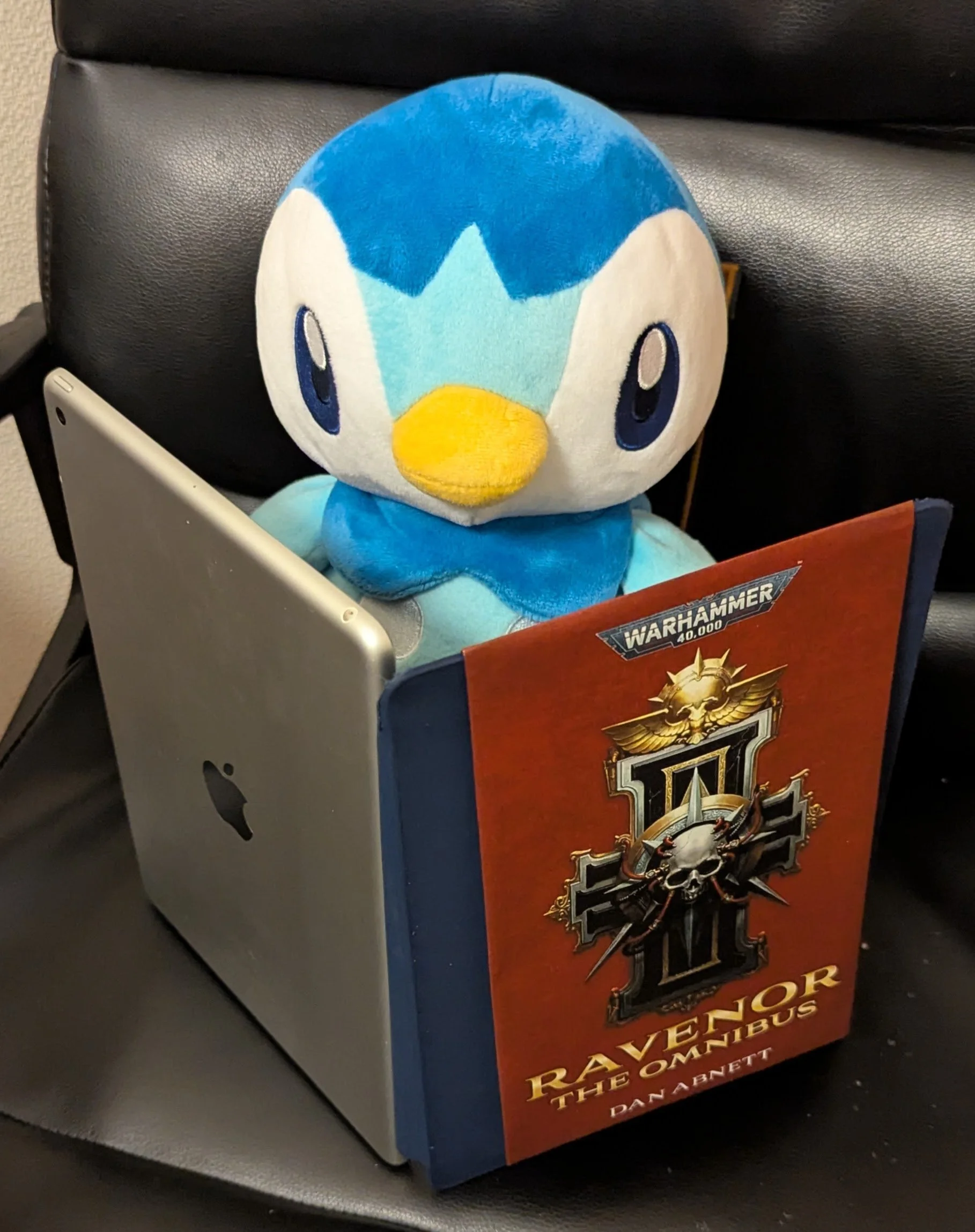
Ravenor Rogue (The Ravenor Trilogy, Book 3) (Part 1)
Hello, all. Welcome to the review of the last novel of the Ravenor Trilogy (and the final novel included in Ravenor - The Omnibus).
If you haven’t caught up on the Ravenor content thus far, I encourage you to do so. If you’re up to speed (or just don’t care about being caught up), then let’s dive back into the grim darkness of the 41st Millennium.
STATS
Title: Ravenor Rogue
Series: The Ravenor Trilogy, Book 3
Author(s): Dan Abnett
Genre: Science Fiction (Space Opera)
First Printing: March 2007
Publisher: Black Library (Games Workshop Publishing)
SPOILER WARNING
Both minor and heavy spoilers for Ravenor Rogue will be provided throughout this review. I will try to keep the first paragraph of each section as spoiler-free as possible and will confine heavy spoilers to clearly labeled sections.
Heavy, unmarked spoilers will be provided for all of the Ravenor content we’ve covered thus far (Ravenor, Ravenor Returned, “Playing Patience”, and “Thorn Wishes Talon”). There will also be mild spoilers for the Eisenhorn stories.
TIMELINE
This plot of this book kicks off in 404.M41 (with a epilogue set in 405.M41). This sets the book one year after the events of Ravenor Returned (403.M41).
STRUCTURE
This will be another 2-part review:
Part 1 (Today)
Premise
Rating
Content Warning
Prose
Worldbuilding
Part 2 (Friday, March 27nd)
Plot
Character
Also, it’s worth noting that the last short story in the omnibus, “Perihelion”, is effectively an epilogue to the trilogy and a transition to The Magos. We’ll be reviewing that story on Tuesday, March 31st.
PREMISE
Going off the product page for the Kindle edition of Ravenor Rogue, we get:
Inquisitor Ravenor continues his persecution of the arch-heretic Zygmunt Molotch – a hunt that has, for him, now become an obsession. In direct contravention of Inquisition orders, Ravenor and his team go rogue, in relentless pursuit of their quarry. Thrown through time and space, pitted against enemies of limitless power and cunning, just how much will Ravenor and his team have to sacrifice to save the day?
Reaction
I have no complaints about this premise. It is quite accurate and does a good job of building this up as a grand conclusion of Ravenor’s clash with Molotch. There are elements mentioned within it that we’ll definitely be coming back to, though.
RATING: 7/10
This book was one of those where the rating was reached via a balance of extremes.
There are elements here that work extremely well. Despite the uneven handling of Ravenor’s relationship with Molotch in previous books, I believe that Abnett successfully sells the idea that this story is the finale confrontation of two enemies with a grudge that has lasted for decades. The character work and worldbuilding also continue to be very strong. On the whole, this is a satisfying resolution to the story, and I honestly do wish that I could rate it higher.
The thing is, for all the things that are done well, there are plenty of elements that feel haphazard. The handling of the alternating POV is the worst out of any of the three novels. Despite the strength of the character writing, there are character inconsistencies and at least one outright character assassination, not to mention one instance where a key aspect of the worldbuilding outright breaks to course-correct after these inconsistencies knock the story off-course.
So let’s get into it, both the good and the bad.
CONTENT WARNING
Ravenor Rogue features:
Violence
Human suffering, often linked to torture
Gore
Horrifying imagery
Fade-to-black sex scenes
An implied threat of rape
Out of the books in the trilogy, this is arguably the most grimdark - yet, much like its predecessors, this never feels forced or obtrusive. It’s all a natural extension of the story being told. If the Warhammer 40K aesthetic isn’t for you, by all means steer clear of this one, but if these things objectively existing within the story isn’t going to be a problem for you, I think you’ll be okay with this one. I still think this trilogy remains a great introduction to Warhammer 40K’s grimdark elements.
PROSE
I really do like the concept of the alternating 1st Person Present / 3rd Person Past POV. It does so much to capture Ravenor’s experiences as a psyker who experiences the world primarily through his psychic gifts.
The problem is that, in this book, it feels like Abnett is only continuing to do the 1st Person segments out of some sense of obligation. There is no longer an rhyme or reason to it. At least in Ravenor, scenes where Ravenor was present but described in the first person were limited to ones where he was both blanked and had his chair disabled (i.e. it was technically just his chair that was able to interact with the scene) or ones where he was only present because he was psychically controlling another character. Here, it feels like the book is written predominantly in 3rd Person, only for it to arbitrarily bounce into 1st Person.
It’s not even like being in Ravenor’s 1st Person POV accomplishes anything the 3rd Person POV couldn’t. There’s nothing about his story in this book that is enhanced by having him be the narrator. If anything, we get multiple examples that demonstrate that 1st Person POV isn’t necessary for this story. Carl Thonius’s POV scenes are all in 3rd Person, Kara Swole’s scenes are all in 3rd Person, Molotch and Orfeo Culzean’s scenes are all in 3rd Person … There’s plenty of strong character work being done without sticking the POV instead their heads.
If anything, the flipping POV just makes things needlessly confusing. I remember a particular action scene where the POV flipped between Ravenor (1st Person) and Nayl (3rd Person). Despite the fact that Ravenor’s pronouns and the verb tenses made it very clear which POV the scene was in at any given time, I still managed to end up losing track. That’s how little the changing POV actually contributed.
So, as much as it pains me to say this - I really do love this concept, and I feel like Abnett used it very effectively in “Playing Patience” - the flip between 1st Person Present POV and 3rd Person Past POV ended up being the single worst aspect of this entire book.
WORLDBUILDING
As in the prevoius books, Abnett paints a rich picture of the Warhammer 40K galaxy, both its grimdark aspects and how people manage to make a living in spite of those challenges. In the interest of not repeating myself, I’m going to focus on just two particular details of note.
Time Travel
Ravenor’s efforts to out-manuever Molotch lead him to seek the counsel of the Wych House of Utochre, a cult built around devotion to a Warp portal. This portal serves as a divinatory device. A petitioner presents a question to the portal, and the portal answers it by delivering the petitioner to a series of locations throughout time and space, with these locations serving as cryptic hints.
I can’t go too much into the portal going into the past, as explaining that would require an unnecessary number of spoilers. I can, however, say that Abnett using the portal’s visits to the future to facilitate a fight scene against Tyrannids, centuries before the hive fleets begin their invasion (which is official recognized with the fall of Tyran in 745.M41). One of the destinations Ravenor visits is a world that suffered a Tyrannid invasion, and Ravenor and his retinue are immediately dedicated by a wave of Hormagaunts. Some of these Hormagaunts are able to breach the portal, spilling back into 404.M41, resulting in a firefight that destroys the Wych House.
Blanks (Heavy Spoilers)
Abnett makes frequent use of both blanks and psychic blocking technology in his stories. This makes sense from both the Watsonian and Doylist perspective. In stories that focus on psykers and Warp sorcery, it makes sense for the characters in those stories to seek out and make use of the means to counter these elements. Having the means to shut down psychic powers is also an effective way to keep everything from being instantly resolved by those psychic powers.
However, in this book, Abnett introduces a bit of lore about blanks that simply does not make sense. Maybe this is something I should have brought up back in Hereticus, when Bequin was able to channel her blank powers through Eisenhorn’s staff in a bit to stop a Chaos titan, yet at least that didn’t alter the trajectory of the narrative. Bequin could have been put into a vegetative state by other means, and it wasn’t even like she succeeded. Here, the lore Abnett introduces directly affects the plot.
Since the end of Ravenor Returned, Ravenor has assumed that Zael is Slyte. He has dedicated his retinue’s blank, Frauka, exclusively to the task of keeping Zael’s psyker powers suppressed until he can confirm the truth. Zael spends the entire book in a coma (one implied, in Ravenor Returned, to have been induced by Carl so that Zael wouldn’t reveal his true nature as Slyle), so this duty primarily entails Frauka sitting with Zael and shrouding the boy in his anti-Warp aura.
This book reveals that Zael is self-inducing the coma, fearing Slyte will kill him if Zael is ever in a positoin to expose his identity. What’s more, over the six-month period since the end of Ravenor Returned, Zael has broken into Frauka’s mind. Frauka’s suffers nosebleeds throughout this book, which are foreshadowing to the reveal that Zael’s influence of Frauka is damaging the blank’s mind. Zael has altered Frauka so that the blank is no longer a blank.
This is … look, I can’t pretend to be an expert on all things Warhmmer 40K, but this is simply not how blanks work.
Blanks do not have psychic powers that allow them to cancel out the Warp. Blanks have no connection to the Warp. That’s why they are “soulless”. They are fundamentally disconnected from the reality of this setting. No matter how powerful the psyker, the Warp sorcery, or the dæmons faced, a blank (and his or her immediate surroundings) cannot be affected by the Warp, as they have zero connection to it. This was demonstrated quite effectively in the Eisenhorn books. The dæmons in those books were quite powerful, yet even they had to find workarounds so as to kill blanks through physical force. Thus far, the only thing demonstrated to have any impact on a blank’s abilities has been the “limiter” that Frauka wears so that he doesn’t shut down Ravenor’s powers when Ravenor doesn’t want him do, and even then, the very name of the device implies that it merely contains Frauka’s powers, rather than reconnecting him to the Warp.
What’s more, Zael is explicitly a psyker who mirrors the psychic abilities of those around him. How, exactly, does that translate to reconnecting Frauka to the Warp? Even if it could do that, this would mean that Zael used psyker powers on a blank while that blank’s powers were active. In other words, the very nature of Zael’s powers should make it impossible for him to overwrite the nature of Frauka’s powers.
The reason this is done is a Dolyist one. Zael needs to reveal at the eleventh hour that Carl Thonius is Slyte. As we’ll into in Part 2, he only “needs” to do this to course-correct a problem that only exists because of contrivances elsewhere. This is a forced solution to an artificial problem.
FOUNDATIONS
On next Friday, March 27th, we’ll assess the plot and characterization in Ravenor Rogue. Both these elements are strong enough to deliver a satisfying conclusion for the trilogy. I feel like on the matter of Molotch specifically, Abnett did a good job playing catch-up to establish him as a meaningful antagonist for Ravenor. What ultimately holds these elements back, though, are some questionable choices that amount to character assassination. The reason Abnett broke the worldbuilding appears to have been to course-correct after damage inflicted by assassinating characters.
Thank you all for stopping by. Please remember to subscribe and share if you enjoy what you read here. Take care, everyone, and have a good weekend.

Looking for more stories like Ravenor Rogue? Check out my free novella, The Unbottled Idol, available over in Tales of the Five Worlds!
Mohsen Yavari's task within the Imperial Inquisition of the Kimian Empire is simple: monitor the gods' activities in the mortal world. However, when a diplomat is killed by a goddess, a maverick inquisitor recruits him for her investigation. Their search for answers will lay bare sinister truths, with a child’s soul hanging in the balance.
Join me on this adventure of intrigue, martial arts, and divine assassination!