Runebreaker (Part 4 - Worldbuilding: Magic & Dragons)
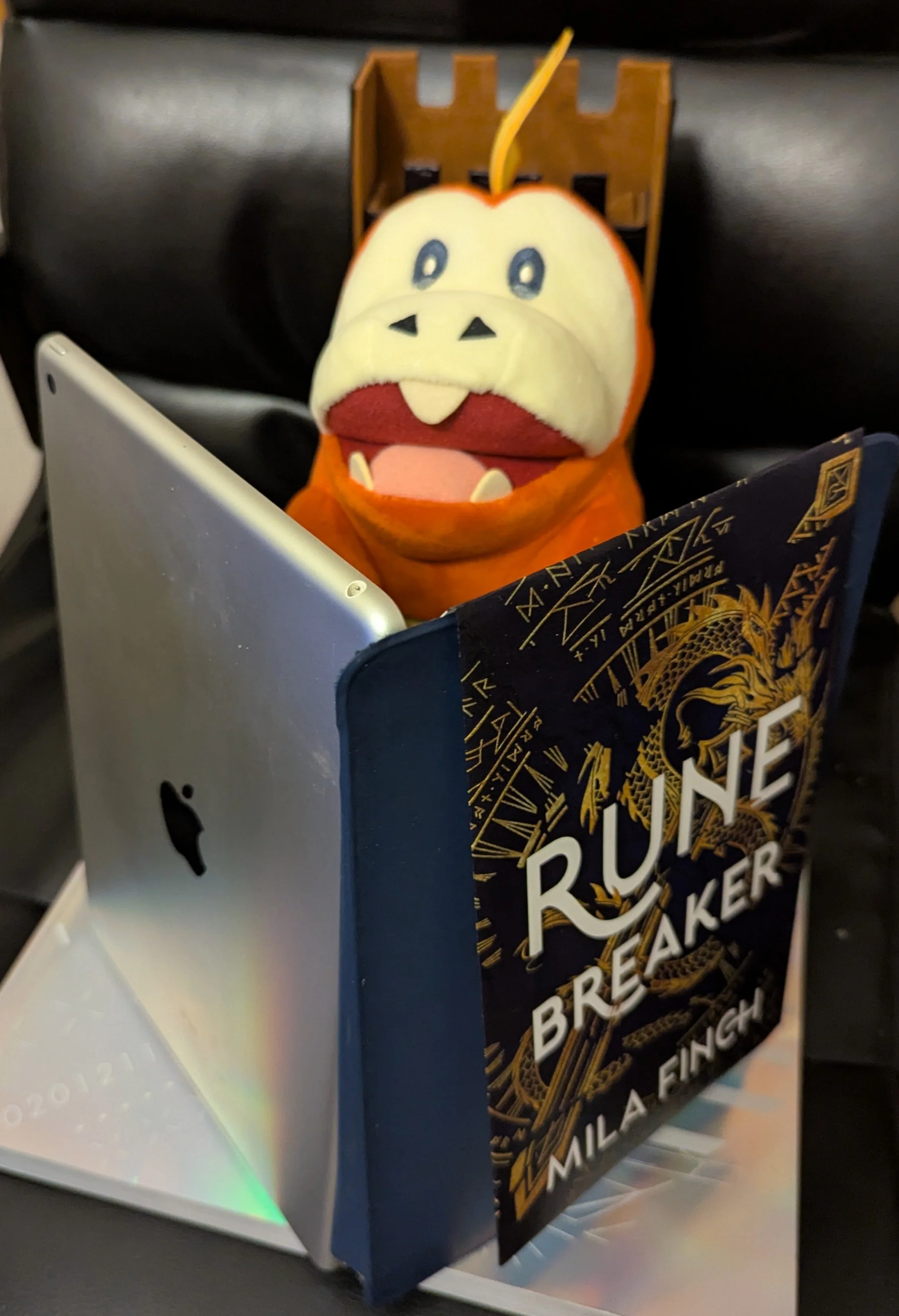
Hello, all. Welcome to the review of Runebreaker, an indie Romantasy by Mila Finch.
We’ve now reached the portion of the review where we start getting into the contradictions that led me to the conclusion that this book is effectively illegible. If you’d like to see an overview of the book, the breakdown of the romance, or the analysis of the power fantasy, please see the previous parts.
Let’s break some bonds.
STATS
Title: Runebreaker
Series: [Untitled Trilogy] (Book 1)
Author(s): Mila Finch
Genre: Fantasy (Romantasy)
First Printing: January 2026
Publisher: Self-published to Amazon
Rating: 0.5/10
SPOILER WARNING
Throughout this review, there will be mild, unmarked spoilers for Runebreaker. I will do my best to keep the first paragraph of each section as spoiler-free as possible. Heavy spoilers will be confined to clearly marked sections.
WORLDBUILDING
The worldbuilding of Runebreaker is a mixed bag.
While the first sign of the Author’s Assumption and/or outright contradictions was in the introduction of Vaeris as a source of heartbreak for Aelie, it’s the worldbuilding where the contradictions started to snowball. A lot of lore (either exposited or implied) seems to exist to wring out specific emotions in one scene. If contradictory lore serves the emotions of another scene, it’s just slapped in, and the audience is just expected to ignore it.
Contrasting this is the fact that there are some strong ideas. The broad strokes of the magic system make sense and are easy to follow. The hierarchical structure of the world flows naturally from the advantages provided by magical power. The ability that could have made Aelie into a Mary Sue instead feels like an extension of the magic system, especially once we get a better explanation of her origins.
All this is to say that I really do wish that this was a section where I could just give praise. It’s just that the problems are too severe to ignore.
To start things off, we’re going to discuss just the magic system and the dragons of this setting. The discussion of the fae is a whole can of worms on its own, so we’ll save them for next week.
Rune Magic
Most of the magic in this setting takes the form of runes. These runes have two key aspects:
They are formed of lines of power. If enough if these lines are broken, the rune will partially or completely unravel.
They are fueled by magical energy sources. This almost always means blood, though “spirits” (a concept that is never elaborated upon) can also be bound into a rune to power it. All blood is not equal, with humans apparently being the least magical blood can be while still being viable (since we hear about humans being sacrificed en masse to avoid spilling fae blood, yet nothing about animal sacrifices). Some runes are so powerful that only dragon blood could fuel them.
Soft Magic
Theoretically, this is a hard magic system, with Aelie studying tomes detailing how specific runes are drawn, the blood they need, and their effects. In practice, though, this is soft magic. Runes do whatever Finch needs them to do for the plot to progress.
That said, most of Finch’s applications of runes are consistent.
Stationary runes to achieve area-based magical effects can be scribed into a surface. These will last so long as blood is applied to refuel them.
Fae can tattoo runes onto their bodies to grant themselves magical abilities, with the runes drawing power from their blood. It’s also possible to bind a spirit into a body to fuel runes that fae blood alone couldn’t sustain. This is why Kairos is so insanely powerful. Not only is he tattooed all over with runes, but the spirit within him provides a massive amount of energy.
Magical oaths manifest as runes on the bodies of those who swore those oaths. The magical threads insinuate themselves into the organs of the marked individuals. Breaking the oath causes these threads to damage the flesh, as if from a severe infection. I think these are also powered by the blood of the person in question, though this is not explicitly stated.
Breaking and Amplifying
Aelie, the titular breaker of runes, has the ability to sense the power bound up in a rune and to snip the magical threads. This usually produces magical backlash that burns her. Dragon hide gloves helps protect against this to some extent, but this seems to be a limited protection, as more powerful runes continue to harm Aelie even with the gloves on.
Rheya, by contrast, has the power to amplify runes. This is framed as her forcing a rune to draw more heavily upon its stored power until the magic either explodes out of the rune or is used up. This element doesn’t get a lot of exploration in the book, though it does play into the climax.
Contradiction (Heavy Spoilers)
While the rune magic has a lot of promise, it is not immune to contradicting itself because Finch wanted to force certain emotions.
As we’ll get into when discussing the plot, Aelie blackmails Vaeris into swearing an oath to her. We’ll discuss the oath itself later. For now, the important detail is that Aelie cannot use her powers to break it. We’re told that the threads of the oath are too tightly wound around her organs for her to survive such an effort.
The hand of the author is pretty visible here. Kairos is also bound by an oath, yet the inciting incident is Aelie breaking his oath, something that somehow causes him zero harm. (No, the fact the rune is on a gauntlet rather than his flesh does not fix this. If the oath was not insinuated into his organs, how was he compelled to obey it in the first race?). Still, if we treat Kairos as a special circumference, the lore holds up …
… until we get to the last chapter.
Vaeris uses the oath to force Aelie to break her mated bond with Kairos. She subverts this by snipping only the magical thread that sustains her telepathic link to Karos, without the bond as a whole unraveling. It is made explicitly clear the Aelie does this deliberately, to avoid properly breaking the bond.
This opens two plot holes.
If the mated bond is still intact after snipping that one thread, then Aelie has not fulfilled the conditions of the oath. It was established earlier that Vaeris controls the interpretation of the oath. He wants the whole bond gone, and he gave Aelie the absolute instruction to, “‘Break the mated bond. Now.’” So unless cutting that one threa caused the whole bond to unravel, the oath should have punished Aelie for disobedience until she cut enough threads to finish the job.
The mated bond threads are burrowed into Aelie, just like her oath to Vaeris. We are explicitly told, via telepathy with Kairos, that cutting the wrong thread will “kill” both of Aelie and himself. (Maybe this was just flowery prose, but in that case, the confusion about that point still makes it a poor choice of words by Finch.) So if this does work, why couldn’t Aelie have also disabled the oath by cutting a single thread? Surely, if she can selectively cut threads that won’t threaten her life in this case, she could do the same to the oath to nullify (or, at least, diminish) her obligations to Vaeris.
This may seem like a small thing, but Finch has made it so that it’s not. She needed oaths to be overwhelming and unbreakable for most of the book so that she could threaten Aelie’s life and frame Vaeris as a villain. Now that she wants Aelie to outsmart him and keep the mated bond, oaths are easily subverted, and magical threads curled through her body can be selectively cut without endangering her life. It wouldn’t have been impossible to reconcile these contradictions, but the information needed to accomplish this was not provided in the text.
Dragons (Heavy Spoilers)
We’ve covered these fellows in the Show Don’t Tell discussion. I also need to save the discussion of the most significant contradictions here the breakdown of plot. For now, I’m just going to provide the details here that are relevant to understanding the worldbuilding issues.
Dragons are the supreme magical beings of this setting. Unlike fae, who need to use runes, dragons can freely wield magic, to the point that they can level or rebuild cities with the wave of a hand. They can also shapeshift. This last feature allowed them to produce half-dragon bloodlines, know as Speakers, who serve as interpreters for the dragons to the fae and humans. Aelie and Rheya gained their magical powers by being members of a forgotten Speaker bloodline. Two thousand years prior to the start of the story, the fae overthrew the dragons and used a pair of powerful runes to imprison the dragons into another universe. Breaking both runes will allow the dragons to return and reclaim dominion over the world.
I like the idea of the dragons as this power lurking in the background. I think that they are a good way to escalate the stakes as the story progresses. When Finch reveals them and changes the focus of the narrative to, “The dragons will destroy the world if they are released,” it feels like a natural evolution from a personal conflict to an apocalyptic threat.
However, this reveal also justifies the Rite (the annual sacrifice of human lives in Aelie’s hometown of Skalgard). As we’ll get into more next week, the Rite was initially introduced as an act of oppression by the fae who rule Skalgard. It is meant to be seen as an unambiguously evil thing. The reveal of the dragons also means revealing that the Rite is actually intended to keep this apocalyptic threat sealed. In other words, by sacrificing a handful of humans each year (all either criminals or volunteers whose families are compensated with years of free food for their sacrifice), the fae kept the dragons from destroying civilization - an outcome that we are meant to agree with preventing - yet are somehow still the bad guys.
I’ll leave this here for now. The nonsense around the imprisonment (and liberation) of the dragons is what properly killed this book, and thus, will need to await a full dissection until we discuss the plot. Let’s just leave off on the note that Finch justified Skaldir’s practices, but kept insisting to us that Skaldir is still the bad guys, without giving us any lore to explain what the alternatives were.
THE GRIM DARKNESS OF A ROMANTASY UNIVERSE
I wish that the contradictions covered so far were the only ones to consider in this setting , but there are more to consider before we can even get to the characters.
On Sunday, April 19th, we’ll get into the worldbuilding of the fae for this setting. Finch introduces some interesting concepts with this. Unfortunately, this desire to have things both ways, to have the lore be whatever it needs to be for the scene at hand, ended shooting this narrative in the foot. Fundamental elements that support this book’s axis of morality simply do not hold up under any scrutiny. Maybe they could have endured if Finch gave us more information to work with, but she didn’t. The information she chooses to share ends up undermining important emotional beats.
Thank you all for stopping by. Please subscribe and share if you enjoyed what you read here. Take care, everyone, and enjoy the rest of your week.

Volume I of my first serialized Romantasy novel, A Chime for These Hallowed Bones, is now available!
Kabarāhira is a city of necromancers, and among these necromancers, none are more honorable or respected than Master Japjot Baig. Yadleen has worked under him since she was a girl, learning how commune with bhūtas and how to bind these ancient spirits into wights. Her orderly world is disrupted, however, when a stranger appears with the skeleton of a dishonored woman, demanding that her master fabricate a wight for him.
To protect her master from scandal, Yadleen must take it upon herself to meet this stranger’s demands. Manipulating the dead is within her power, but can honor survive in the face of a man who has none?
Come for slow-burn tension, and Enemies-to-Lovers dynamic, and bone-based engineering! I hope to see you there. Volume II is in development!