Defining Clean Fiction
Hello, all. I hope your week is going well.
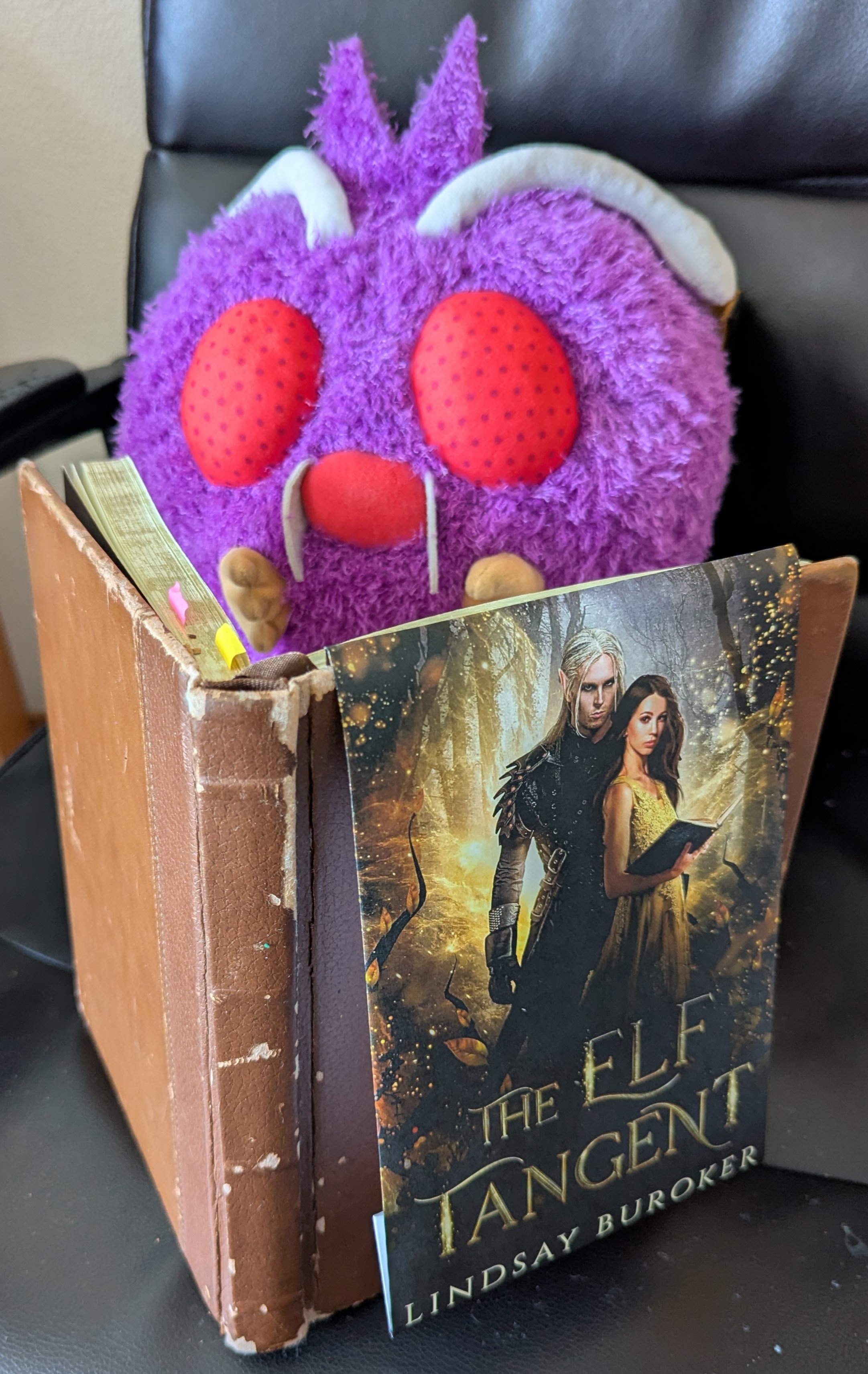
Back in January, Lindsay Buroker posted a Tweet about a sale on one of her backlog titles, The Elf Tangent.
If you shop for audiobooks on Chirp, The Elf Tangent is only 99 cents there for the next couple of weeks. It's a clean romantic fantasy adventure. :)
After reading multiple Romantasies where the main pairing’s relationship was nothing but a pretense for pornography, I was looking forward to one where there was an actual relatoinship. Reading Magnetic Magic taught me that Buroker can absolutely write a couple with meaningful chemistry and reasons to be drawn to each other outside of sex. I was looking forward to seeing what she could do when sex was completely taken off the table.
I didn’t get around to actually reading The Elf Tangent until April. Around that time, discourse about “clean” fiction picked up on Substack and Threads. From what I can tell, the discourse has been split between authors / readers celebrating and promoting clean fiction and people complaining about the very concept of “clean” fiction as something limiting and / or stigmatizing. (Perhaps there is more to this discussion. I see only what my algorithm shows me.)
Then, right at the tail end of April, Substack user B. D. Bradley posted this question.
Does Romantasy require sex scenes? I guess that'd be “clean” Romantasy? But if it still has bad language, violence and all kinds of mature situations, it can't be clean…
I provided an initial response in the comments section of that post. In the weeks since then, I found myself thinking more about the question of what “clean” actually means.
As I see it, there are three situations in which “clean” can be used to describe fiction. Bradley mentioned two of them. These definitions are all equally valid, merely being applied in different contexts … and yet, none are valid without their respective contexts. This understandably causes writers, readers, and reviewers alike a lot of confusion.
I don’t think the situation is so bad as to render the term “clean” useless. It’s just that we really do need to take a moment to acknowledge what the definitions are, in what context each applies, and why they are being used today.
Let’s get into it.
GROUNDWORK
The Foundational Question
To start with, we need to understand what, exactly, is being implied by “clean”.
One of the synonyms of “clean” is “pure”. This is a serviceable definition. Many people advocating for “clean” fiction do so on religious (or, at the very least, spiritual) grounds. However, as pointed out by some commentators who have complained about the “clean” label, setting purity as the goal would at least imply that many dark, mature topics would be off-limits, which would in turn be counterproductive for writing about certain topics related to religion or spirituality.
Better synonyms to use would instead by “orderly”, “simple”, or “laundered” … or “trim”. In other words: the real meaning of “clean” is “without excess.”
Bradley listed the following things as potentially being in opposition to a “clean” story.
Sex
Bad language
Violence
Mature situations
The first three items on this list are all elements that are often used in excess (or, in the case of sex scenes, are often excessive by nature), particularly to make a work of fiction seem more mature. Sometimes, these elements are the justification for claiming the work is mature. Other times, “mature” is just an excuse to have the excess. To name a few easy examples:
We’ve been over the vomitous swearing, sudden violence and bloodshed for the sake of implying that danger exists, and pornographic sex that is pervasive throughout The Empyrean.
Excessive violence and gore are often used in Warhammer 40K to feed into its grimdark aesthetic.
The New Adult genre, as it stands today, is often defined as too mature for Young Adult because it has sex and swearing, rather than because the writing is actually more complex than what the YA demographic could handle.
Premium cable shows have sometimes gone out of their way to feature sex and nudity as a demonstration of them not having restrictions on mature content, to the point that A Game of Thrones added in at least one sex scene that wasn’t in the books.
Who can forget the many Unrated movies of the mid-2000s that reveled in the ability to cram in all the sex, swearing, and violence that had to be cut out of theatrical cuts.
There are other things we could potentially add to this list of excesses. Drugs and alcohol are an obvious one. In our modern era of hyperstimulation, an argument could potentially be made that needless spectacle could also get caught in this net.
However, the focus should always be not on the things themselves. We should instead consider how they are applied.
That’s why mature situations don’t inherently belong on the list, and why “clean” fiction and mature content are not mutually exclusive. The objective reality of sex can exist in a story without graphic sex scenes. Serious and adult discussions can be had without swearing, and if swearing does serve a purpose, then it doesn't need to be a situation where every character swears profusely. Violent altercations don’t necessitate comical amounts of blood and gore.
In fact, the only situation where mature situations are arguably incompatible with “clean” fiction is when content is written for children. The point of calling children’s content clean is to say that it is “sanitized” - that is to say, unable to expose a vulnerable, impressionable mind to certain elements or topics before said child’s parents decide he or she is ready for them. Even this feels like an overgeneralization. Plenty of children’s stories deal with very mature subject matter; the portrayal is simply crafted in a way that is appropriate to the age group. We’ll be reviewing The Icebound Land, the third book of The Ranger’s Apprentice, in late summer, and that book includes both slavery facilitated by drug addiction and nods to young women working as prostitutes. It’s just these things are delivered in a way that makes them inoffensive for consumption for young readers.
Meaningless Without Context
It’s not often that children’s media is described as “clean”. That sort of thing usually (or, at least, used to be) implied by virtue of being children’s media. The same could be said for YA. Limits in these genres are generally understood and not tested, because said content is written for vulnerable, impressionable youths.
At least, that is how it used to be. These days … well, allegedly, there are now cases of parents bringing books from their child's school library to board meetings, reading aloud from said books, and getting told by the school board that the content is too sexually explicit to be read aloud at a professional meeting of adults. And it’s common knowledge that Young Adult is seeing an invasion of graphic sexual content.
What I’m getting at here is that calling something “clean” is meaningless unless there is excess to be contrasted against. It used to be that calling a child’s story “clean” meant nothing. Now, the English-speaking West may be approaching a state where a contrast can be found.
Moving away from that insanity to broader application, calling a work “clean” only matters if there are excesses in the contemporary market to contrast against. By extension, this means that the precise meaning of “clean” is dependent on the context in which it is applied. This is the key factor that needs to be kept in mind, both so that the word is applied correctly and so that people understand what is meant in any particular situation.
So, with that groundwork laid … let’s get into it.
DEFINITIONS
(1) Child-Appropriate
We already started on this one, so let’s tie up the lose ends first.
I originally didn’t think I would need to include this particular definition at all. A basic understanding of target demographics should make children's media and YA inherently clean. However, after thinking about recent backlash from some parents in the English-speaking West towards modern media, plus the general complaint that something being “clean" prohibits mature subject matter, we do need to at least acknowledge this, just in case it starts to be used in the near future.
What exactly is “clean” in children’s media and YA is particularly context-heavy. This is because a child’s brain is rapidly developing, and the impact of different elements upon him or her will vary wildly on the current state of the brain and on what concepts or experiences he or she has had the opportunity to be influenced by. However, it is generally accepted that picture books and Middle Grade works shouldn’t have sex, may have only the most mild or euphemistic swearing, and should keep violence limited and bloodless. These elements are permitted gradually as one transitions to YA, but even then, it is supposed to be a gradual increase. YA is not supposed to be a magical line where we drop children into pornography.
The key point, though, is that the child does not set these definitions. Parents (and legal guardians) do. This is where the so-called “book bans” that are so popular to virtue signal about began. Parents found out their children’s school libraries were providing children with sexual or highly politicized content without the parents’ permission, thereby forcing (or, worse, bypassing) discussions that should have happened when the parents thought the child was ready. The parents then pushed to have those books removed from the school libraries (not outlawed, just moved out of the reach of children who were in an environment where the parents could not supervise them). They had trusted the schools to provide “clean" fiction. When the schools let them down, they pushed lawmakers to make these learning space clean again.
(My intention here is not to make any actual statement about the so-called “book bans”. That is a separate topic. I am merely pointing out that it used to be that we could assume content was “clean” if it was marketed as children’s fiction or placed in a school library, and that the mess in question began when parents realized that was no longer the case.)
So, if you start to hear “clean" applied to children’s fiction, it should be taken to mean that said fiction is something that a reliable majority of parents within the market in question would be fine with exposing their children to without direct parental oversight.
(2) No Pornography
Bringing this back to Bradley’s original question:
Does Romantasy require sex scenes? I guess that'd be “clean” Romantasy?
Yes, that would indeed be “clean" Romantasy (or, to speak more generally, “clean” Romance).
We live in an era where fiction - particularly Romance - not only embraces pornographic sexual content but is actively marketed and sought out for it. That is what “spice” means. “Low-spice” is softcore porn. “High-spice” is hardcore porn. More chili pepper emojis means more graphic content.
And, look, I get that my insistence on referring to “spice” as pornography may ruffle some feathers … yet that is, objectively, what it is. The sexual content that has become so common in modern literature isn't just suggestive. It isn’t just erotic. It is, in every qualitative way, the exact same thing as the written pornography circulating in the sewage pipes of the Internet (particularly in forums and pornographic websites that cater to women specifically). Even the comments sections of these pages read the same as discussions of “spicy” books on social media. All that's changed is that, instead of being short form fiction that stands on its own, this content has been sandwiched inside hundreds of pages of other content (only to be re-exposed as a means to market said content). That’s why I have zero scruples about calling it pornography. A change in market and heaps of filler does not qualitatively change what the product is, just in the same way that merely changing the medium of a pornographic story from film to written work doesn’t make that story non-pornographic.
I was going to point out that we used to refer to such explicit sexual content by the euphemism “dirty”. “Clean” makes sense as a contrast to that. Any confusion about the use of “clean” is purely due to an effort to move goalposts and pretend that porn in literature is different from the free porn that can be found with a quick Google search.
… at least, I was going to say that, but using “dirty” as a euphemism is still very much a thing today. It is even used positively, by people who want that content. While I was still drafting this article, I saw someone on Threads use “dirty” in precisely that positive context. Using “clean” in this way is therefore absolutely valid even in the modern era.
In other words, if applied in an environment where pornographic content is normalized, “clean" very obviously refers to just the absence of pornography. Not the objective reality of sex, mind (as we will get into with The Elf Tangent). Just the excess of the manner in which that narrative information is relayed to the audience.
(3) Create In Me A Clean Heart
The final usage of “clean” that I have been seeing is the one that comes close to just meaning “pure”. It is about telling stories that trim the excesses in a more general sense. This is what some Substackers, like Elliot Kessler and Emily Ackerman, build their platforms upon.
Writers and readers seeking this definition of “clean" are looking for work that is, in a word, disciplined. After all, the objective reality of something in a work does not necessitate excesses in the portrayal, so why show the excesses to the audience in the first place? Drop the pornography, cut back the swearing, and limit the violence to what is truly necessary to tell the story.
Kessler actually did a nice article on May 7th about this definition of “clean”. My takeaway from it was, “You are what you eat” - that is to say, that people like Kessler want to create and consume entertainment that is enjoyable without undermining personal discipline through needless exposure to excess. I reached out to Kessler about this interpretation, and he was agreeable to it, further adding:
Our input directly affects our output, and so we need to be very careful about what we put into our minds, as it isn’t always good.
Because of how broad this particular definition of “clean” is, it's the hardest target to hit. This understandably causes confusion for anyone thinking they need to work around it. For example, John Wick is “clean" in terms of not having pornography, but the spectacle of it relies of violence that is often gory, so it's hard to argue that there’s no excess at all. Many indie dramas are free of violence, yet they drop significant profanities, justifying this decision with arguments along the lines of, “Well, real people do talk like this.” These dramas will also often throw in sex and nudity that offers nothing at all to the story. “Clean” fiction is a very hard target to hit if the writer is committed to a portrayal that deals in excesses.
Still, purely in terms of definitions, this is pretty simple. If “clean” is used in an environment where no other definitions take precedence, it can safely be assumed that this is the intended one.
BACKLASH
It seems that there are quite a few people who are not happy that “clean” is a concept that can be used to market fiction. I have personally seen two camps on this, which are specific to Definitions (2) and (3).
Opposition to Definition (3)
There are people are who are understandably frustrated that their work will miss out on this “clean" accolade. The following list is not an all-inclusive list of concerns, but I think it hits the highlights.
Writers don’t want to be restricted in how they tell their stories.
They feel the line that delineates “clean” fiction is too amorphous.
They don't want to get lumped in with far more graphic works over, say, a little gore, a few swear words, or the objective reality of sex taking place.
Fully responding to the first point is a completely different subject that is already being covered by Kessler and others pushing for “clean” fiction. I hope this article will address the second point. As for the third … well, it really is a matter of giving the people what they want. There is an audience for “clean” fiction. No one has to write for that specific audience. Sometimes, to tell a story true to the writer’s vision for it, the writer needs to accept that readers will be lost. Every Romance or Romantasy writer who markets a “clean" story accepts the loss of the “spice” market. That sacrifice goes both ways.
Opposition to Definition (2)
I don’t have a lot of respect for this particular objection. Not even because of my feelings about pornography - I just find this objection to be inherently hypocritical. Still, I understand where people are coming from when they make this particular complaint.
The opposition to “clean” in the sense of “no pornography” boils down to implied stigma. After all, if “clean” is the antithesis of sex, the implication is that sex is “dirty”. As one commentor on Threads put it, “clean” feels like a relic of “purity culture”. Another commentor on Threads proposed that we instead refer to “clean" Romance as “sweet” Romance; many others prefer just to use the term “no spice” instead of “clean.”
I get that. It can be frustrating when someone setting themselves in contrast to you claims to hold some virtue, and then turns around and uses that claim to accuse you (implicitly or explicitly) of lacking virtue. I can also somewhat understand the use of “sweet” or “no spice” as matter of getting everyone on the same page in terms of words used.
However … when once considers the bigger picture, complaining about “clean” for casting stigma onto “spice” is an objection without much of a leg to stand on.
As stated above, “dirty” is still used as a positive euphemism for this material, so referring to the contrasting material by a positive term should be equally acceptable.
The same complaints about implied stigma can be made for the “spice” euphemism. Spice means flavor, so the absence of spice equates to blander fare; spice requires a certain constitution, so those unwilling to consume spice are implied to be weak; children don’t typically start out with a high spice tolerance, so “spice” implies work for adults while the absence implies a work is for children. If we’re going to complain about “clean” having negative implications for works (and their readers) that aren’t “clean”, then “spice” is no less problematic.
If the pornographic content in Romance is not the antithesis of “clean” … why not just call it what it is? Drop the euphemisms. No more “spice”, not more “dirty” - just call it porn. Market Fourth Wing as a pornographic work. Ask for recommendations based on the presence of softcore or hardcore porn. By this same logic of implied stigma, pretending that “spice” is different from any other pornography implies that the consumption of this other pornography (and the people who consume it) is qualitatively lesser. At least “clean” delineates a meaningful contrast. “Spice” is just putting lipstick on a pig and then pretending that pig is above the other animals.
In the end, the use of the word “spice” is about manipulating perception. It is about swerving around the stigma associated with pornography while publicly celebrating the indulgence. The use of the word “clean” undermines the narrative. Protesting the use of “clean” in a world of “spice” is purely about controlling language.
If fans of pornographic literature want to play word games to euphemize their excesses, no one can stop them. Likewise, they can’t stop the rest of us from choosing words of our own. Either every niche audience gets to call their favored fiction what they like, or else we should stop with all the euphemisms and refer to things as what they are. That is what is most fair for everyone.
FINAL THOUGHTS ON THE DEFINTION OF CLEAN FICTION
Clean fiction is not so much a genre as a content warning or vibe. Similar to “dark” or “grimdark”, it can be applied to a lot of different fiction. Some people will seek it out. Others will avoid it.
Either way, it is a perfectly valid way to describe and market fiction, even with its context-dependent definitions. One just needs to be mindful of the context in which it is used.
Going forward, I don’t intend to make a habit of commenting on whether or not fiction qualifies as clean fiction. I trust you all to gauge that for yourselves from my content warnings. That being said, if a work is specifically marketed as being clean, I will assess if that label is earned. The assessment will probably be folded into discussions of genre, the target audience, and / or the content warning, depending upon what else needs to be discussed for a particular book.
And that is exactly what we will do next Wednesday, to kick off our first review of a clean Romantasy. I hope you’ll all join me for it.
Thank you all for stopping by. Please subscribe and share if you enjoyed what you read here. Take care, everyone, and enjoy the rest of your week.