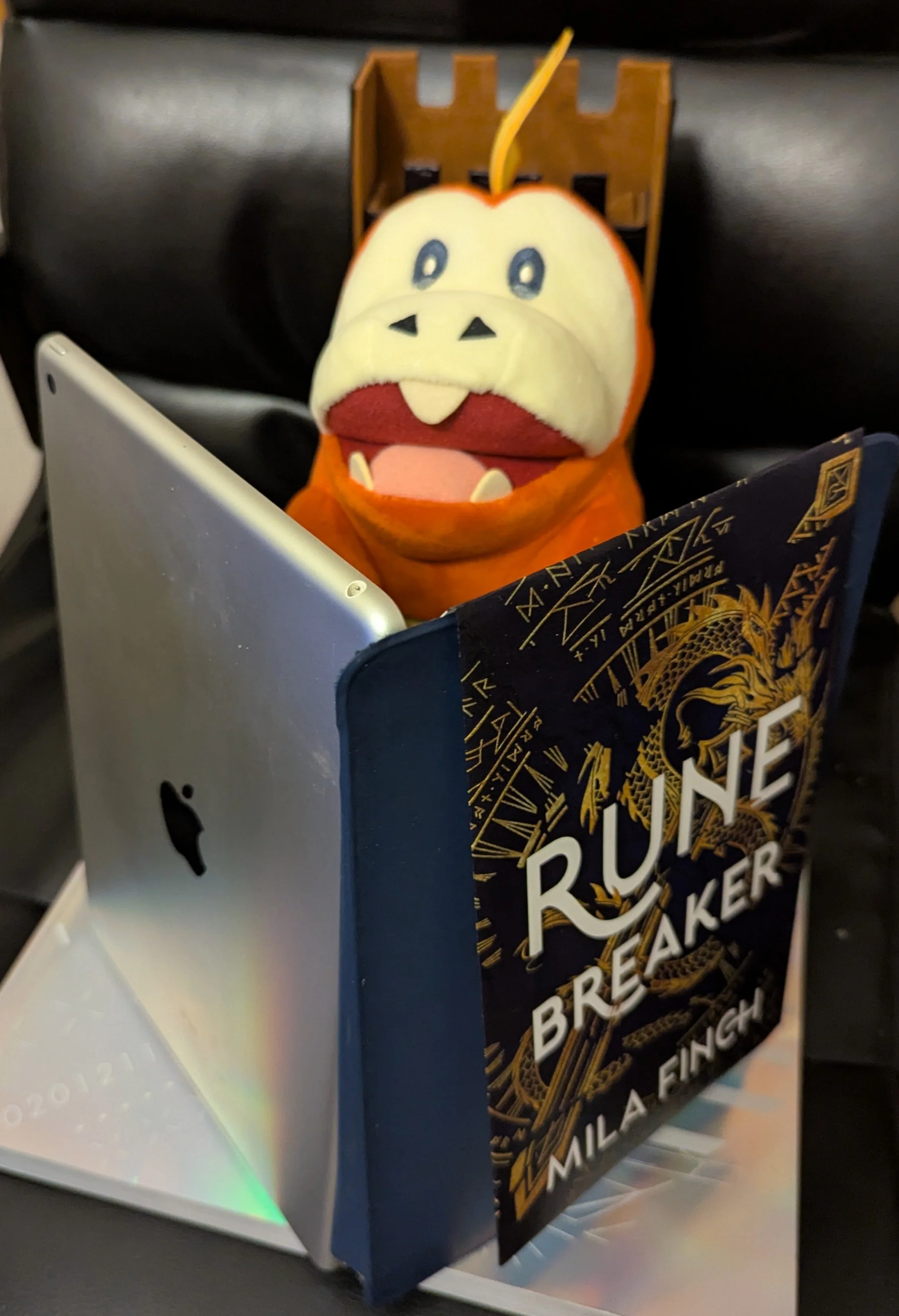
Runebreaker (Part 12 - Retrospective)
Hello, all. Welcome back to the final retrospective of the review for Runebreaker, an indie Romantasy by Mila Finch.
In this part, we’re going to be summarizing the issues with this book and trying to understand how they might have come about. This will include a combination of speculation and of insights extracted from a cursory exploration of Finch’s Instagram and TikTok (both of which she provided links for in her About section at the back of the book). The purpose of bringing in these outside sources will solely be to better understand what is actually in the page.
Let’s break some bonds.
STATS
Title: Runebreaker
Series: [Untitled Trilogy] (Book 1)
Author(s): Mila Finch
Genre: Fantasy (Romantasy)
First Printing: January 2026
Publisher: Self-published to Amazon
Rating: 0.5/10
SPOILER WARNING
Throughout this party, there will be heavy, unmarked spoilers for the entirety of Runebreaker.
ABOUT THE AUTHOR
I’m going to just post the entirety of the About section of the novel (sans contact details) here so that Finch can speak for herself.
Mila Finch writes dark romantasy where morally grey characters make terrible decisions, magic breaks the world, and mating bonds complicate everything.
When she's not writing about feral book boyfriends, she's reading about them. Based in the Pacific Northwest, she survives on coffee, rain-soaked inspiration, and the unshakeable belief that enemies-to-lovers is the superior trope.
This same narrative appears in her website, Amazon bio, TikTok, and Instagram. (If she has a Twitter or BlueSky, it isn’t under the name “Mila Finch”.) All of her Instagram posts and TikTok videos are promotional material for Runebreaker, and with the exception of a single Tiktok put out in August 2024, she didn’t post anything prior to November 2025.
Curiously, despite this being an indie book, Finch claims that she is represented by the WME Agency. I couldn’t find anything from WME to independently confirm this. Given how prestigious WME is, I’m a bit surprised that they haven’t at least promoted Runebreaker on their own Instagram page, but maybe this is a recent development that happened after the book already released. I’ve reached out to WME directly to see if they could clarify this situation. (Thus far, I have not heard back from them one way or the other.)
What This Tells Us
The only reason to bring up the author when discussing the art is if something about the author can shed light on a decision or pattern within the art. What, then, does this limited information tell us about Runebreaker.
Not a lot. At most, it would seem to indicate that Finch is indeed dedicated to her novel and passionate about the genre she writes in. This doesn’t seem like someone who is just pumping out a book for attention, fame, or wealth. She really does seem to be someone telling a story she is invested in.
This is a good thing, I think. Yes, it means Finch isn’t handing us an easy answer to explain the patterns in this book, but it would also suggest that Finch is every bit as dedicated to her craft as CJ Van or Lindsay Buroker. This book doesn’t fail because the author doesn’t care about her audience. Furthermore, that means there’s hope for Finch to learn and grow as a writer in the future, provided that enough other reviewers (or simply someone whose opinion Finch trusts) calls out these same problems.
RETROSPECTIVE
The Core Issues
No Substance
I’ve stated a few times that this book is nothing but a checklist of tropes, yet I want to emphasize that this does not inherently make it bad. You can tell stories that are checklists of tropes and still have those stories be good. The Inheritance Cycle was overflowing with tropes and derivative elements, but Paolini still managed to produce a satisfying narrative from those tropes.
The problem with this book is that it doesn’t go any deeper than the tropes. This is a story about … actually, what did Finch say about herself again?
Mila Finch writes dark romantasy where morally grey characters make terrible decisions, magic breaks the world, and mating bonds complicate everything.
Yeah. That’s all there is to this book. The characters are “morally grey”. (They’re actually just evil, but that’s because they’re badly written. It’s clear what the objective was.) The magic does indeed break the world. The mating bond was a needless complication, yet it did indeed exist.
Behind that, the characters are barely characters. The world breaks even without Aelie’s magical power. The mated bond is just one of the needless things to complicate this plot.
This is a book marketed on tropes because it offers nothing outside of tropes. This is the antithesis of Paolini’s derivative storytelling. This is not a story that can stand on its own unless you are fully engaged with the tropes and the tropes alone. If you buy this book, you are here to snort Shadow Daddy smut the way that fans of The Empyrean snort power fantasy. Joke’s on you if you expect more.
Because the Author Says So
On the matter of the overcomplicated plot and broken worldbuilding, this story is driven by Finch needing things in the moment. No thought is put into how the things she says in different scenes interact with each other. Character motivations are discarded and reclaimed, accountability is forgotten, worldbuilding details are swept under the rug or outright contradicted, and the axis of morality whips in whatever direction is needed to assert that Aelie is always the hero while her opposition are always the villains.
This could be a matter of the Author’s Assumption. Maybe there’s a way this all makes sense to Finch. The problem is that she did not successfully communicate those critical details to tie everything together. As a result, ideas that could potentially tied together in a nuanced way, producing characters who are actually morally grey, just come across like Finch never bothered with continuity edits.
Patterns and Theories
With the limited information that is available about Finch, I have two potential theories for how this all went wrong. I personally lean towards the first one. However, I feel I should at least acknowledge the second.
Theory #1: No One Is Seeing the Problems / No One Cares
This one is really two theories in one, and it goes back to the issue of the book being marketed on tropes.
It is entirely possible that Finch’s entire focus is on writing to tropes she likes, and thus, she’s not thinking about the story any deeper than that. Likewise, if she is writing for an audience that also prioritizes the tropes over narrative quality, maybe no one has cared enough to point out to her that the story does not work if you think beyond the tropes.
Furthermore, we live in an era when writing for BookTok, where a book can be financially successful and build an audience based off nothing but tropes and vibes, has become normalized. It’s entirely possible that Finch is aware that the writing is subpar and/or that she has gotten feedback to point out these problems, yet she simply doesn’t care. She’s got her target audience figured out, and thus, it’s entirely possible that she’s not bothering to put in the effort to do more than to check off trope boxes.
This doesn’t contradict the idea that Finch is passionate about her work. It just means her passion is on the tropes, rather than the writing. It means she loves stories with certain elements, rather than stories that are good in a more general sense.
I’d like to be wrong about this, because if this is indeed the case, it’s highly unlikely that Finch’s writing will ever improve. Not in the next book, at least, and probably not even within the timeframe of this series. She’s going to get constant validation from her target audience to encourage her to keep producing slop. I wouldn’t go so far as to call this toxic positivity (after all, there’s no evidence that I could find of her lashing out at critics), but it’s not conducive to personal growth.
Now, obviously, Finch isn’t doing anything wrong as a writer if she’s writing with a target audience in mind and satisfying that target audience. It’s just a reminder that success does not equal quality. Finch is just the latest example of an author who finds success while writing bad books.
Theory #2: Generative A.I.
To preface this part, I want to emphasize that I do NOT assume that generative A.I. wrote this book, either in whole or in part. I have no evidence that this was the case, nor do I have the expertise to make such a judgment. Let’s not jump to the conclusion that this theory is correct without actual evidence of it.
With that being said … this book absolutely reads like it was written by A.I., and if that is indeed the case, it would explain virtually every flaw in the book.
It is my understanding that, at this stage its development, generative A.I. struggles with maintaining continuity of anything that isn’t the main focus of the prompt. For example, I saw an A.I. generated video of an elephant falling off the back of a truck and rolling head-over-heels. The truck and all other vehicles on the road maintained continuity, but the elephant’s head and tail switched places midway through the roll
Applied to literature, I’ve been told that this phenomenon produces stories with inconsistent characterization and plots that veer in wild directions. This would explain so much about Runebreaker.
Worldbuilding that warps to whatever the scene demands, with zero effort to reconcile the lore, could come from an A.I. providing explanations for things without knowing to double-check for continuity.
An illogical reservoir in the middle of Skalgard, which manifests to facilitate one scene and then evaporates from the remainder of the story, could have been spawned by the A.I. to force a scene of peril and then forgotten in subsequent descriptions of the city.
Aelie’s relationship with Vaeris getting new lore constantly stacked on rather than taking time to earn emotional weight, plus the fact his villain reveal is treated as a shock even after all the effort put into emphasizing Aelie doesn’t trust him, could come from an A.I. that received a prompt about Aelie’s dynamic with Vaeris without any guidance on how to apply that to a character arc.
The radical reversal of the story's morality at the climax, without any acknowledgement that Aelie has embraced the means and motivation of the villain, could be from separate prompts (one for Aelie’s actions and one for Vaeris’s) that were applied to the text at different stages in the writing process.
All that setup of Aelie as a hero of oppressed humanity being forgotten once she changes locations makes sense if the A.I. was only told to treat this aspect of her character as a backstory.
Even Aelie’s static characterization - the endless hammering on the idea of her distrusting Vaeris and being unwilling to trust Kairos, her constantly playing the victim, her drive to help Rheya without doing anything to help Rheya - could be attributed to prompts that didn’t outline her and Kairos’s relationship beyond, “Mutual declaration of love after Sex Scene #3.”
Again - I am NOT saying that Runebreaker was written by generative A.I. Finch should be given the benefit of the doubt until actual evidence of her claiming credit for a machine’s work is uncovered. Just because generative A.I. exists, that doesn’t mean that we should default to that instead of chalking a book’s issues up to the failure of the author.
What I AM saying is that, much like Murtagh before it, a lot about Runebreaker would be very conveniently be explained if it turned out that the true origin of this book was an entity that didn’t understand any of the elements it was slapping onto the page.
SHATTERED CHAINS
Runebreaker is a terrible book. It has done nothing to improve my impressions of the Romantasy genre, which is rather unfortunate, given that I picked up this random Romantasy title with the hope of finding something redemptive. It’s a good example of how a successful release doesn’t equate to a book actually being a good book. I’m happy that Finch has found her audience, but that doesn’t mean the glaring flaws in this book suddenly don’t exist.
Finch has promised a sequel, tentatively titled in Bondbreaker. She apparently plans to release it sometime this fall. I don’t plan on reading it. If you all really want me to look at it and review it, by all means let me know. I simply don’t have any incentive to look at it beyond entertaining you all.
Thank you, everyone, for joining me for this review series. Please remember to subscribe and share if you enjoyed what you read here. Take care, everyone, and have a good week.