Penitent (The Bequin Trilogy, Book 2) (Part 1 - Overview)
Hello, all. Welcome back for another delve into the grim darkness of the 41st Millennium.
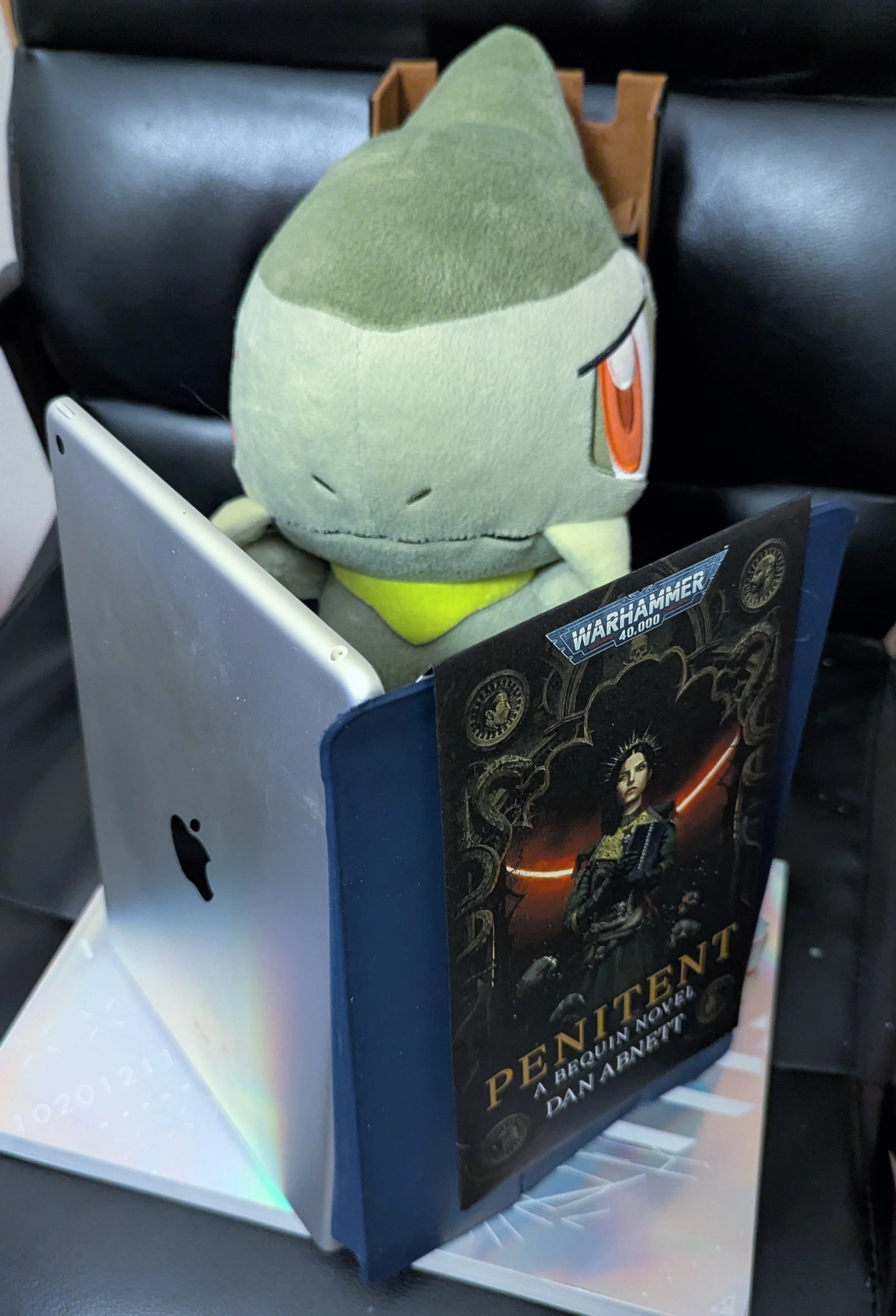
Today, we return to the Bequin Trilogy for the second book, Penintent. It’s a book that I was greatly looking forward to. While I will admit that the book we got didn’t quite live up to the expectations set by its predecessor, I do think it works both as a story on its own and as the middle entry of a trilogy. It’s a novel that adapts to the changing nature of the story being told without losing its distinctive voice.
Limiters off, everyone. There are heretics to hunt.
STATS
Title: Penitent
Series: The Bequin Trilogy, Book 2
Author(s): Dan Abnett
Genre: Science Fiction (Space Opera)
First Printing: February 2021
Publisher: Black Library (Games Workshop Publishing)
SPOILERS
Throughout this review, there will be mild, unmarked spoilers for the events of Penitent. I will keep the first paragraph of each section as spoiler-free as possible. Heavy spoilers will be confined to clearly marked sections.
There will be heavy, unmarked spoilers throughout the review for the events of all the Inquisitor content we have previously reviewed thus far, including the Eisenhorn and Ravenor novels, their associated short stories, and Pariah.
TERMINOLOGY
The Alizebeth Bequin in the story is not the same woman from Eisenhorn’s novels. This Bequin is her daughter (or, at least, a person engineered from the original Bequin’s genetic material). Within the narrative itself, Abnett establishes distance between the two characters as early as Chapter 1, with Bequin operating by the “affectionate contraction” of “Beta”. I’ll therefore be referring to this character as “Beta” throughout this review, while her mother will be referred to as “Alizebeth”.
TIMELINE
This book is harder to place in the timeline than any of the other Abnett novels. There’s no explicit statement of the date within the text that I can recall, and unlike Pariah, this book doesn’t show up on the timeline within the Eisenhorn omnibus. I can’t lock down a date with a great deal of certainty.
That said, it is acknowledged within the text that it’s only been a few months since the events of Pariah. Furthermore, there’s a point where a character refers to an event from the previous book as happening “last year”. I feel we can safely assume that this book is set in 501.M41.
STRUCTURE
This will be a 4-part review, divided up as follows:
Part 1 (Today)
Premise
Rating
Content Warning
Prose & Genre
Part 2 (July 24th)
Plot
Part 3 (July 31st)
Character
Part 4 (August 7th)
Worldbuilding
Fanservice
PREMISE
Per Amazon’s Kindle e-book product page, we have:
Book 2 in the Bequin series
Alizebeth Bequin's world has been turned upside-down. Now she must choose who she will follow as Inquisitors Eisenhorn and Ravenor battle to discover the secrets at the heart of Queen Mab.
READ IT BECAUSE
The latest chapter in Dan Abnett's Inquisition saga is here, and it's packed with shocking twists and stunning revelations that will change the way you look at the Warhammer 40,000 universe forever.
THE STORY
In the mysterious city of Queen Mab, the forces of light and darkness are locked in a murderous struggle for truth. The dedicated agents of the Holy Inquisition battle with their shadowy counterparts, the infamous Cognitae, to discover the encrypted identity of the enigmatic, all-powerful King in Yellow. Caught at the heart of this struggle is the pariah Alizebeth Bequin. Will she stand with the Inquisition or with the Cognitae that raised her? And if she chooses the Inquisition, will it be the wise but ruthless Ravenor or his rival, the denounced heretic Eisenhorn? Bequin must withstand an onslaught of angels, daemons, and even the monstrous warriors of the Traitor Legions, to unpick the greatest riddle of her life.
The beloved characters of Eisenhorn and Ravenor return, as implaccable adversaries in a novel of esoteric mystery, macabre intrigue, and vivid action, where the revelation of true identity could mean death… or might shake the Imperium to its very foundations.
Reaction
This is mostly accurate, and it inadvertently reflects what I feel to be one of the fundamental issues with this book.
A big deal is made here about how the information Bequin uncovers is regarding an existential threat to the Imperium … but it’s that the status quo? The Imperium of Man is always on the brink of extinction. Every single one of Eisenhorn’s novels, as well as the second and third Ravenor novels, has addressed a threat on this scale. I’m not saying that Abnett doesn’t put any effort into the story to earn this idea, but the effort he does make isn’t nearly enough to sell the idea that the threat that this time is the one that should truly scare us.
Aside from that, the emphasis put on Bequin unraveling her life and deciding the path to take is exaggerating. She has a few minor moments of inner conflict through the text, but never to the extent that it’s truly an obstacle for her. I’d actually argue that she has the opposite problem (and will do so when we analyze her character).
Beyond that, though, this premise is on the mark. This is a story about multiple factions fighting each other to either gain access to (or prevent others from accessing) the Yellow King. It’s a natural evolution upon elements established in the previous story.
RATING: 8/10
On the whole, Penitent is still an engaging story of entwined mysteries told through a rich narrative voice. It has fleshed-out characters with understandable motivations and perspectives and worldbuilding that expands upon existing ideas while still feeling like a natural part of the Warhammer 40K mythos. While Bequin is no longer tumbling about and struggling to keep her head above the water, there is still a sense of palpable struggle and danger as she attempts to navigate the complex clashes between different factions to achieve her objectives.
What holds this story back is this tangible sense that it’s having an identity crisis. This is the middle entry of a planned trilogy. There are many ways one can write such a story. To name just a few.
It can serve as a middle chapter is a story that was fully planned (or, at least, set up to be) a three-part saga ((i.e. The Empire Strikes Back). This often involves ending this middle ending on a Darkest Hour that the heroes will need to rise above in the finale.
It can take what was originally a standalone story (now the first installment) and introduce a conflict to be resolved in the third installment (i.e. The Matrix Reloaded). Again, there may be a Darkest Hour ending.
It can be a standalone sequel, telling its own narrative, with the designation of “trilogy” coming from a third story that either ties a nice bow on things or simply ends up being the last story made (i.e. Ocean’s Twelve).
The problem is that Penitent reads like it is trying to be all three at the same time. I don’t know if this is directly linked to the writer’s block that Abnett reportedly suffered from while writing it, a result of him taking so long to write it, or him trying to write a satisfying ending in case Games Workshop kills this trilogy entirely (remember, the company has put the series on hold). Whatever the reason, it feels like this story doesn’t entirely know what it wants to be. It feels like way too much is crammed into it and getting resolve at the same time.
I do still think this is a great book. If you enjoyed Pariah, you will probably enjoy this one. Just don’t be surprised if you end up feeling a bit confused at parts.
CONTENT WARNING
This story has the usual Abnett Warhammer 40K fare: violence, innocent people dying, gore and scary imagery. There’s some suggestive description that teases the audience with female nudity and an Astartes who is naked in nearly every scene he’s in (I will explain his deal later). As usual for Abnett, none of this feels excessive, crass, or immature. He keeps things matter-of-fact unless it serves the tone and then applies these elements only to the extent necessary to achieve his goals.
PROSE & GENRE
My thoughts about this aspect of the narrative are virtually identical to my thoughts from Pariah. Beta’s narrative voice provides an experience that is distinct from either Eisenhorn or Ravenor. She paints Queen Mab in terms that makes it sound more like a sprawling Renaissance city than an Imperium hive; the Science Fiction aesthetic of Warhammer 40K is transformed into something that feels right out of a Dark Fantasy. The handling of descriptive prose gives scenes a richness that makes them more engaging than they otherwise would be. My only major complaint about the prose is that, at some points, the dialogue gets a bit convoluted, but it never gets so far out of hand as to make the passages of dialogue illegible, and it does at least make sense in terms of Beta regurgitating information as she would remember it.
TWISTS AND TURNS
Next Friday, July 24th, we’ll properly dive into the analysis of Penitent with an assessment of the plot. While I think that the story of Penitent is good overall, it is also the source of most of this book’s problems. Abnett just tried to do too much, and the result was a narrative that didn’t have nearly as much punch as it could have.
Thanks for stopping by today. Please remember to subscribe and share if you enjoyed what you read here. Take care, everyone, and have a good weekend.