The Eternal Ice (Ice Age Cycle, Book 2) (Part 1 - Overview & Character)
Hello, all. Welcome to Dominaria’s Ice Age.
It’s Silver Week, and seeing has how we’ll be reviewing Mercadian Masques this Wednesday, I thought we might as well make this holiday all about MTG by giving you all a couple bonus reviews. It’s time we return to the Ice Age Cycle for The Eternal Ice.
I didn’t enjoy The Eternal Ice when I was younger, and I certainly never reread it. Now that I have reread it, I have to say that I didn’t appreciate it enough back then. In this second installment in the epic tale of Jodah, the Archmage Eternal, Jeff Grubb once again knocked things out of the park.
Bundle up, and we’ll step out into the cold.
STATS
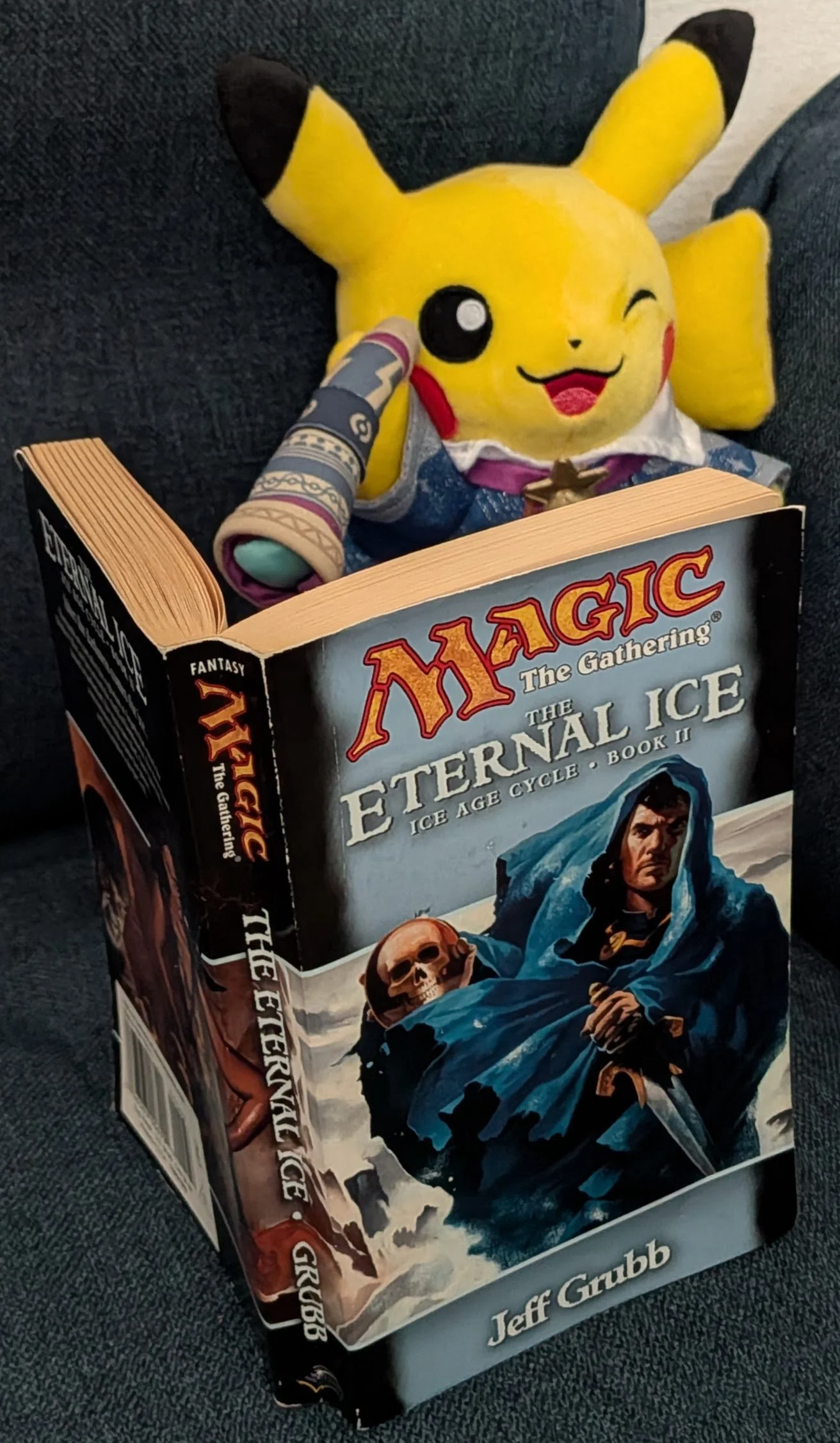
Title: The Eternal Ice
Series: Ice Age Cycle (Book 2)
Author(s): Jeff Grubb
Genre: Epic Fantasy
First Printing: May 2000
Publisher: Wizards of the Coast LLC
SPOILER WARNING
Mild, unmarked spoilers for The Eternal Ice will be provided throughout this review. Heavy spoilers will be confined to clearly labeled sections. I will keep the first paragraph of any given section spoiler-free.
Throughout this review, I will also be providing heavy spoilers for later events within MTG canon. While I will be steering clear of details that would spoil the progression of this book specifically, there is a strong chance that you will figure out certain spoilers if you pay attention to these bits of lore. I’ll confine the heavy spoilers that are relevant to this book into clearly marked sections.
Heavy, unmarked spoilers for previously reviewed Magic: the Gathering tie-in novels may also be provided, regardless of where they fall in the timeline relative to this book. I will also assume that you’ve already read my reviews of those books, though they aren’t essential to understand this one.
STRUCTURE
This will be a 2-part review.
Today
Premise
Timeline
Rating
Content Warning
Character
Tomorrow (September 22nd)
Plot
Worldbuilding
Theme
Cover Art
PREMISE
Per the back cover of my mass market paperback copy, we get:
After the darkness comes the ice.
Thousands of years after the explosion at Argoth that ended the Brothers’ War, ice has covered the world of Dominaria. The strong have turned to barbarism. The weak have died. Now Lim Dûl, a necromancer with a taste for power, seek to awaken a deeper evil.
Reaction
As with the previous book, this is a premise that is on-point in an emotional sense. The bit about Lim Dûl’s objective is technically wrong, but given what his actual plans are, “awaken a deeper evil” could be read metaphorically.
What this premise fails to mention is Jodah. This is a tale of his conflict with Lim Dûl. The story also fails to mention the involvement of the planeswalkers Leshrac and Freyalise in the story. Their roles are minor, but narratively significant, and compared to how much involvement Teferi had in Prophecy (a book where, remember, he was a selling point), so it’s a bit strange that neither of these two are mentioned.
TIMELINE
Based upon references made to Jodah’s age, we know that The Eternal Ice has to be taking place in at least the 2900s AR. The MTG wiki timeline sets this story in the year 2934 AR. That puts it 310 years before the start of the “present” timeline in Planeswalker (3244 AR).
In terms of the set it adapts, The Gathering Dark is an adaptation of MTG’s sixth expansion, The Dark, released in June 1995.
(For those of you wondering why we went from the novel for the fourth expansion to the one of the sixth, it’s because the Ice Age Cycle is omitting the fifth expansion, Fallen Empires. I’m not sure why this was done. Perhaps Fallen Empires was just that much less popular than The Dark and Ice Age?)
RATING: 9/10
Once again, hats off to Grubb. He took a story that was clearly commissioned as a cash grab and put in the work needed for it to stand on its own as a work of literature. This is another fun, immersive adventure that is very easy to engage with.
The story of The Eternal Ice is a straightforward Fantasy tale of magical heroes teaming up to fight an evil necromancer. There’s action, there’s intrigue, and there’s a unification of disparate factions to face off against a greater evil. And, of course, its nature as a tie-in story means that there’s lots of very blatant fanservice to cards in the source material.
What’s important is that Grubb doesn’t leave it at that. He develops character dynamics that carry forward the pathos of the previous book, despite a millennia-long timeskip that should have reset the narrative. He lets the archetypes and tropes play out in a manner that feels natural to the story, rather than being a crutch. He flips the roles of Hero and Mentor midway through the narrative without it feeling forced. And, to top it all off, he has vibes. If The Gathering Dark captured the grim darkness of the idealized (so to speak) Dark Age, The Eternal Ice captures the essence of struggling to survive in a global ice age.
Really the only thing that keeps me from rating this book a 10/10 is that it fails to deliver on its themes. Grubb tries to play with ideas of stagnation and change, along with the need to moderate power with self-awareness to avoid corruption. These aren’t bad ideas, nor do they buckle under weight they can’t support, but they also aren’t explored anywhere near well enough to feel meaningful.
CONTENT WARNING
The Eternal Ice is a lot more tame than its predecessor. There’s a lot less by way of dark subject matter. While there’s arguable more gore, nearly all of it is of the undead variety (i.e. zombies being gross, skeletal warriors having parts hacked off and ignoring the injuries), which blunts the impact.
CHARACTER
The character work in this book is more solid than its predecessor, to the point that the characters end up carrying the simplified plot. It’s not necessarily great character work, but it is more than functional for the story being told.
The Role Reversal (Heavy Spoilers)
Grubb plays a rather interesting game with the audience in the first third of the story. While this point is really more of a plot thing, I feel I should cover this here, so as to simplify discussion of the main characters.
At the start of the story, Jodah wakes up in a strange castle with foggy memories of the events of The Gathering Dark and nothing after that. He is introduced to the master of this castle, the necromancer Lim Dûl, who informs him that he is only a magical summoning, a simulacra of the real Jodah who died millennia ago. The necromancer commands Jodah to do magical research for him, on penalty of being dissolved back into nothingness if Jodah refuses or fails to deliver results.
It probably won’t surprise you to learn that this is a lie. Jodah is the real Jodah. The Archmage Eternal has survived the past two and a half millennia thanks to his brush with the Fountain of Youth early in the last book. His memories have simply been stripped from him, thanks to Lim Dûl’s allies disrupting a ritual Jodah routinely performs to maintain his sanity.
This is where the role reversal comes into play. At the start of the story, Jodah is the Hero and audience avatar. He has access to magic, but not much more than he had at the end of the last book. When the taskmage Jaya Ballard comes to rescue him, she acts as a Mentor figure for him, updating him (and the audience) on the truth state of the world and guiding him to safety.
Once Jodah is safe from Lim Dûl, their roles reverse. Jaya has to go on an adventure to recover Jodah’s magic mirror (an item that was important in the last book, though it didn’t have a central role). Once Jodah’s memories are restored, he regains his full powers, but he slides into the background and takes on more of an advisor role. Outside of the final showdown with Lim Dûl, this becomes Jaya’s story.
I feel like this was a clever choice that enhanced Jodah’s characterization. Grubb does characterize Jodah differently before and after his memories are restored, but the difference isn’t drastic in and of itself. Having Jodah’s narrative role shift from the Hero to the Mentor amplifies the impact of his shift in personality.
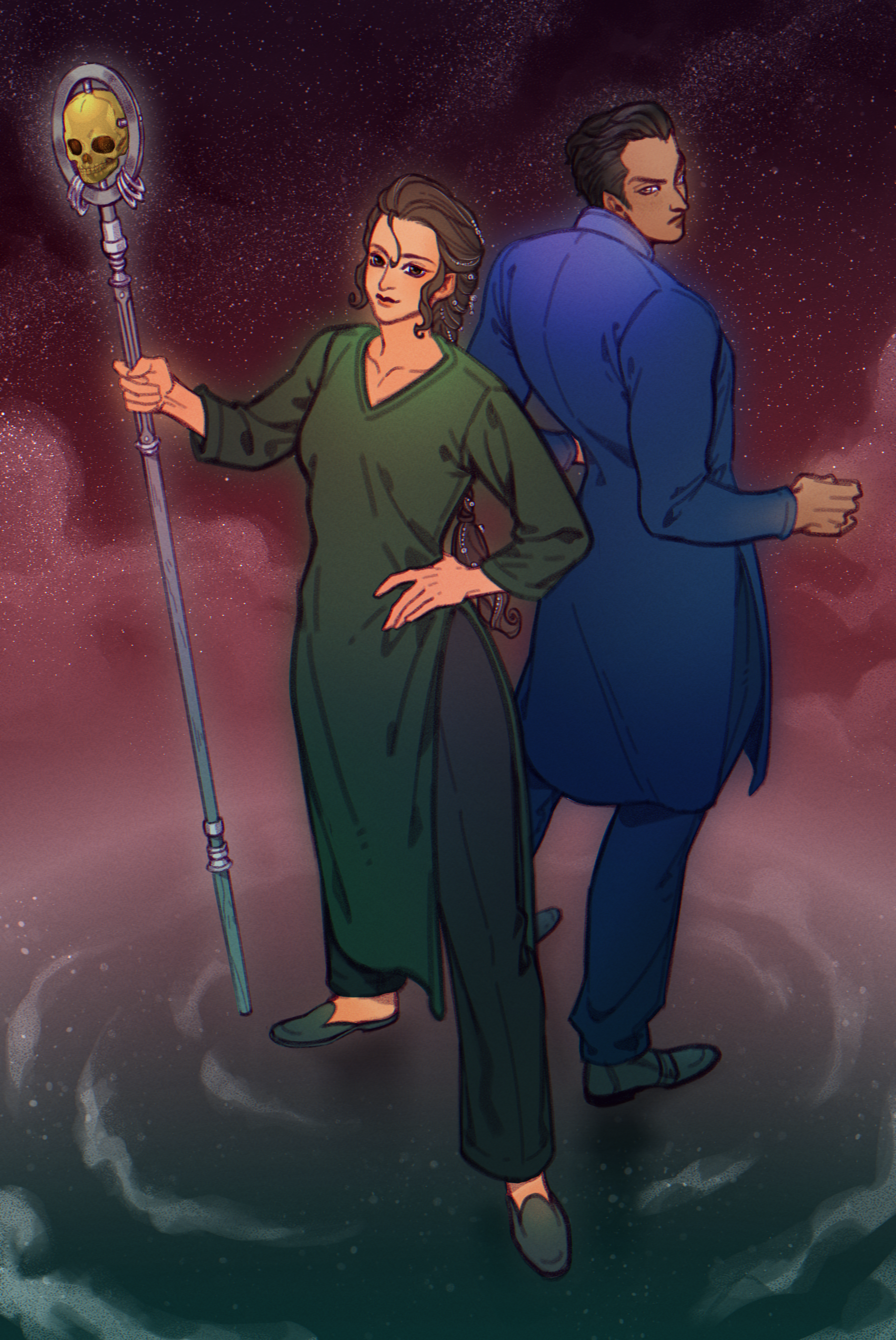
Jodah, the Archmage Eternal (Heavy Spoilers)
Jodah begins the story as the next stage of the character from The Gathering Dark, but before the end of the story, the impact of the timeskip plays out at high speed.
The Jodah we meet prior to the restoration of his memories is still very much a blank slate. His only motivation is self-preservation. He shows immense revulsion at being Lim Dûl’s slave, but this comes across as being about the principle of the matter, rather than something deeply rooted in him specifically. The one clear trait he has is his intellect: he is able to dissect situations, draw logical conclusions, and find creative solutions that make sense within the context of the world as he understands it.
After his memories are restored, though, Jodah becomes much more detached. I wouldn’t necessarily say that Grubb sells the idea that he is brimming with wisdom of the ages, but there’s definitely a sense that he’s been studying magic as an academic subject for that long a time, and Jodah does react to social situations with a weariness befitting someone who’s gone through these same scenarios countless times over the years.
Overall, Jodah is a strong character to serve as a foundation for this story, both when he is the Hero struggling to make sense of his surroundings and when he reverts to the wise Mentor with a firm grasp of his situation.
Jaya Ballard
This is a character who should be a forgettable archetype. At a glance, she’s a Femme Fatale whose defining traits are her unwillingness to be tied down, a fiery temperament, and a heart of gold. You’ve probably read this character as a Love Interest in multiple other stories. Case and point, she’s basically Siti, but with magical fire powers.
Yet, for some reason, Jaya is memorable, while Siti is so forgettable that I suspect even those of you who read my A Master of Djinn review don’t remember anything about her.
I meant, I suppose there’s narrative relevance. Jaya Ballard is destined to be a planeswalker. That’s not even a spoiler anymore - she’s had three different Planeswalker cards printed over the last ten years, and she’s tangentially connected to Chandra Nalaar’s backstory. The thing is, there was a gap of more than fifteen years between this book series and her first planeswalker card. She went a long time without any narrative relevance, yet I had no trouble remembering her characterization when she resurfaced.
I think this comes down to Grubb earning Jaya’s passionate nature, her heart of gold, and her relationship with Jodah. This isn’t merely a case of the middle-aged wizard and his hot (literally and figuratively) apprentice. From the moment Jaya comes onto the scene, it’s clear that she genuinely cares about her mentor and that she is setting aside everything else she values to help him. You can feel the weight of the history behind this relationship. Then, as we follow along in her efforts to help him and stop Lim Dûl, we see her strength as a hero in her own right. Jaya doesn’t need to stick around and continue helping Jodah, but she does so anyway because she doesn’t want to leave him in a bad spot.
Lim Dûl
The necromancer who drives the story through his schemes is a pretty archetypal Big Bad. He’s got minions, he’s got schemes, and he wants to rule the world. He’s also got a bit of the Starscream in him, scheming to kill his planeswalker patron. For as simple and unambiguously evil as he is, though, he works perfectly well for this story being told. A nuanced villain wasn’t necessary for this story to work.
(I have a bit more to say about this character, but it has to wait for the discussion of theme.)
The Planeswalkers
Both Leshrac and Freyalise play parts in this story, though primarily as background characters. The struggle between Jodah and Lim Dûl could potentially be read as a proxy fight between the two (a fact the narrative itself acknowledges), though in reality, neither of these planeswalkers seems to care that much about the others’ schemes. Neither get much character, being treated more like Lovecraftian entities who are involved and bargained with at the peril of mortals - but that’s the point.
One of the only things that does work regarding the theme is the contrast between Jodah and the planeswalkers. Jodah is, for all his power and experience, fundamentally human in his perspective and morality, whereas both Leshrac and Freyalise have lot go of both over the long millennia of their ascendant states. They are, in a sense, corrupted, while Jodah is not. So having them be so alien, so unreadable, is part of the point. It’s the same situation as the Dreamers in Murtagh. Characterizing them in a more nuanced way would weaken their narrative impact.
MAKING STUFF HAPPEN
Tomorrow, we’ll wrap up this review by going over the plot, worldbuilding, and themes. The Eternal Ice is a simple story, but thanks to the characters involved, it’s still enjoyable. The themes, sadly, don’t work nearly as well, but neither do they damage the story. This is a solid story, through and through.
It also has great cover art. I have thoughts about how Jodah is illustrated on these books. Well, more like thoughts of how he is illustrated now. We lost something worthwhile when his official art got changed.
If you’re looking for more stories of magic and intrigue, I recommend my ongoing necromancer serial, A Chime for These Hallowed Bones. Chapter 1 through Chapter 10 Part 2 are now posted. Join in for the ongoing adventure!
Thank you for joining me today. Please remember to subscribe and share if you enjoyed what you read here. Take care, everyone, and have a good week.