The Eternal Ice (Ice Age Cycle, Book 2) (Part 2 - Plot, Worldbuilding, Theme & Cover Art)
Hello, all. Welcome back to the review of The Eternal Ice, Book 2 of the Ice Age Cycle.
Yesterday, we did the overview and discussed the characters. Today, we’ll go over the plot, worldbuilding, and themes before delving into my thoughts on the cover art.
Bundle up, and we’ll step out into the cold.
STATS
Title: The Eternal Ice
Series: Ice Age Cycle (Book 2)
Author(s): Jeff Grubb
Genre: Epic Fantasy
First Printing: May 2000
Publisher: Wizards of the Coast LLC
Rating: 9/10
SPOILER WARNING
Mild, unmarked spoilers for The Eternal Ice will be provided throughout this review. Heavy spoilers will be confined to clearly labeled sections. I will keep the first paragraph of any given section spoiler-free.
Throughout this review, I will also be providing heavy spoilers for later events within MTG canon. While I will be steering clear of details that would spoil the progression of this book specifically, there is a strong chance that you will figure out certain spoilers if you pay attention to these bits of lore. I’ll confine the heavy spoilers that are relevant to this book into clearly marked sections.
Heavy, unmarked spoilers for previously reviewed Magic: the Gathering tie-in novels may also be provided, regardless of where they fall in the timeline relative to this book. I will also assume that you’ve already read my reviews of those books, though they aren’t essential to understand this one.
PLOT
K.I.S.S.
Stuff happens in this book. Lots of stuff. There are clashes with wizards, the undead, and demons. There’s a heist. Jodah and Jaya get to stop a coup. A whole war takes place, with a huge battle scene to cap off both it and the book. Arguably, this book has the same amount of content as Iron Flame or The Will of the Many.
In execution, though, Grubb keeps the plot simple. It’s really just there to give the characters something to do, rather than being the main reason we’re here. Take the coup, for instance. Grubb doesn’t drag things out with complex schemes and melodrama about who can be trusted. The coup is mentioned, Jaya confirms it’s a thing, and then there’s an action set piece. The point isn’t, “What will happen next?” It’s, “How will Jodah and Jaya respond to this situation?”
The closest thing to plot taking precedence over character is the climax. Even there, it’s about Jodah stepping up as Archmage Eternal to deal with a magical threat to the world. (There’s also the stuff that ties into the theme, but we’re not ready to talk about that yet.)
Then They Cast Spells
The action in this story is good. Not great, but good. There’s a distinct lack of choreography when thing get up close and personal, but Grubb balances this out with environmental stakes. For example, there’s a scene where Jaya gets chased by two guards. The stakes don’t come from her fighting off these two guards; they come from whether she’ll fall off the roof that they’ve chased her up onto.
One thing I do find noteworthy - at least, compared to modern Fantasy - is that this story treats men and women a equals in physical combat, with militaries being egalitarian, and it feels completely normal. This is because Grubb doesn’t invoke physical differences between the sexes (or the traits that map onto said physical differences) as a source of tension. The story doesn’t make a big deal about weight, reach, and upper body strength, so it makes the women sword-fighting with brawny men feel a lot more credible.
Where the action really shines is the magical combat. Grubb takes the rules that originated in MTG and that he made diegetic in The Gathering Dark and applies them in multiple combat scenarios. The finite availability of memories (and, thus, mana) and spells to cast serves as a meaningful limit in the longer fight scenes, and early in the story, Jodah suffers from a shortage of both that makes even the shorter fights a perilous situation.
Footnote in History
This book ends with Freyalise working a cataclysmic spell for her own purposes, one that comes with the added benefit of ending the Ice Age.
I don’t list that as a spoiler because the stakes of the story don’t actually lean upon this. Freyalise is able to work this spell because of favors Jodah repays to her before the climax, and he only owed those favors in the first place because of help she renders to Jaya near the middle of the book. The big reveal that this is where those favors led isn’t until the falling action of the story, though.
Still, I think that this was an okay way to handle things. The Ice Age, in and of itself, was not the antagonist of the story. The contemporary audience knew the Ice Age had to end somehow, since the world is distinctly de-iced by the time of the Weatherlight Saga. The fact that Grubb nods to the consequences of near-instant climate change also works to support the themes. This may have been an abrupt development, yet it is one that fits the story being told.
WORLDBUILDING
Much like with The Gathering Dark, the big thing here is vibes.
Grubb didn’t just rehash the environmental worldbuilding of the previous story. He went back to the drawing board. Instead of an oppressive religion, we get the oppressive cold. Instead of impoverished city-states squabbling for power, we get kingdoms and wandering tribes squabbling for the resources to survive while undead prowl the frozen land. Instead of magic being feared and wizards being oppressed, magic is a sought-after power to survive in this world, and wizards have the ability to shore up civilization or topple regimes.
Is this worldbuilding thematic? I think Grubb intended that, playing into the idea of the world changing, but the gap is too big. There are some callbacks to the now-ancient history of The Gathering Dark, but these come across less like a reflection upon an evolving world and more like me seeing imported candy at the supermarket. History feels like a foreign setting that exists alongside the present, rather than a precursor to it.
Does the worldbuilding work for the story, though? Yes. Locations feel more isolated because the cold weather makes travel dangerous. Lim Dûl is a more menacing threat because his armies does suffer from exposure or the logistical issues that living armies do. The Ice Age even synergizes with Jodah’s characterization as the Archmage ETERNAL, since he’s lived through the whole thing and has long ago ceased to think of it as anything but the status quo.
THEME
Those of you keeping track might notice that I have had only nice things to say about the theme thus far.
Well, those were the only nice things I had to say.
These aren’t bad themes. I also don’t think the story is diminished by their inclusions or poor execution. They just don’t have any weight to them. You could delete them from the story entirely, and nothing meaningful would change.
Nicer Mammoths (aka the Corrupting Influence of Power)
Jodah is like a planeswalker in many ways. He is ageless. He is an extremely powerful spellcaster. While the difference between him and them is still vast, both in power as well as psychology, a similar gap exists between him and other mortal spellcasters.
This gap is dangerous. After Freyalise resets the climax, Jodah compares planeswalkers to sleeping mammoths, which seem harmless while sleeping yet crush whatever’s next to them when they roll over. Earlier in the story, Jodah also reflects on how long life and immense power can calcify the mind and make a person too rigid in how they deal with others, seeing this as corruption. He also brings up how acquiring power just brings the desire for more power.
I like these ideas. I see where Grubb was going with them. The pieces are in place to explore this theme.
… except, if not for the two scenes where these ideas are bluntly stated, the theme vanishes entirely.
The plot isn’t driven by Jodah or the planeswalkers being set in their ways. Lim Dûl doesn’t grow and change as the result of an increase in power across the story. Jaya does have some friction with Jodah because of his detachment, but that comes across less as inflexibility and more like experience.
Change versus Stagnation (Heavy Spoilers)
An idea first introduced in The Gathering Dark is that magic is change. This was most significant in Jodah’s failed bit to open a portal to Phyrexia, where he failed to consider that the land (and, thus, the memories and mana) needed to fuel the spell had changed over the generations. The same idea is brought up here, with magic being explicitly associated with change at multiple points.
This is fine … but it falls flat in the climax.
The big reveal when Jodah confronts Lim Dûl for their final duel is that Lim Dûl is possessed by (or, at least, influenced by) the spirit of Mairsil. After being immolated by Ith at the end of the last book, Mairsil managed to flee to a cave and bind his soul to one of his rings before his death. In the book’s prologue, which doubled as Lim Dûl’s introduction scene, he found the ring and put it on, allowing Mairsil’s spirit to meld with his and grant him magical power.
Jodah figures out that Lim Dûl is Mairsil at some point before the climax and reveals this information when they meet for this last duel. Their banter includes this rather pointed exchange.
“Magic is change, Jodah. You hid away for millennia and stayed the same. I reinvented myself. That is why I will rule this icy land.”
“I have gained power myself over the passing centuries, necromancer. And I have changed, though at my own speed.”
Again - the idea is there. The elements are in place. But this story hasn’t been about whether or not Jodah is changing with the times. If anything, the deft way in which Jodah handles political maneuvering demonstrates that change isn’t all that important. The whole reason he’s so good at it is because he’s seen it all before … in other words, that the other players change, but the game itself remains the same, so he didn’t have the change.
COVER ART
This last point has noting to do with writing. It’s just something I both really like and that is ultimately the source of great annoyance for me.
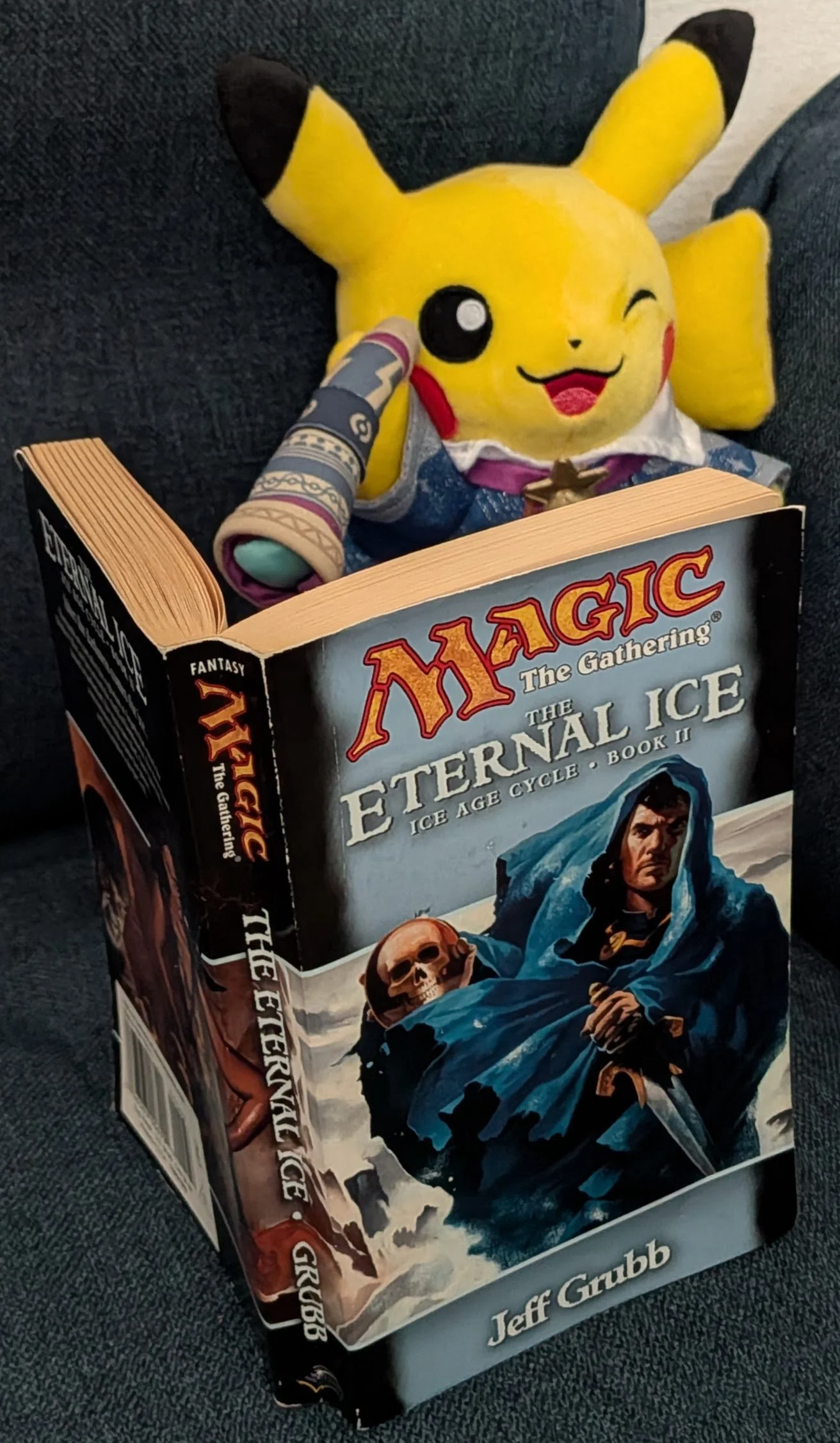
See, the cover art for all three books of the Ice Age Cycle was done by Gary Ruddell. The character on the cover of all three books is supposed to be Jodah (and, in the case of The Shattered Alliance, I’m pretty sure that’s Jaya with him). This was, to my knowledge, the canonical appearance of Jodah for 18 years, until he finally got an official card in Dominaria.
I like Ruddell’s art. It makes Jodah look mysterious and brooding, and the progressive covers capture the effects of time upon him as he moves through the series. I’d say it compensates for the shortfalls of the prose when it comes to reflecting Jodah’s wisdom.
…
Then Jodah, Archmage Eternal got printed. Now Jodah looks like a Male Love Interest from a K-drama. Not a particularly wise or experienced one, either, despite that card reflecting Jodah’s state another 1,500 years farther along his timeline.
I don’t think the new look is bad in and of itself. It’s just a massive downgrade from what came before. I believe the Jodah on this book’s cover has lived through an Ice Age, studying and teaching magic all the while. That’s a lot less credible for the Jodah on the cards.
THE THAW
The Eternal Ice is a wonderful example of what an author can accomplish with even simple ideas if he’s willing to put in the work. I’m sure WotC had some financial logic behind not converting this one to e-book format, but that doesn’t make it any less of a shame that they didn’t convert it. This is a book that deserves a re-release.
Speaking of books needing a re-release, the conclusion of the Ice Age Cycle, The Shattered Alliance, is really hard to get at a reasonable price. It may take some time before I am able to review it and wrap up this trilogy. Please bear with me. Much like with the long wait for the Hereticus review, I don’t intend to simply let this review series go unfinished.
In the interim, you’re looking for more Fantasy adventure in an immersive setting, my first Military Fantasy serial, Moral Support, is now posting over in Tales of the Five Worlds! Chapter 1 through Chapter 3 Part 1 are now available. I’ll hope you’ll join me for these new adventures!
Thank you for bearing with me through this delay. Please remember to subscribe and share if you enjoyed what you read here. Take care, everyone, and have a good week.