Game of Captives (Part 5 - Prose & Tone)
Hello, all. I hope your week is going well. Thank you for joining me as we continue our exploration of the third Fire and Fang book, Game of Captives.
This will be the final part of the review, focusing solely on the elements that I feel to be the biggest issues within the book. Please see the previous parts of the review if you’d like just an overview or else breakdowns of plot, character, worldbuilding or the romance.
If you’re all caught up (or don’t care about that), let’s fly.
STATS
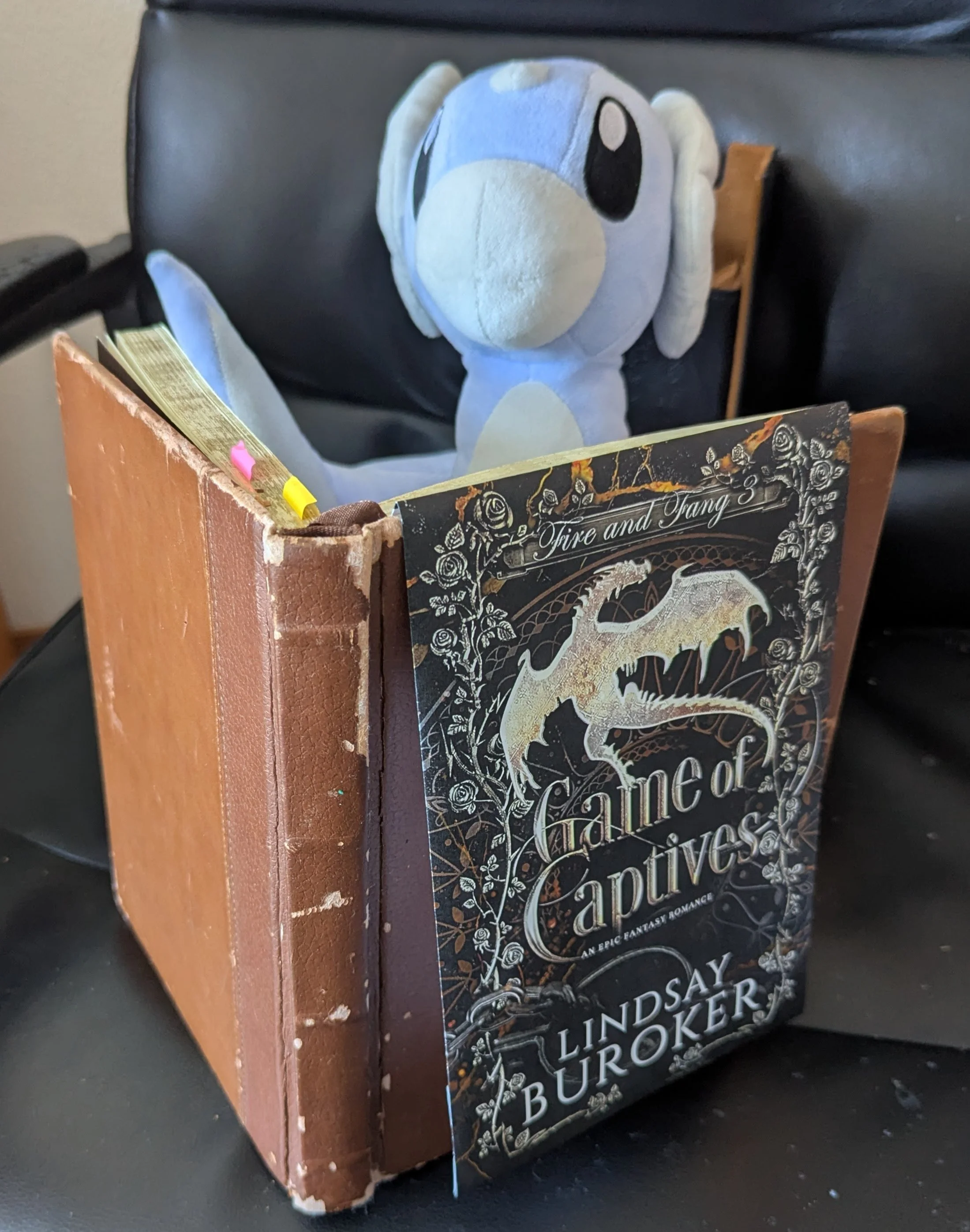
Title: Game of Captives
Series: Fire and Fang (Book 3)
Author(s): Lindsay Buroker
Genre: Fantasy (Romantasy)
First Printing: February 2026
Publisher: Self-published to Amazon
Rating: 5/10
SPOILER WARNING
Mild spoilers for Game of Captives will be included throughout this review, through I will keep the first paragraph of each section as spoiler-free as possible. Heavy spoilers will be confined to clearly labelled sections.
Heavy, unmarked spoilers for the previous two books in the series, Sky Shielder and Red Dragon, will be provided throughout this review. I’m also going to assume that you’ve already read the reviews for those books, though it isn’t necessary to do so to understand this review.
PROSE
For the most part, the prose of Game of Captives follows the same mold as Sky Shielder and Red Dragon.
A lot of information, particularly character motivations, is repeated unnecessarily.
There is a surplus of quips and banter.
There’s a definite sense that the characters have a modern mindset about things, rather than one that is molded by the world in which they live.
Vorik’s and Syla’s narrative voices are indistinguishable, to the point that it can be hard to keep track of which of them is the POV.
For the most part, I don’t think these are inherently problematic elements. If you are this far into a series, it’s to be expected that the prose will read similarly to the previous entries. There’s only so much that can be changed without fundamentally altering the vibe of the story. (Obviously, this would also be okay if fundamentally altering the vibe is the goal, but I don’t think Buroker intends this, so I wasn’t expecting massive changes.)
That being said, I couldn’t help but notice a pattern to the quips. Maybe the pattern has always been there, or maybe I’ve simply reached my limit with them. Either way, I think it’s worth calling out.
First, their density. It seems that barely a single exchange of dialogue can go by without someone (usually Syla or Vorik) ramming in some quip or forcing banter. Usually, this takes one of three forms.
Challenging someone’s statement with a quip
Character A: [Says line]
Character B: [Quip that contradicts Character A’s statement or forces clarification]
Character A: [Acquiesces or counters statement
Character B: [If Character A did not acquiesce, either change subject or make a second a second quip]
Character A: [Acquiesces or counters statement]
Repeat until one of the characters acquiesces or changes the subject
Correcting an exaggeration
Character A: [Makes exaggerated statement]
Character B: [Makes correction]
Character A: [Acquiesces or insists upon the exaggerated statement]
Character B: [Acquiesces or insists upon correction]
Repeat until one of the characters acquiesces
A forced joke about either sex (usually delivered by a dragon) or Vorik’s sweet tooth.
Repeated scripts or forced jokes aren’t inherently damaging to a narrative … when used sparingly. When used with restraint. When they are in every chapter, when it feels like not a single exchange of dialogue can escape them, it becomes stale. I am not exaggerating when I say that the best chapter in this book is one where there is almost no dialogue until the end.
And then there is the damage that this humor does to the tone.
TONE
Everything I covered about the tone of Red Dragon still allies here. This is a narrative where character motivations are rooted in existential stakes, where we are repeatedly reminded of the lives lost or threatened, where Syla and Vorik feel the weight of their respective nations upon them. What makes this narrative compelling - our POV characters’ struggles between what they want and what their people need - is rooted in heavy, serious stuff. So when those same POV characters partake in endless quips and jokes, setting an expectation that we shouldn't take things seriously, it sucks the air out of the narrative.
There are two moments in this story that really hammered this in for me. There are a handful of payoffs in this book. These two, in particular, leaned heavily on emotion for buildup. Thanks to the excessive quipping, they just ended up feeling lifeless.
Betrayal (Heavy Spoilers)
In her quest to recover the shielder components from the stormers, Syla realizes that Vorik is her way into their camp. He has openly told her that he’s been ordered to kidnap her (or, at least, argued for kidnapping her instead of assassinating her). With this in mind, she prepares a contingency for her future escape, loading her first aid kid with poisons and keeping it with her at all times (since she knows Vorik won’t make her get rid of it if he does manage to abduct her).
Around the two-thirds mark, Syla gets her wish. Vorik sinks the ship that the weapons platform is on as a means to lure her into the open, then snatches her. Syla does make a token effort to seduce him into releasing her (which does appear to be a genuine effort, which somewhat contradicts her whole plan), but otherwise, she does not put up meaningful resistance.
When she arrives in the stormer camp, she is interrogated with hydra scale powder. This leads to her spilling the location of the Bogberry Island shielder. She would have exposed more shielders, but the camp is attacked by monsters, and she uses the confusion to dose herself with a drug to combat the influence of the hydra scale powder.
This unfolding of events makes sense in terms of the characters involved and their motivations.
The framing does not.
This moment is framed as a betrayal. Syla realizes that, by delivering herself to the enemy for this interrogation, she has betrayed her people. Vorik privately bemoans how his actions have betrayed Syla. While I can’t recall Syla ever directly accusing Vorik of betraying her, she does directly call him “an enemy” in the wake of the interrogation.
It’s all so lifeless. It makes sense, given how Syla and Vorik have been characterized, but there’s no weight to it. Both of these characters have known, since Sky Shielder, that the only reason for the stormer tribes to keep her alive is so that they can extract the locations of the remaining shielders from her. Vorik has understood that Jhiton had the hydra scale powder ready to go since the start of this book. Syla has already had Jhiton try to kill her twice in this book alone, so she had to know that the most likely alternative to being interrogated was to be executed.
But has this stopped the story from being lighthearted and quippy at every opportunity? Has this stopped Syla and Vorik from partaking in (if not instigating) banter?
Of course not.
The incessant humor has stolen the buildup needed to give this moment emotional weight. There’s even quippy banter during the interrogation scene, so it’s not like the suddenly dire emotions work as a contrast to the rest of the story. What’s more, in Vorik’s case specifically, the knowledge that his brother wanted to pump Syla for information is something he has always been aware of, and yet his mood hasn’t darkened as this series progressed. Him moping now just rings hollow. When the characters don’t care about the emotional implications of a very likely outcome that they are fully aware of, why should the audience?
(I suppose we could also complain about this from a character perspective. Both Syla and Vorik are smart enough to have realized where things were going. I feel like that’s a lesser problem, though. This scene could have still have punch even while the characters are being idiots.)
Brothers’ Quarrel (Heavy Spoilers)
Jhiton makes a third attempt to kill Syla in this book. It’s at this point that Vorik’s attempts to protect Syla exhaust Jhiton’s patience.
Syla escapes the stormer camp by poisoning a communal soup pot. When she tries to slip away, however, she is intercepted by Jhiton. He’s decided that enough is enough and to simply kill Syla while Vorik is occupied.
Only, Vorik isn’t occupied. He wasn’t poisoned. He catches up to Syla and Jhiton just before Jhiton can kill her. The pair end up dueling while Syla is extracted by one of Wreylith’s dragon allies.
Once she is gone, the brothers stop fighting and just sit down and talk. It’s a moment that I want to like. The subject matter is heartfelt. Jhiton makes it clear that, while he is furious as Vorik for constantly undermining the stormer war effort in the name of protecting Syla, he still treasures his brother. They are the only family each other has left.
This scene should work … except this scene suffers from both of the fundamental issues as the betrayal.
This story has been so lighthearted, with nothing being taken seriously, that this sudden shift to sincerity is jarring. Jhiton and Vorik have had a lot of conversations across this series. None of them were like this. I want to say that this contrast enhances the emotional punch, except in the middle of the scene, Vorik makes another sweet tooth quip. Suddenly, this heartfelt moment is placed on the same emotional level as Vorik’s dragon quipping about ‘sexual orifices”.
Instead of being caught up in the emotions of the moment, I just ended up feeling frustrated. This scene shows what this book could have been. It belongs in a story where the stakes of the conflict were taken seriously. Instead, it’s crowbarred in so that we’ll feel bad for Vorik when he kills Jhiton in the climax (which is done to protect Aunt Tibby, not Syla).
The Chapter With Barely Any Talking (Heavy Spoilers)
Speaking of scenes that belong in a more serious iteration of this book …
Syla’s escape from the stormer camp is by far the most engaging chapter in the book. It comes directly between the two failed beats we just discussed. With the stormers all asleep, Syla has to sneak around and steal back the shielder components, then slip out of the camp.
The tension here is palpable. Syla knows that her poison was not as effective as she would have hoped. Sure, she took out some guards, but most of the camp didn’t even eat the communal soup, and she knows that Jhiton is somewhere outside the camp. As she creeps around, there’s a looming sense of danger.
And you know what makes that danger stronger? The fact there is no dialogue. Syla isn’t able to quip at anyone. No forced sex jokes kneecap the tone. She is trying to fulfill an objective to save her people from an existential threat, and there is a genuine risk that she will be caught and (probably) killed.
The Quips Could Have Worked
What I find particularly frustrating about the overuse of tone-killing quips and banter is that these elements didn’t need to be erased entirely. There just needed to be a sense of moderation. In fact, I’d go so far as to say that the jokes that occurred during the two botched moments we covered above were the best-executed ones in the book. They could have been left in those scenes without causing any problems. They only become issues because of the association between them and the oversaturated humor in the rest of the book.
As I said back in the Red Dragon review, I think the level of humor we get in this series could have worked if the stakes weren’t so dire. The story just needed to be one that relies on less emotionally fraught elements to drive it forward. In fact, that’s exactly what Buroker delivers in another one of her novels that I’m currently reading, The Elf Tangent. It’s a lower-stakes adventure that keeps things much more personal. Sure, there’s the odd passage where the quipping gets annoying, but in those cases, that’s an issue of the dialogue taking too long, not the humor itself. The story has the breathing room needed for the jokes to land.
For Fire and Fang, I just hope Buroker dials back the jokes for Clutch and Claw. Otherwise, no matter how well-executed the rest of the finale is, it’s going to go over like a wet firecracker instead of a satisfying drumroll of fireworks.
CLAWING THE WAY TO VICTORY
I know I had quite a lot to say about Game of Captives, but in most respects, it is the best entry in the story thus far. Buroker has gotten comfortable with these characters and the world. She knows how to use them effectively to tell an engaging story. At this point, the tone - or, to be more precise, the clash between the tone and the stakes - is the only major issue that holds the series back. Even that’s really an issue of moderation rather than being wholly incompatible.
So, despite my extensive criticisms, I genuinely am looking forward to Clutch and Claw (which should have released by the time you read this). I’m hoping Buroker will end this series on the high note.
I don’t know exactly when the review for that will come. The reviews I post on Sundays and Fridays are prepared months in advance, but I do these Wednesday reviews whenever I have time available. My real-world schedule has been rather busy of late, so I haven’t even had time to read Clutch and Claw yet.
It is my hope that, at the absolute latest, I will start the review series by mid-August (which is the next available gap in the Friday schedule). I’ll do it earlier if I can, but no promises. Thank you all for your patience.
Thank you all for joining me on this adventure. Please remember to subscribe and share if you enjoyed what you read here. Take care, everyone, and have a good week.