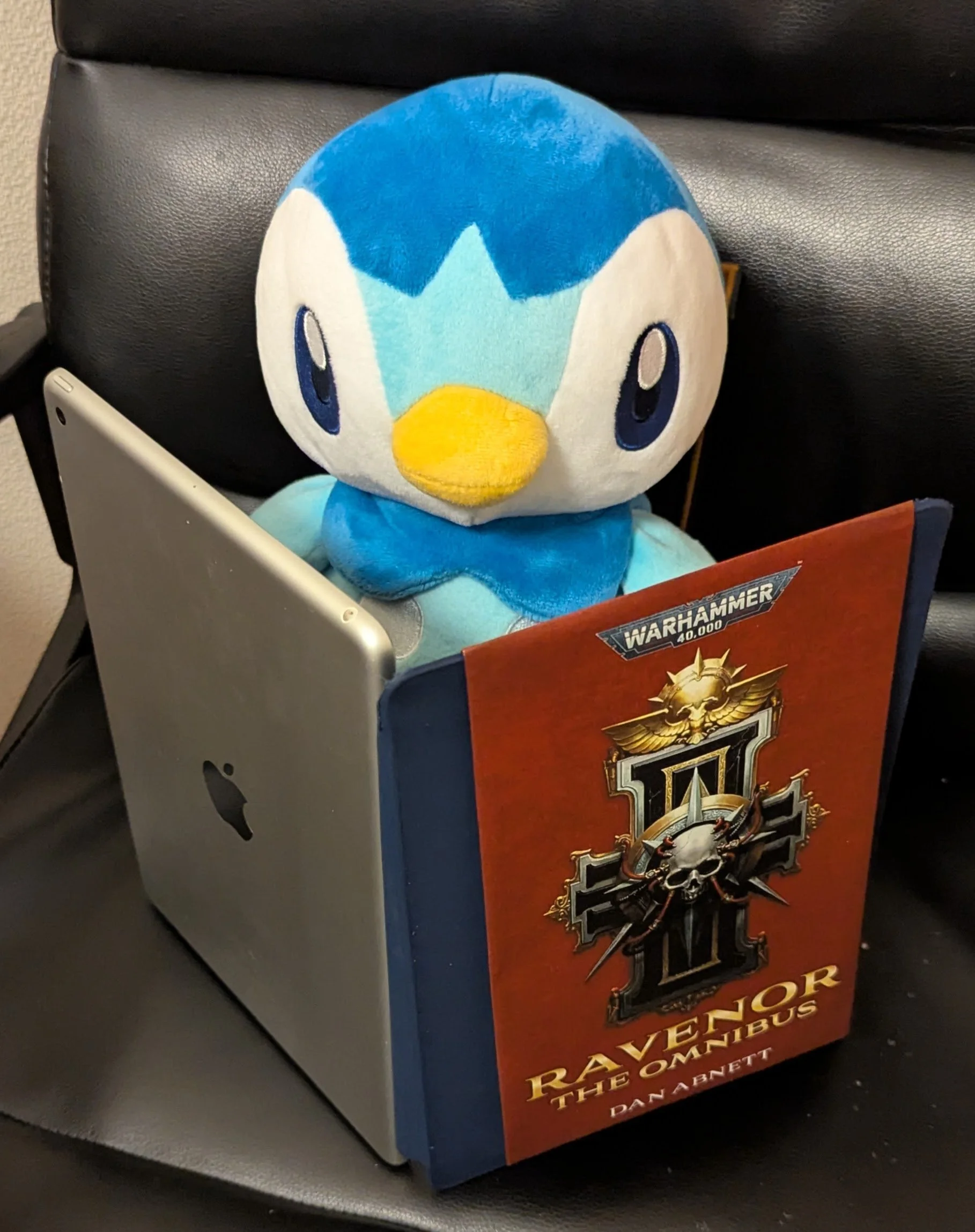
Ravenor (The Ravenor Trilogy, Book 1) (Part 1)
Hello, all. Thank you for joining me for another Warhammer 40K book review. Today, as promised, we are kicking off the Ravenor Trilogy with Book 1, Ravenor.
I actually didn't know about this trilogy before picking up Eisenhorn - The Omnibus. All of the Ravenor novels are listed on the timeline in the back of that book. The only other thing I learned prior to starting to read it was a couple of sources claiming that these books are far more grimdark than Eisenhorn’s. We’ll see how that claim holds up as we go through the series.
Let’s dive in.
STATS
Title: Ravenor
Series: The Ravenor Trilogy, Book 1
Author(s): Dan Abnett
Genre: Science Fiction (Space Opera)
First Printing: March 2005
Publisher: Black Library (Games Workshop Publishing)
SPOILER WARNING
Both minor and heavy spoilers for Ravenor will be provided throughout this review. I will try to keep the first paragraph of each section as spoiler-free as possible and will confine heavy spoilers to clearly labeled sections.
Minor spoilers for the Eisenhorn stories will be provided during this review. There will also be mild spoilers for “Playing Patience”.
TIMELINE
Ravenor begins in the year 401.M41, after Heretius (386.M41) but well before the events of The Magos (475.M41). Interestingly, the timeline in the back of Eisenhorn - The Omnibus contradicts this by starting that the story takes place in 402.M41. I think the most logical way to reconcile this is that the story bridges the new year. There’s plenty of Warp travel as the book progresses, so that’s not a huge stretch.
In keeping with continuity established at the end of Hereticus, two members of Eisenhorn’s entourage from Hereticus, Harlon Nayl and Kara Swole, are now working for Ravenor. Eisenhorn is mentioned in passing a couple of times, with Nayl further stating that he doesn't know if Eisenhorn is alive. Given that Nayl is once again working for Eisenhorn in “The Keeler Image” and onward into The Magos, I assume that Eisenhorn’s true status will be revealed to at least Nayl at some point later in this trilogy.
STRUCTURE
This review will be split into two parts as follows:
Part 1 (Today)
Premise
Rating
Content Warning
Plot
Part 2 (Sunday, January 25th)
Characters
Worldbuilding
Prose
PREMISE
Per the Amazon product page for this novel, we get:
When his body is hideously damaged in an enemy attack, it looks as though Inquisitor Gideon Ravenor's promising career would be abruptly brought short. Now, encased in a life support sytem that keeps him alive but forever cuts him off from the physical world, Ravenor utilises his formidable mental powers to continue his investigations and thwart the machinations of Chaos. Along with his retinue of warriors and assassins, Gideon Ravenor fights to protect an Imperium he can no longer see, hear or feel.
Reaction
This is such a vague premise that I should be able to say that the audience is not misled …
… and yet.
One could reasonably assume, both from the association with Eisenhorn and this book’s own prologue (more on that in a moment), that this book is about Ravenor taking on threats as apocalyptic as any in Eisenhorn’s novels. That isn’t the case, though. Based upon the prologue, we can assume that such an apocalyptic threat will manifest down the line, but that isn’t revealed in Ravenor. As far as the titular character and his entourage are concerned, this is a small-stakes story about drug smuggling. Chaos-linked drugs, perhaps, which can only lead to bad things down the line, but equating this with Eisenhorn is like trying to equate 2 Fast 2 Furious with F8te of the Furious.
So, yeah. I do find this premise at least slightly misleading.
RATING: 6.5 / 10
Overall, Ravenor is a story that is strong in concept and execution. The plot, while operating in smaller stakes than any of the Eisenhorn books, still applies those stakes effectively, and its twists are handled far more effectively than anything in the Eisenhorn books. The worldbuilding is immersive, with time taken to flesh out the character of each new world visited. The depth of the character work is honestly a bit shocking after coming from the Eisenhorn Trilogy. The sudden jump in the quality of characters from Hereticus to The Magos suddebly makes a lot more sense.
I want to rate this book a lot higher than I have. It should be an 8. Unfortunately, as mentioned in the conclusion of the “Playing Patience” review, the strengths in the execution of this story are offset by a series of missteps. This book reads like either an early draft in dire need of development edits or a hodgepodge of elements that Abnett didn’t yet understand how to fit together. The three examples that stand out most to me are:
The first prologue - the book has two - which is likely intended to set up a trilogy-spanning narrative, sets false expectations that undermines this book.
A character arc is presented out of order, robbing it of emotional impact.
The hybridized 1st Person / 3rd Person Omniscient POV that I praised in “Playing Patience” is handled inconsistently.
CONTENT WARNING
I completely forget to add this section to my original draft of the review, only remembering it months after the fact when I got to the Ravenor Rogue review … and I think that should honestly say something in and of itself.
This is a Warhammer 40K story. This means that the usual grimdark elements - the immense human suffering, the cheapness of human life, gore, horrifying imagery - are all present. If I’m being completely objective about it, I think I’d say that Abnett dialed these things up from the Eisenhorn books.
The thing is, though, is that the delivery flows in such a manner that these things don’t jump off the page. I’m not saying that they don’t have weight. It’s just that they blend so well with the story being told that they go beyond a vibe. I never felt like Abnett was exaggerating things or milking them to get an knee-jerk reaction from the audience. He’s painting an honest picture of what life is like in this setting, and in a way, that makes the grimdark elements feel less obtrusive.
So, as a matter of due diligence, I want you all to know that these things exist. If you do not like the aesthetics and vibe of Warhammer 40K, this book is probably not for you. At the same time, though, if you wanted to dip your toes into the grimdark waters of the 41st Millennium, I think Ravenor might be one of the safest options available.
PLOT
The First Prologue
The inclusion of this prologue is, in my opinion, a miscalculation in the same vein as the prologue of Dot Monster Re:Volution.
We start of the story as Ravenor and his team avenge the attack by the Cognitae heretic Molotch upon their ship years prior (the event we touched upon in the “Playing Patience” review and that is mentioned a few times throughout this book). They catch up to Molotch at a Cognitae dig site where he and his followers are collecting scraps of Enuncia. This altercation ends to Molotch’s apparent death.
One would think, from this prologue, that the book that follows will focus on some distardly scheme by the Cognitae, something building on this encounter with Molotch. Maybe the trilogy as a whole will indeed lay bare sure a scheme. Molotch’s death seems pretty permanent (crash landing a shuttlecraft), but not even a roasted corpse in enough to guarantee death with the Warp is involved, and as we saw in The Magos, the Cognitae are all about messing with the Warp.
However, that’s not the story we got. This is a story about breaking up a Chaos-related drug operation. The Cognitae are mentioned as its backers at a few points, but no confirmed Cognitae operatives are encountered. If I’m understanding the book correctly, Ravenor didn’t even realize there was a Cognitae connection until more than halfway through the story, and even then, it’s framed more as, “Oh, great. We stumbled across more of their people.” I kept expecting Molotch or a Warp sorcerer or a greater dæmon to pop out of the woodwork, but it never happened. As a result, up until the twist reveal at the start of the third act, this story felt like it was still waiting for an inciting incident.
Look - the story we got here is not bad. And if this expectation were purely a result of me overthinking things after reading The Magos, I wouldn't mark this against the book. The issue is that, through this prologue, the book itself sets an expectation that never gets paid off. At least when A Game of Thrones showed us the Others in the prologue before spending hundreds of pages on a world apparently devoid of magic, it as least gave us an ice zombie and dragons by the end. This prologue may be intended to set things up for later in the series, but in the process, it undermined an otherwise decent story.
(I haven’t touched on the second prologue because it honestly works fine. It introduces the audience to Ravenor’s perspective on the world as a skilled psyker capable of reading minds across vast distances. It sets very accurate expectations for the story ahead.)
Low Stakes, High Investment
Setting expectations aside, the story we do get is pretty good. Much like with Eisenhorn’s many side adventures in his short stories, it’s nice to see the Inquisition dealing with smaller-scale stuff.
Ravenor and his entourage enter the story in the midst of an investigation into “flects”, glass beads that grant a glimpses into the Warp. These glimpses induct an addictive high, thereby spawning a drug epidemic that is rotting away at the foundations of Eustis Majoris, a sub-sector capital world. Ravenor wants to figure out where the flects are coming from and cut out the operation at its roots.
As adventures in WH40K go, this is incredibly tame. At the same time, though, that allows the narrative to really focus on characters and get us invested in the narrative through their struggles. The focus is less upon grand stakes and more on Ravenor and the people on his entourage pooling their talents and working as a team to find their next clues. These dynamics kept me hooked even with the false expectation that all this was merely setup for something more exciting.
A WARPED PERSPECTIVE
On Sunday, we’ll continue this review in Part 2, focusing on Characters, Worldbuilding, and Prose. I hope you’ll join me for it.
Thank you all for being here today. Please remember to subscribe to the newsletter if you’d like weekly emails with the latest links and to share this review around if you enjoyed it. Take care, everyone, and have a good weekend.

On Tuesday, February 3rd, Volume I of my first serialized Romantasy novel, A Chime for These Hallowed Bones, premieres!
Kabarāhira is a city of necromancers, and among these necromancers, none are more honorable or respected than Master Japjot Baig. Yadleen has worked under him since she was a girl, learning how commune with bhūtas and how to bind these ancient spirits into wights. Her orderly world is disrupted, however, when a stranger appears with the skeleton of a dishonored woman, demanding that her master fabricate a wight for him.
To protect her master from scandal, Yadleen must take it upon herself to meet this stranger’s demands. Manipulating the dead is within her power, but can honor survive in the face of a man who has none?
You can see the full schedule for Volume I here! I hope you’ll join me on this new adventure.