Playing Patience (A Ravenor Short Story)
Hello, all. Welcome to another Sunday mini-review.
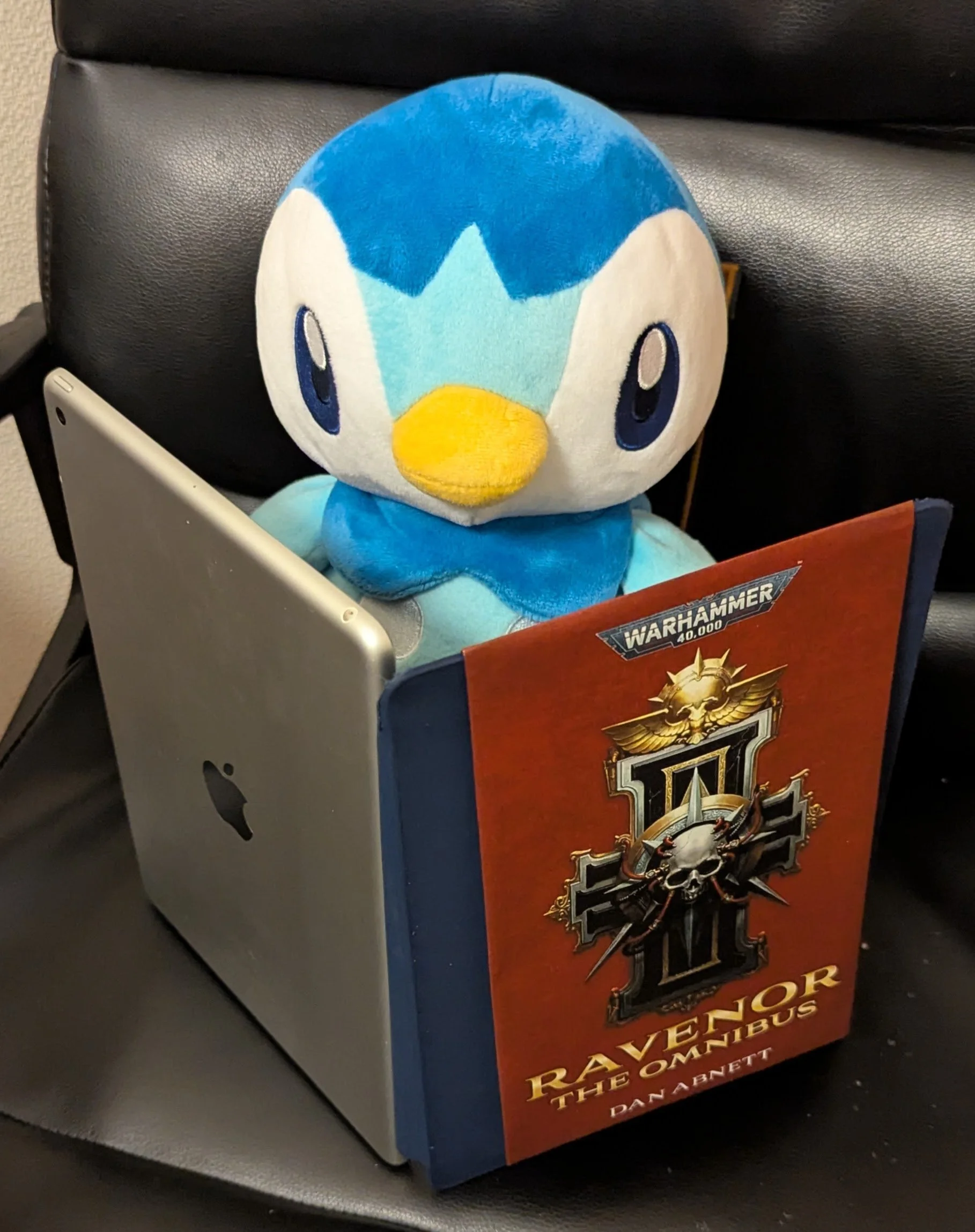
As promised at the end of the review of The Magos, I have acquired Ravenor - The Omnibus and begin to work my way through it. Much like Eisenhorn - The Omnibus, this book features Ravenor short stories, which are positioned around the individual novels in an order the reflects their positions in the Warhammer 40K timeline. I plan to schedule my reviews to honor this timeline, since that is the order I am reading them all in. Since we will be doing a 2-part review of Ravenor ithis upcoming weekend, we’ll are kicking things off today with the first short story in the omnibus, “Playing Patience”.
STATS
Title: “Playing Patience”
Series: Ravenor
Author(s): Dan Abnett
Genre: Science Fiction (Space Opera)
First Printing: November 2016
Publisher: Black Library (Games Workshop Publishing)
SPOILER WARNING
Both minor and heavy spoilers for “Playing Patience” will be provided throughout this review. I will try to keep the first paragraph of each section as spoiler-free as possible and will confine heavy spoilers to clearly labeled sections.
Minor spoilers for the Eisenhorn stories will be provided during this review. You can find my reviews for these other stories here. There will also be some mild spoilers for Ravenor, which we’ll review this upcoming Friday.
TIMELINE
I’m hazy on exactly when this story takes place. There’s this timeline in the back of Eisenhorn - The Omnibus that I’ve been using to gauge when each of this stories takes place, and while that timeline does include all of the Ravenor novels and the other short stories within Ravenor - The Omnibus, “Playing Patience” isn’t on that timeline.
That said, there are context clues. In this story, Ravenor’s interrogator is a man named Carl Thonius, who is described as being 24 years old. In Chapter 1 of Ravenor, which is set in the year 401.M41, he is instead described as being 29 years old. We can therefore reasonably conclude “Playing Patience” is set in 396.M41, or perhaps 395.M41 at the absolute earliest. This is shortly after Heretius (386.M41) but well before the events of The Magos (475.M41).
STORY
This short story is the origin story for Patience Kys, one of the members of Ravenor’s entourage from the Ravenor Trilogy (which concluded publication about 9 years before this story released).
The story is broken down into two plot threads. One follows Patience, an orphan in a scholam (the WH40K version of an orphanage) that is secretly a front for the Cognitae; the other follows Ravenor and his entourage, who are on the planet to undermine the Cognitae by tracking down an operation that supplies the Cognitae with thugs. When the Cognitae realizes that Patience is a low-level psyker, they sell her off to some local nobles to use in sport hunting, only for Ravenor to arrive on their doorstep shortly afterwards and learn of Patience. The rest of the story then details a cat-and-mouse came as Patience tries to survive the hunt while Ravenor and his team try to take down her hunters and rescue her.
RATING: 7.5 / 10
This is a fun, self-contained action story. Given that I read this before I read a single Ravenor novel (and, as of the time of writing this, I’ve still only read Ravenor), I can’t really argue whether it does Patience justice, but as an introduction to a character, I think it was also quite effective. This short story also makes very effective use of Ravenor’s POV, in a manner that at least the novel Ravenor didn’t do quite so well - but more on that in a moment. Overall, I think this is worth checking out even if you aren’t generally interested in WH40K stories.
PLOT
The narrative we’re presented with here is well-paced and to-the-point. The events of Ravenor’s investigation and of Patience being discovered and thrown into a hunt flow very well and have a nice energy to them. Nothing ends up feeling contrived.
With that said, there is one point that really bothered me.
The story opens with a reference to an attack Molotch, a Cognitae operative whom I think is supposed to be Ravenor’s personal arch-nemesis (the way Glaw was for Eisenhorn), executed against the rogue trader vessel that Ravenor uses an his galactic Uber. This isn’t in medias res - this is just dropping us into a story in progress without showing us vital information. I actually thought that this short story was out of order, that it was supposed to come after Ravenor, but no - this same attack is also referenced in Ravenor as a past event.
Granted, we did get a similar situation in the Eisenhorn books. The replacement of Midas Bentacore with his daughter, Medea, was handwaved by a passing statement in Malleus about the circumstances of his death, while the opening of Hereticus then used that same event as setup for the inciting incident. However, that was an event that replaced one character in an established cast. It wasn’t the backdrop against which the entire cast of characters is being introduced. What’s more, at least the Eisenhorn books explored and resolved that background event with Hereticus. Even after finishing Ravenor, there’s no resolution to this. It’s just used to handwave why Ravenor has an axe to grind with Molotch.
Now, maybe this attack is going to get Shown to use in a flashback as part of either Ravenor Returned or Ravenor Rogue. Maybe Abnett assumed that his target audience would have already read the Ravenor Trilogy and didn’t think this needed to be explained (and that would be a fair assumption, given that this is an origin story written well after the trilogy). I’m going to take it on good faith that this is indeed the case. That would make this confusion a flaw in how the omnibus was assembled, rather than with the story itself.
If it’s not, then I’d probably shave a half-point of this story’s score, because the lack of information is so confusing that it ends up being distracting. Imagine if I opened a review by saying, “Sorry if I seem rattled this week, I survived an attempted murder this afternoon,” and then gave zero context. it would really throw off everything that followed.
CHARACTER
While this is an effective origin story for Patience, giving us an idea of what her life was like before Ravenor discovered her, this isn’t a strong story in terms of characterization. Again, I think this is a symptom of the story being intended for an audience that had already read the trilogy, rather than as an opening to an omnibus. The character moments we get for Ravenor, Patience, and all the members of Ravenor’s entourage are done far more effectively in the first third of Ravenor.
That said, there are two details that, while not really indicative of the quality of the character as a whole, do serve as nice introductions to Ravenor.
Gimmick
Whether or not this story was intended to be read before or after the trilogy, it does work very well as an introduction to how Ravenor operations.
First, a little background. Ravenor was actually introduced back in Malleus. He was a secondary character who, at the time, I didn’t realize was worth calling attention to. He was a promising future inquisitor who was horrifically wounded in the terrorist attack that leads to Eisenhorn being falsely accused of heresy, with the seeming end of his bright future being one of the forces that drives Eisenhorn throughout the novel. However, he pulled through this, and by the time of Hereticus, Ravenor is now a full-fledged inquisitor.
You see, Ravenor is a very effective psyker. He used the breaking of his body to throw all his efforts into honing his psychic potential. In addition to be trained by the Imperium, he has also studied under the Eldar (this being the heresy that Eisenhorn was unsettled by in Hereticus). His psychic gifts include telepathy, telekinesis, precognition, astral projection, and possession of others’ bodies (just to name the gifts shown to us in this story and Ravenor). He further augments these abilities by making use of various equipment that amplifies his psychic abilities.
The end result of this is that Ravenor is a cross between Professor X and the Batman Beyond incarnation of Bruce Wayne. He has stocked his entourage not with investigators or subject matter experts, as Eisenhorn did, but with muscle and assassins. He’ll park the armored hover-chair that contains his life support tank in a safe place that is close enough for him to maintain telepathic contact with his entourage. Most of the actual work is conducted by said entourage or by his interrogator, Thonius, with Eisenhorn using his telepathy to coordinate everyone’s efforts. He only takes the field personally if something is truly important.
I think this story did a good job of setting an expectation for how Ravenor operates. Most of his involvement in the story is him quarterbacking members of his entourage. When he does get personally involved, things feel adequately weighty.
Voice
One thing that does work as an introduction to an omnibus, though, is how Ravenor comes across in his narrative voice. It’s clear that, despite being trapped inside a life support tank inside an armored wheelchair, Ravenor is both a more socially approachable and overall nicer guy than Eisenhorn ever was. Even Eisenhorn in the days of “Regia Occulta” was more jaded and brusque than this. It really effectively sets an audience expectation for how Ravenor will differ from his former master.
WORLDBUILDING
There’s nothing particularly remarkable here. I think it’s nice to get a casual glimpse into a world that is more properly bleak by WH40K standards. The Eisenhorn short stories showed us worlds that, while not all necessarily Civilized Worlds, were still not all that grimdark in and of themselves. Sameter, the world visited in this story, is instead an example of one of the nicer places among the utterly miserable worlds that define the grimdark aesthetic. It further helps give Ravenor’s stories a distinct identity from Eisenhorn’s.
PROSE
You may recall from my review of Dot Monster Re:Volution that I don’t like 3rd Person Omniscient POV. However, I like how is it used in this story …
… because, despite the multiple scenes of this story that are in 3rd Person, everything is really Ravenor’s 1st Person POV.
Ravenor’s psychic talents allow him to head-hop in the same method as the audience in a 3rd Person Omniscient story do. At the same time, any reference to him presents him in the 1st Person, making it clear that he is out viewpoint character. The synthesis of these two elements makes it clear that everything happening, even in scenes were Eisenhorn is not physically present, is intended to be filtered through his POV. This is explicit in the cases of any entourage members whom he’s in contact with. As for the POV of Patience and those entourage members he’s not in contact with, it’s implied that he could be pulling memories from their heads. We did him use this same talent during an interrogation with an uncooperative individual, so the idea he could extract similar information from a willing participant makes a lot of sense.
I’m actually going to criticize this same element in Ravenor, but that’s only because it’s handled badly. Here, there are no contradictions that I could find. Ravenor consistently describes himself in the 1st Person, while every other POV character has a clear link to Ravenor by which he could have tapped into their memorizes of events.
THE MAN IN THE CHAIR
On Friday, January 23rd and Sunday, January 25th, we’ll be diving into the Ravenor Trilogy proper with Book 1, Ravenor. This novel doesn’t quite measure up to the quality of ‘Playing Patience”. It’s not bad, mind, just not as well-tuned. I think this is another symptom of publication order. Abnett started the trilogy with a decent enough start, but it seems like he hadn’t quite figured out how to best execute all of his ideas. “Playing Patience” reflects what he was able to bring out of these characters once he fully understood what he was working with; Ravenor reads like a rough, yet still functional, prototype.
Thank you all for joining me for this mini-review. Please remember to subscribe to the newsletter for weekly e-mails with all the latest post links and to share this review with others if you enjoyed it. Take care, everyone, and have a good week.