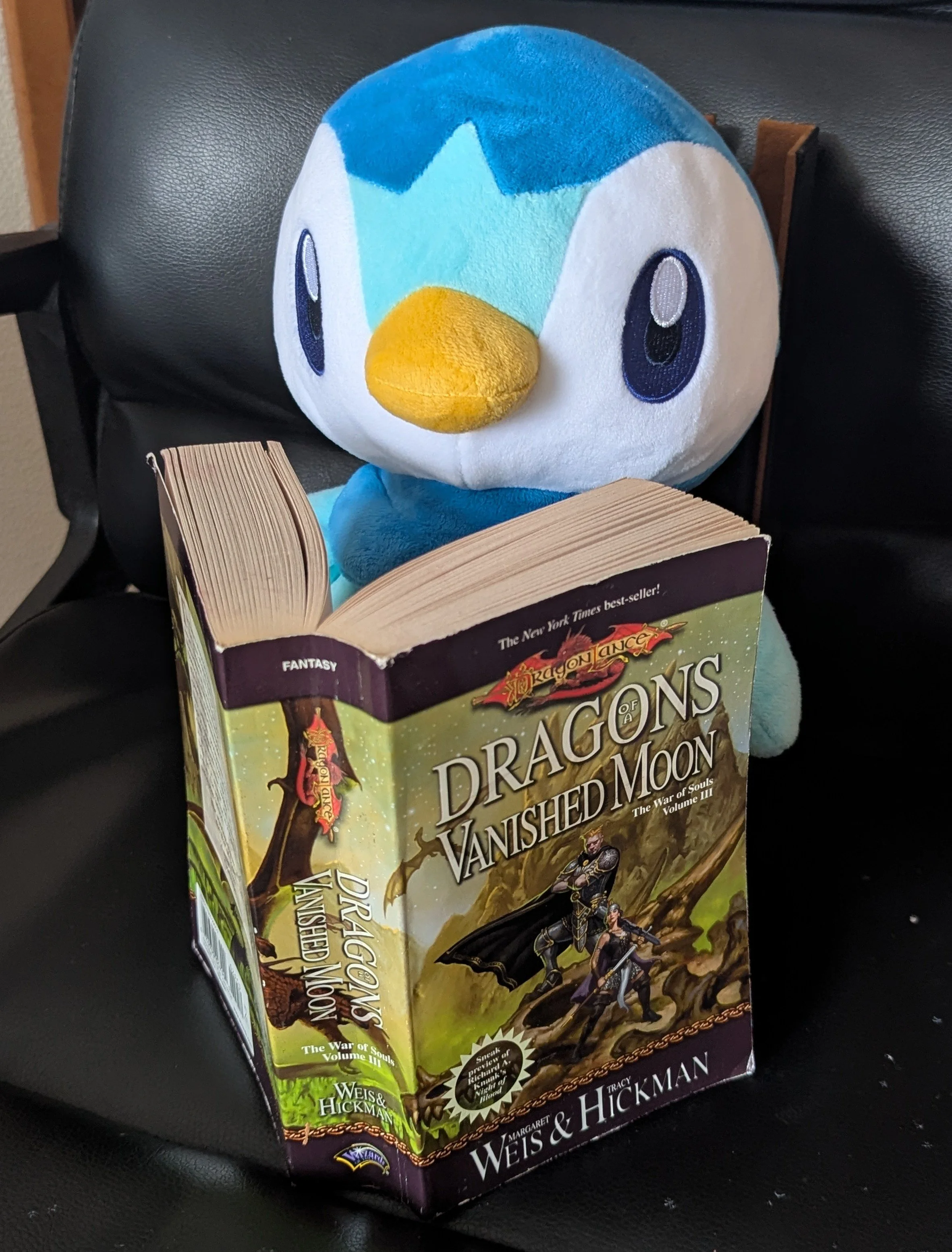
Dragons of a Vanished Moon (The War of Souls, Volume III) (Part 2)
Hello, everyone. Welcome to the second and final part of the review of Dragons of a Vanished Moon, the finale of the War of Souls trilogy. This part will cover the following:
Worldbuilding & Exposition
Plot
Character
Mysteries
I highly to encourage that you check out Part 1 of this review if you haven’t already, as well as the reviews of the previous books in the trilogy. If you’re all caught up or don’t care about that, then let’s get right to it.
STATS
Title: Dragons of a Vanished Moon
Series: The War of Souls (Volume III)
Author(s): Margaret Weis & Tracy Hickman
Genre: Fantasy (Epic)
First Printing: June 2002
Publisher: Wizards of the Coast, Inc.
Rating: 4/10
SPOILER WARNING
Mild spoilers for Dragons of a Vanished Moon will be included throughout this review, through I will keep the first paragraph of each section as spoiler-free as possible. Heavy spoilers will be confined to clearly labelled sections.
There will be heavy, unmarked spoilers for Volumes I and II of The War of Souls (Dragons of a Fallen Sun and Dragons of a Lost Star), as well as other titles earlier in the Dragonlance chronology, particularly the Dragonlance Chronicles series (Dragons of Autumn Twilight, Dragons of Winter Night, and Dragons of Spring Dawning) and Dragons of Summer Flame. Those books fundamentally shape the world in which the War of Souls trilogy takes place, so I can’t really discuss this book without spoiling key elements from those ones.
If you don’t mind spoilers but haven't read the previous books of The War of Souls, I do recommend that you at least go back and read my review of those books, since there will be multiple points in this review where I refer back to what I said in that one.
WORLDBUILDING & EXPOSITION
Early in the book, so much exposition is dumped on the audience that it effectively overturns the status quo of the series, and not in a way that’s earned by the twist from the end of the last book.
When Dragons of a Lost Star ended, we understood that the One God was Takhisis. That was the answer to one mystery, but it left other matters up in the air, particularly how she remained in Krynn after the other gods departed.
Dragons of a Vanished Moon opens by replaying the final scene of Dragons of a Lost Star from the POV of Palin and Dalamar. They are both initially surprised by the twist reveal of Takhisis. And then Dalamar just … jumps to conclusions. He goes from “the One God is Takhisis” to “clearly, Takhisis stole the entire planet and moved it across the multiverse”.
This isn’t the only time this happens. Later, two dragons find out about Takshsis and discuss her return. And they just … know … that the other gods are currently searching for Krynn. They also know that the reason there have been almost no metallic dragons (the dragons of good) in this series is that they left Krynn on the night when the series began, when they sensed Takhisis’s return, to search for the gods, and thus fell into a trap that Takshsis set for them.
We went from two volumes that were full of mystery, except for fundamental exposition that got hammered in, to a volume that lays all cards on the table up front, and those cards completely shift our understanding of the story. It’s jarring. It feels almost as if there’s a book missing that was meant to earn this rushed exposition as the answer to additional mysteries. Were Volumes I and II meant to be a single book, with an extra book that was supposed to come before Volume III? Or did W&H initially want this series to be more than three books?
PLOT
Stakes
Okay, so you have a story where the main antagonist is a god who’s effectively an omnipotent, omnipresent, and omniscient (except for when the story needs her to now know something). She is the master of dragons, controls all magic, and enslaves the souls of all the dead. The protagonists are in a futile struggle against this overwhelming force. Their only hope is for the other gods to find them before this god fully consolidates their hold.
If W&H chose to Show us the gods searching for Krynn, while the heroes developed a concrete plan of action to stall Takhisis from consolidating her hold, this could have worked. There would have been a sense of direction. That isn’t what they chose to go with, though. Instead, the search of the gods for Krynn was an afterthought, and the protagonists bumbled about with no clear sense of what they were doing.
The Bridge (Heavy Spoilers)
In the back half of the book, Takhisis’s objective becomes clear. With Mina’s help, she is preparing a ritual that will allow her to bridge the physically and spiritual realms. This would supposedly make her unstoppable.
What is actually means is not properly explained. I think what the book was getting at is that Takhisis couldn’t manifest a physical avatar for most of the book, but that completing the ritual would allow her to do that.
There’s a point in the story where it seems like there is a possibility to stall Takhisis. There is a totem of dragon skulls that she plans to use for the ritual. At one point in the story, the spirit of Palin conspires with the dragon Mirror to shatter the totem. This is a step in the right direction in terms of the stakes issue, except these two get very little focus in the narrative. Destroying the totem also doesn’t end up meaning anything in the grand scheme of things, as about a hundred pages later, Takhisis makes a bid to enter the world without the totem anyway.
Add to this how easily the gods manifest in the physical world when they return at the climax. How, exactly, would Takhisis keep herself from being overwhelmed by the other 20 gods of this pantheon, one of whom is explicitly her equally due to the magical Balance that’s apparently been a thing for this whol series, three others of whom are the original gods of magic, and one of whom is apparently the rightful god of the dead? Seems like they’d pummel her into submission regardless of what she pulled off.
The Other Drama
All the other events that don’t link directly to combatting Takhisis aren’t terrible, but they do end up feeling like filler. Imagine if Onyx Storm focused almost entirely on Rhiannon struggling with her insecurities as a squad leader and Sawyer dealing with his prosthetic leg, with only occasional glimpses of Violet on the rainbow dragon hunt and us constantly being reminded that the venin will kill everyone if Violet fails. The stories of human drama could absolutely make for a great story. Because everything is so lopsided, though, it turns into filler.
Action
I haven’t really held up my initial plan of comparing changes in Fantasy literature over time, so I’d like to correct that here.
I don’t necessarily think that the action in this book is bad. It also doesn’t seem to be atypical of the era. Around the time I read this book, I also read Hereticus and The Brothers’ War (both of which have reviews coming in the new year), and they were in a similar situation.
What this action is, though is … distant. Less visceral, less exciting. I don’t feel like I’m truly experiencing the action with the characters. I feel like I’m being Told about it.
Is it fair to chalk this up to the era? Hard to say. It could be a matter of POV. Of the three examples I just gave, the most intense action was in Hereticus, which is written in 1st Person POV (which supports a more visceral experience). I would say that the action in both Onyx Storm and The Will of the Many is far exciting than any of this, but they are written in both 1st Person POV and Present Tense, prose that lends itself to an even more immersive and exciting experience.
Alternatively … it could just be a matter of style. The action in Fourth Wing wasn’t all that visceral, after all. Yarros grew into that.
I think I’ll need to evaluate more examples to draw clear conclusions. However, the intensification of action over time is a potential trend to keep track off as more points of comparison are called upon.
CHARACTER
Rather than doing a character-by-character analysis for this one, I’m just going to give an overview, since much of what I have to say has already been covered.
The following is not a comprehensive list of all the POVs within this book, but they are the POVs with the most agency.
Galdar, the minotaur who is Mina’s closest confidant and most loyal servant.
Gerard, the Solamnic knight who originally encountered Tasslehoff back in Volume I.
Odila, another Solamnic knight, who fals into worship of the One God.
Mirror, a blind silver dragon who once knew Mina.
Tasslehoff, the time-traveling kender. While he sits out most of the book, he does technically have a major role to play, as he makes the pivotal decision to travel back in time to his own death, and thus preserve the timeline, at the end of the book.
Gilthas, the king of the Qualinesti elves.
All of them engage in their own struggles through the story. The most noteworthy of these is Gerard and Odila. Gerard is sent into the ranks of the Knights of Neraka as a spy, while Odila deserts from the Solamnic knights out of a desire to have a god to believe in; Gerard tries to convince her to leave the One God’s service, but she refuses, only doing so once she understands that the One God is Takhisis. There are small yet potent character moments throughout the story. It’s just that, as mentioned about, the lopsided stakes makes most of the character drama feel pointless.
The one character arc that holds up throughout the book is Galdar. His entire identity is built around loyalty to Mina, rather than conflict with Takhisis. He loses faith in the One God when he realizes this god is the treacherous consort of his one race’s patron god; however, he remains loyal to Mina. It is tragic and compelling to watch him agonize over Mina’s well-being as Takhisis’s commands place a heavy toll on her.
Mina herself is not really a character in this story. At least, she is not a character with agency, not in the way she was in the previous books. She is very much just a puppet for Takhisis and someone for Galdar to take care of.
The character beat that is rather nice is a vignette featuring the death knight Lord Soth. Tasslehoff stumbles upon him during the random jaunts throughout time and space. As a servant of Takhisis who has languished alone for decades, Lord Soth is now confronted with the decision of whether to serve her now that she is the One God of Krynn. I won’t spoil what he decides and why, because it genuinely is a nice moment. It’s just a shame it’s squandered as filler to keep Tasselhoff out of the story.
MYSTERIES
I can’t honestly say that there are any mysteries in this book. At most, the great unknown is when the Deus ex Machina will kick in. As mentioned above, key exposition that reads like it should have been the answer to one or more mysteries ends up being used to radically shift the status quo from the start of the book.
There is one unanswered question hanging over most of the book: “Where did the metallic dragons end up when Takhisis trapped them?” However, that is never really explained. The story doesn’t give it much focus, and then suddenly, they are discovered. I don’t think we even got an explanation for where the place where they were trapped actually was.
AFTER THE WAR
Dragons of a Vanished Moon is a disappointing ending to an otherwise decent trilogy. It’s not the worst thing ever, and it certainly has its moments, but the execution of the divine conflict was sloppy.
While I don’t recommend Dragons of a Vanished Moon on its own, I don’t think it’s so terrible that it destroys the series. I would just recommend tempering your expectations. The series as a whole is decent enough to read if you want to read Dragonlance.
Whatever you’re here for, thank you for stopping by. Please remember to subscribe if you’d like weekly e-mails with the latest post links and to share this post with others if you enjoyed what you read. Take care, everyone, and have a good weekend.

On Tuesday, February 3rd, Volume I of my first serialized Romantasy novel, A Chime for These Hallowed Bones, premieres!
Kabarāhira is a city of necromancers, and among these necromancers, none are more honorable or respected than Master Japjot Baig. Yadleen has worked under him since she was a girl, learning how commune with bhūtas and how to bind these ancient spirits into wights. Her orderly world is disrupted, however, when a stranger appears with the skeleton of a dishonored woman, demanding that her master fabricate a wight for him.
To protect her master from scandal, Yadleen must take it upon herself to meet this stranger’s demands. Manipulating the dead is within her power, but can honor survive in the face of a man who has none?
You can see the full schedule for Volume I here! I hope you’ll join me on this new adventure.