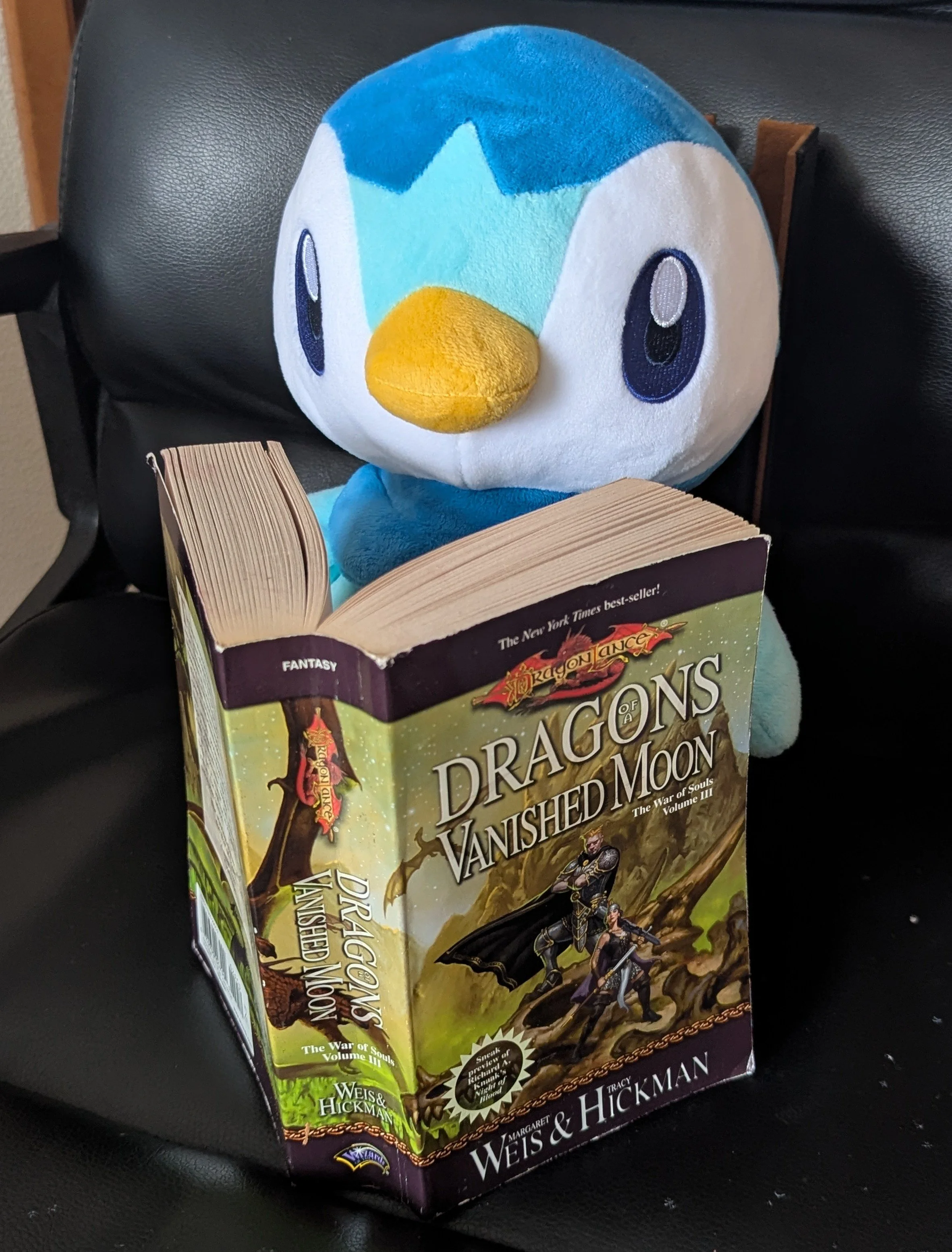
Dragons of a Vanished Moon (The War of Souls, Volume III) (Part 1)
Hello, everyone. Welcome back to the War of Souls for the third and final volume of the trilogy, Dragons of a Vanished Moon.
Full disclosure - I had a bit of trouble getting through this book. Not because of the quality of writing, mind. The diminishing role of Mina as the trilogy progressed and the lackluster reveal of the One God’s identity drained away the element that I had most enjoyed about the trilogy. There was also the issue of lore that got revealed in the opening of the book, the kind of lore that ruined the stakes of the story. I might not have finished reading this book at all, were it not for sake of completionism.
I will strive to maintain my usual throughness and level of quality throughout this review. I just wanted to apologize in advance if I seem less enthusiastic than usual.
STATS
Title: Dragons of a Vanished Moon
Series: The War of Souls (Volume III)
Author(s): Margaret Weis & Tracy Hickman
Genre: Fantasy (Epic)
First Printing: June 2002
Publisher: Wizards of the Coast, Inc.
SPOILER WARNING
Mild spoilers for Dragons of a Vanished Moon will be included throughout this review, through I will keep the first paragraph of each section as spoiler-free as possible. Heavy spoilers will be confined to clearly labelled sections.
There will be heavy, unmarked spoilers for Volumes I and II of The War of Souls (Dragons of a Fallen Sun and Dragons of a Lost Star), as well as other titles earlier in the Dragonlance chronology, particularly the Dragonlance Chronicles series (Dragons of Autumn Twilight, Dragons of Winter Night, and Dragons of Spring Dawning) and Dragons of Summer Flame. Those books fundamentally shape the world in which the War of Souls trilogy takes place, so I can’t really discuss this book without spoiling key elements from those ones.
If you don’t mind spoilers but haven't read the previous books of The War of Souls, I do recommend that you at least go back and read my review of those books, since there will be multiple points in this review where I refer back to what I said in that one.
STRUCTURE
In the interest of comparative analysis, we’ll cover the same points as the previous books, split across two parts:
Part 1 (Today)
Premise
Rating
Series Structure
Target Audience
Title
Prose & Editing
Part 2 (Tuesday, January 20th)
Worldbuilding & Exposition
Plot
Character
Mysteries
PREMISE
From the back cover of the hard copy, we get:
The flames of war devour Ansalon. The army of dead souls marches towards conquest, led by the mystical warrior Mina, who services the powerful One God. A small band of heroes, driven to desperate measures, leads the fight against overwhelming odds.
Two unlikely protagonists emerge. One is a dragon overlord who will not easily relinquish her rule. The other is an irrepressible kender who has been on a strange and remarkable journey that will end in a startling and unforeseen fashion.
Reaction
The first two sentences of this premise are factually correct.
Nothing else is.
There is no “band of heroes”. There are heroes scattered around, and we follow their stories through some decent character moments, but half of them aren’t leading anything, and they certainly aren’t unified.
As for our “unlikely protagonists”, the dragon overlord is treated as a villainous force of nature, while Tasslehoff (who is the only kender this premise can be referring to, as there are no other kender in the core cast) spends the entire story sitting out the action, like a much less interesting version of the Doctor in “Blink”.
RATING: 4/10
Dragons of a Vanished Moon is a story that focuses on its characters. Now that the audience is aware of who the One God is and understand the stakes of the story, we get to see how characters react to being presented with such an unassailable foe. I wouldn’t go so far as to say that any of this characterization work is great, most of it is at least decent. On a chapter by chapter basis, it is somewhat enjoyable to follow their stories.
The problem is that “unassailable foe” bit.
The protagonists are trapped in a world where the only god is the one trying to conquer everything. There is nothing they can actually do to affect the overall trajectory of the narrative. This could have been entertaining in a grimdark, tragic way, with heroes making their desperate last stand against evil … except, from very early in the story, it’s established that the gods of Kyrnn are coming back. They are coming to literally Deus ex Machina away the threat of Takhisis. They will be the ones who resolve the conflict, not any of the characters who we’ve followed thus far or follow throughout the book.
Still, that could have also worked. Maybe this could have been a story about the heroes enacting a desperate gambit to stall the final ascension of Takhisis to mastery over the world. Unfortunately, the majority of the heroes don’t know this, and the ones that do wander around aimlessly before doing a thing that isn’t properly explained and doesn’t end up mattering much to the narrative.
Thus, while there are elements I did want to love here, this whole book feels like a pointless exercise.
And that’s before we get into the handling of POV characters.
SERIES STRUCTURE
To the credit of Weis & Hickman (W&H), they do manage to tie up most of the loose plot threads in this narrative. I can’t recall anything that was set up in Volume I or Volume II that didn’t find some sort of resolution, and of the newer threads in this book that weren’t resolved, they seem to be setting up sequel series (in particular, the Minotaur Wars trilogy and the Dark Disciple trilogy).
The handling of POV characters is another matter. W&H killed off three very important POVs (Goldmoon, Medan, and Laurana) in the last book. They then proceeded to bench three others at the start of the book.
Tasslehoff ends up using the Device of Time Journeying early in the book and ends up ping-ponging through time. Most of this scenes are him popping up in random moments that have no impact on the wider narrative (and I say that despite liking really liking one of the random encounters he has along the way). he then pops up near the end for a Kender ex Machina before going back to his original time to die (a plot thread that has sort of fizzled out as this series progressed and then got resolved abruptly here).
Palin and Dalamar are slaughtered by Mina early in the story, when they refuse to bend knee and worship Takhisis. That should have been the end of it, but Mina then raises their corpses, leaving the pair as disembodied spirits who float around and observe things.
Given how much these three could potentially have impacted the story (Tasslehoff because people would want to wrestle the Device of Time Journeying from him, Palin and Dalamar because their knowledge makes them dangerous even if they are unable to properly use magic), I can’t help but wonder if this was deliberate. W&H wanted to focus on more mundane characters and so wrote these three wild cards out. Were Volume III a standalone story or only the second in the trilogy, I think this could have worked, yet it makes for a rather unsatisfying conclusion. They were set up as important players and got so much focus in the previous entries, yet now they’re swept under the rug.
All in all, as a closing to the trilogy, this is a mixed bag.
TARGET AUDIENCE
This is a weird one to have to explain.
Early in the story, the state of the world is properly established. The gods of Krynn did not leave at the end of the Chaos War; rather, Takhisis shifted the entire planet across the multiverse, then cloaked the world from the sight of the gods. The gods of Krynn has been searching for the world and will return if they find it.
At first brush, this is a fine concept. It does not rely on any external knowledge. Anyone who has read the previous two books will know Takhisis being the One God is a very literal acknowledgement that she is the only god left for this world. Other gods are coming to stop her.
The issue is that, a third of the way through the book, the gods of Krynn are introduced as characters. We get bombarded with names and portfolios. The idea that Krynn is a world of balance, where there must be an equal number of good and evil gods, ends up playing an important role in the story. The potential return of the gods of magic is treated as a big deal. (Also, Raistlin Majere’s soul is chilling in the realm of the gods, as if it’s an airport lounge where he’s waiting for his flight to the afterlife.)
There’s also a good chunk of the story where the threat is that Takhisis will bridge the spiritual and physical worlds, and that this will make her unstoppable … but why? That’s never explained either.
Any time the story dips into this divine worldbuilding, it felt like we needed to do homework before reading this book.. The rest of the story seems like it should be accessible to anyone who has at least read the previous books. If literal Deus ex Machina wasn’t so important to the book, I don’t think this would have been any issue.
TITLE (Heavy Spoilers)
Finally, the title of a book in this series makes perfect sense.
A detail that has been touched on throughout this series is that, before the gods “left”, there were three moons, one for each of the gods of magic. Since the Chaos War, when the gods left, there has been only one. We learn in this book that this moon is a reflection of Takhisis’s power, since she is now the god in control of magic within the world. At a couple of points in the book, it functions as a portal through which Takhisis gazes down upon the world. Takhisis also manifests within this book in her five-headed dragon avatar. With her defeat and the restoration of the other gods, the one moon vanishes and the original three are restored.
PROSE & EDITING
The Tolkien-esque prose of the previous books continues through to this one. For the most part, this isn’t a problem. However, I think it somewhat backfires in the final battle. Tolkien knew how to pace his battle so that they didn’t feel rushed, taking multiple chapters if he had a lot of events to cover. Here, the major battles are torn through so quickly that it enters, “And then they fought,” territory.
Also, there were some editing errors in this professional edited book. The one that jumped out to me most was a repeated work in the last third of the book. It wasn’t even like it was an article, preposition, or some other short word that would be easy to overlook.
THE INVESTIGATION
On Tuesday, January 20th, we’ll conclude the review of Dragons of a Vanished Moon with a discussion of the Worldbuilding, Plot, Character, and Mysteries, including a deeper dive into how the reveal of Takhisis’s involvement undermines the story being told. I hope you’ll join me as we close out not only our review of this book but of the War of Souls as a whole.
Before then, on January 18th, we will kick off our dive into the Ravenor stories of Warhammer 40K with a review of the first short story from Ravenor - The Omnibus, “Playing Patience”. It’s a story that’s a lot of fun, so I highly encourage that you either join me for the review or check it out for yourself.
Whatever you’re here for, thank you for stopping by. Please remember to subscribe if you’d like weekly e-mails with the latest post links and to share this post with others if you enjoyed what you read. Take care, everyone, and have a good weekend.