Path to Power (ARC Copy Review) (Part 1 - Overview)
Yes, you did read that title correctly. I have an Advanced Reader Copy of Path to Power, the re-released of Charlotte Goodwin’s unpublished novel The Queen of Vorn. She put out the call for ARC readers on Twitter. I obliged her. She sent it to me.
Is she going to regret that decision as much I regret reading it?
Hard to say. I really, really, REALLY regret reading this book.
I cannot stress enough how much I was hoping this stupid thing would be good. I went it it fully intending to latch onto the slightest bit of gold, wrench it from the dross, and polish it until it shone too brightly to notice the muck it had been pulled from. I wanted to have a ringside seat to Goodwin’s redemption arc as a writer.
This desperation for a positive mindset was without being offered an ARC copy. When Goodwin made that open offer to the community, I figured, why not? I’d committed myself to reviewing this book already, and I’ve already put in labor for it by answering her call for a beta reader, so why not accept the free copy?
The answer to that question is that this book is the worst-case scenario that I tried so hard to ignore: a book where Goodwin made less than the bare minimum of changes. The added negatives outstrip the improvements. The only reason I can rate it higher than the original is that one of the few things Goodwin fixed is enough to liberate the book from thematic cannibalism. This is still a bad book, but now it isn't kneecapping itself.
Enough burying the lead. Let’s get into it. We’re going to discuss the book itself first, then go into Goodwin’s crash-out in the face of ARC reviews at the very end.
STATS
Title: Path to Power
Series: The Stolen Throne Trilogy (Book 1)
Author(s): Charlotte Goodwin
Genre: Fantasy (Epic)
First Printing: February 20th, 2026 (Scheduled)
Publisher: Self-published to Amazon
STRUCTURE
This analysis will be broken into three parts.
Part 1 (Today) - Overview
Part 2 (Tuesday, December 16th) - Analysis of Improvements
Part 3 (Tuesday, December 23rd) - Show vs. Tell Imbalance, Theme, and a discussion of what was in the version of the book I beta-read
Everything you really need to know to decide whether this book is worth purchasing when it comes out (as stated above, Goodwin currently has the release date schedule for February 20th, 20026) will be presented in this part.
SPOILERS
This is the part where I would talk about how I will handle mild and heavy spoilers for Path to Power … but there is no point.
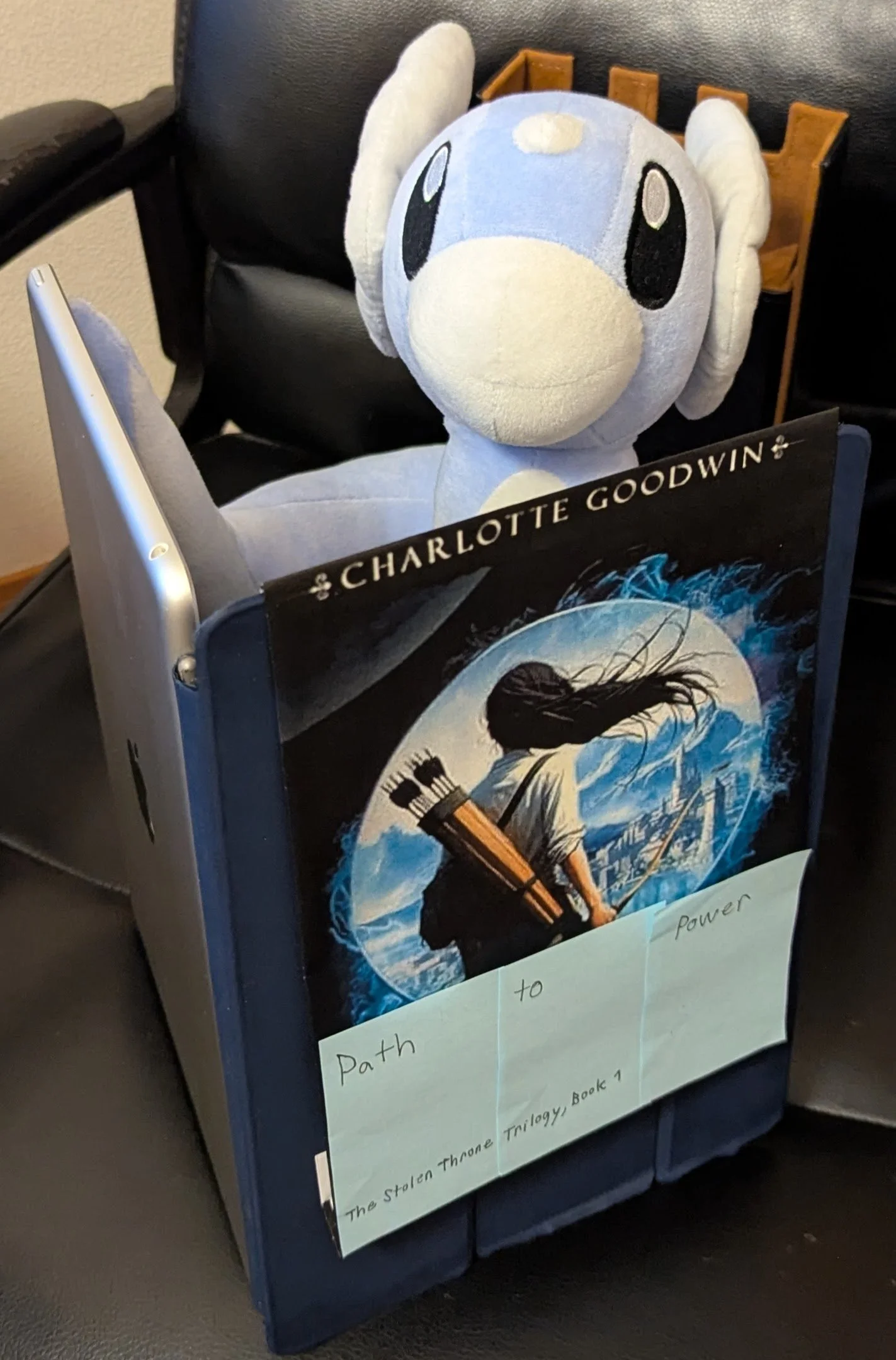
My decision to make the blog picture by just tagging sticky notes onto the cover photo of The Queen of Vorn was not merely a way for me to save 50 yen. I did it because, despite Goodwin changing the title, despite her rewording some dialogue and tweaking internal details within scene, Path to Power is just a hatchet job of The Queen of Vorn. All of the mild or heavy spoilers I might need to bring up in this review were already handled with care and respect in my original review of The Queen of Vorn.
As a result of this, there is no need for me to give heavy spoilers at all. I barely need to give mild spoilers. Anything worth spoiling has already been covered in that previous review, so there’s no need to repeat myself.
PREMISE
At the time of this review, Path to Power is available for pre-order on Amazon. As described on that page:
A queen without a throne, a sorcerer without magic, a usurper bent on genocide...
Emma thought she was just an ordinary woman. She had no idea that she’d been abducted by aliens to save her life; until they returned her memories. The Zargons watch, they study, they don’t interfere, until one of them did. One of them saved Emma’s life when they shouldn’t have, now they want her to save thousands more.
Emma’s stepmother is the mightiest sorcerer Dunia has ever seen. She used her power to steal Emma’s birthright, and now she’s using it for genocide. Only Emma can supplant Queen Lila, but she can’t do it alone. Her husband, Tom, has a potential he never knew; a potential to wield magic. Together, they must travel across the galaxy, find Tom’s magic, and save the homeland she never knew existed, until now.
Reaction
I like this iteration of the premise more than the one from The Queen of Vorn. It’s more concise. Given that Queen Lila is no longer a POV character in this story, reducing the focus on her so that Emma can have more of the spotlight also makes sense.
However … in hindsight, I misspoke in that previous review when I said Goodwin didn’t make any false promises. Both versions of the premise radically oversell the Science Fiction elements. This is something more we’ll get into in Part 2 of this review series.
RATING: 3/10
I should be able to give this book a 4/10. It is effectively the same as the version I beta-read, and I gave that a 4/10.
However, in hindsight, that score was biased by a combination of misplaced optimism and a desire to be encouraging to Goodwin. See, when Goodwin asked for feedback in the beta-read version of the story she shared with me back in July, she asked for me to rate that version of the story. I told her it was a 4/10 score as a means to convey to her the magnitude of the work still to be done while assuring her that she’d already improved from the 2/10 that was The Queen of Vorn. I wrongly assumed she would keep revising the story, and I was blinded by the promise of what might be if she did.
This is still not a bad story. It could be good if told by someone who actually cared about telling a good story. Sadly, Goodwin continues to demonstrate that she doesn’t care about telling a good story. She made the least effort possible to change things from the previous version. The most significant effort she made was to hack out whole chapters to improve the pacing. The rest are small tweaks one could make over a weekend.
The biggest issue is still Show versus Tell. Goodwin still relies on Telling the audience about important plot developments, including entire scenes needed to hold the narrative together. As a result of not correcting this, the plot still fails to build any momentum until (what is now) the halfway point of the book. Everything before that is less a plot and more a string of isolated vignettes that don't have meaningful consequences on later vignettes. As a knock-on effect, Goodwin also didn’t fix any of the narrative contrivances that the Show versus Tell imbalance fed into. Emma and Tom decide to the go the elves because of the sudden reveal of information that they should have had all along, Tom’s magic nuke ability is established in a scene that is not referenced, and the escape of Tom’s group from the military encampment is still based on magical powers that the audience should have been told about in advance if Goodwin wasn’t going to actually show is the escape.
Furthermore, Goodwin didn’t deal with the bloated worldbuilding. She didn’t add to the characters. The few fixes she did make are only for minor details, and while these are mostly good in isolation, a few cause problems if one stops to think about them in the broader context of the story. For example, taking out of the Lila and Grinthy chapters streamlined the plot, but in doing so, the genocide ceased to have any impact of the story. We only glimpse it through videos the Zargons are watching, which is a very detached experience. It goes from something Goodwin is trying way to hard to make edgy to hollow noise.
At the end of the day, the only reason I rate this version of the book higher than The Queen of Vorn is that the thematic foundation is not as horribly botched. No longer does this book go out of its way to present the victims of genocide as monsters while making the defense of those monsters into the only driving force behind the plot. Instead, it goes out of its way to present the victims of genocide as monsters, but now the driving force of the plot is on stopping the genocide before the slippery slope of extremism leads to the deaths of people who aren’t monsters. It’s still ludicrous, but it does at least hold together.
STORY
The Hatchet Job
This book is nearly identical to the version that I beta-read, with only small internal tweaks within chapters. Basically, to read this book, all you need to do is pick up a copy of The Queen of Vorn (or, I suppose, my story summaries from Parts 4 through 6 of the original review) and read the following chapters:
Chapters 4 through 7
Chapters 9 through 11
The last few pages of Chapter 12 have been tagged onto the Zark POV scene that previously sat in the back half of Chapter 10. Yes, it is every bit as awkward as my putting this explanation in the middle of a list.
Chapters 13 through 15
Chapters 17 & 18
Chapter 20
Chapters 22 through 25
Chapters 27 through 29
Chapters 31 through 33
Of the ten chapters that were cut (I’m counting Chapter 12), we got:
Chapters 1 through 3 were the introductory chapters for Emma, Tom, and Lila. Goodwin has been open about cutting these for a stronger opening, and it’s a decision I agree with the broad strokes of.
Two additional POV chapters for Lila
All of Grinthy’s POV chapters
Outside of slicing chapters out, Goodwin also broke a couple of the remaining chapters down into smaller ones to better focus on specific POVs (i.e. isolating scenes in Zark’s POV that were previously lumped onto the ends of other chapters). There may have been a Zark POV scene in one of the cut chapters that survived to this book as its own chapter, but as we covered in the original review, Zark is irrelevant to this story. Goodwin could have wiped out the Zark POV scenes, too, and lost nothing.
The only other significant story change that I could identify was that Goodwin scrubbed most references to Grinthy as a meaningful character. Grinthy’s boss fight at the climax is now the death of a random goblin. Her name is only mentioned in a single exchange of dialogue between goblins when Emma is abducted. In fact, the only relic of Grinthy’s importance is that repurposed scene from Chapter 12, which I will come back to next week.
Inadequate Changes
Back when Goodwin posted Chapter 1 of this book to her website, I had this to say in my analysis of that chapter.
I don’t find this chapter particularly encouraging. The changes we do see are confirmation that Goodwin does have technical skill as a writer and can grow and improve. However, the fact we’re getting recycling text that leaves fundamental issues in place is a warning that Path to Power will just be a slightly rearranged and repatched version of the original text, with maybe a little connective tissue to help things flow better. Given that a lack of connective tissue was a huge problem in the original, maybe that will be enough for the strong concept to shine through. I hope it is. If not, then we could be in for another rough ride.
My prediction has come true in the worst possible way. Goodwin didn’t even add connective tissue. She just repurposed the inadequate connective tissue she had already, with very little to show for it.
She unpublished this book in June. These were all the changes she could be bothered to make between then and November (when the ARC copy released)? This reads like she did a single weekend of work after the beta-read (which, remember, started in July), then paid for line and copy edits. Sure, everyone works at their own pace, so maybe she just works REALLY slow, but in that case, she should have waited longer before going to ARCs and setting a release date.
And to say that she works incredibly slow is really a best-case scenario. Given that Goodwin likes to talk up the quality of her own prose and keeps coming to Twitter for validation when she gets the slightest bit of bad feedback, it seems a lot more likely that she ignored feedback from anyone who didn’t drown her in praise. It’s possible that the few tweaks she did make from the beta-read version were requests made by those who praised her the loudest.
CONTENT WARNING
This book has all the same content issue as The Queen of Vorn, except now, the genocide is dialed way down. It’s not mishandled to the point of absurdity. It’s just a vague idea. We are told it is happening and that it is bad, and that is supposed to be enough. Yes, the principle of the matter can do some heavy lifting, but as content that might affect reader enjoyment, it has effectively been sterilized.
DUE DILIGENCE
The purpose of an ARC reader, as I understand it, is to build hype for a book. The hope is that the reviewer will say positive things to encourage people to buy the book. We are under no obligation to write a positive review, of course (something Goodwin herself acknowledges in the foreword of the ARC copy). Still, I should do my part to identify the target audience for this book.
So, with that in mind, who would I recommend buy this book?
People who buy books to “support indie authors” on principle, with no care for quality (and, possibly, no intention of actually reading the book)
People with an emotional investment in Goodwin, who want to buy it just to support her (especially if, again, reading the book does not matter)
Anyone who truthfully and ironically enjoyed reading The Queen of Vorn and is already dedicated to spend money on the re-release
If you do not fall into any of these three categories, then I cannot in good conscience recommend this book to you. I cannot recommend that you spend money on it, nor can I recommend that you invest time in reading it. There are more deserving indie authors out there in the world, authors who have not flagrantly wasted their second (their third, if we count the unpublishing of the Offspring Trilogy) chance.
THE PATH AHEAD
As indicated above, there will be three parts to this review. Part 2, due out next Tuesday, will assessment the improvements Goodwin could be bothered to make, as well as how the ripple of these changes ultimately created new problems. In Part 3, due out on December 23rd, we’ll discuss the continued impact of Show versus Tell and how the revised theme, while not as self-annihilating as the previous, still doesn’t benefit the story very much.
Thank you all for stopping by. Please remember to subscribe and share if you liked what you read here. Take care, everyone, and have a good week.
…
Okay, if you’re still here, I assume you want to read about Goodwin’s latest crash-out. It’s not necessary to understand the rest of the review series, which was finalized before said crash-out. That’s why I’m sticking it way down here, instead of putting it in front, the way I did when I admitted to being one of her beta-readers. This next bit is purely for those of you who value understanding of the author as a means to better understand the art.
GOODWIN IS SPITTING ON HER ARC READERS NOW
I scheduled this review weeks ago. Originally, I considered holding off until right before the book released, to maximize relevance, but I wanted to release another original work to Tales of the Fives Worlds in January, so I figured I’d get this series out of the way in December. (I then ended up pushing back that original work to February, so we may hit a slight dry spell in January. Apologies in advance.)
I explain this because never, in my wildest dreams, could I have imagined that Goodwin would crash out about ARC reviews just 3 hours before this post released.
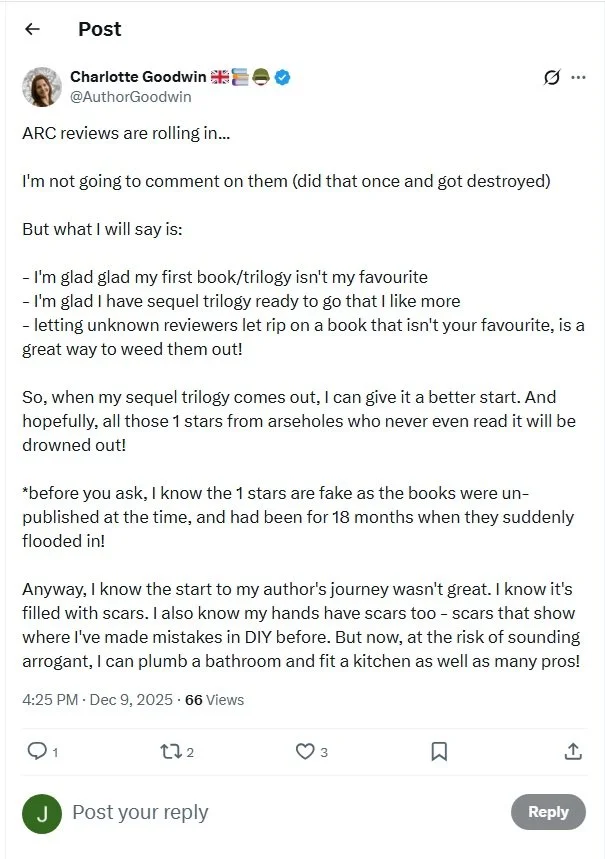
What prompted this, you ask?
Her average ARC reader score on Goodreads, at the time of the Twitter post, was 3.6 stars.
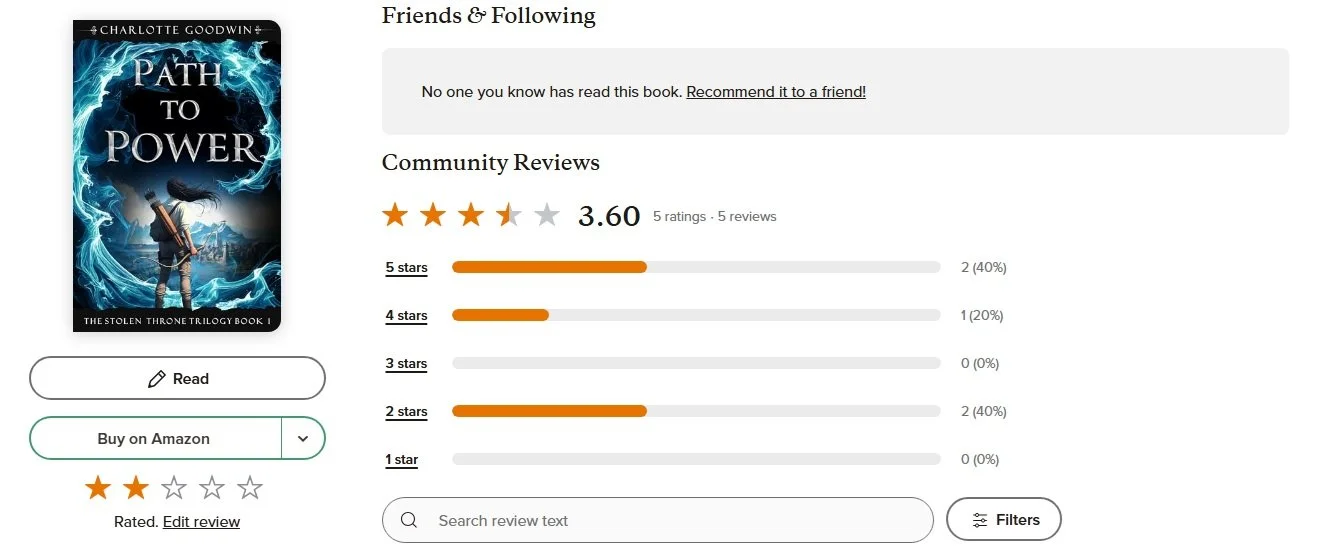
As far as I am aware, these are the only reviews she has. Amazon is blank. Maybe other reviewers have posted elsewhere, but Goodwin told us in the ARC copy to post to Goodreads and Amazon, so even if there are other reviews elsewhere, I don’t know where Goodwin is finding them.
…
Seriously, Ms. Goodwin?
This is just like when you pilloried someone for giving you a 3-star review. Your overall feedback is positive. Even those 2-star reviews, while not holding back on spelling out their issues with your book, admit that there is an audience for it.
What Just Happened Here
Once again, Goodwin is playing the victim so she can market herself as having overcoming that victimhood. By itself, that’s not worth dissecting. I’ve said all I really can on that matter. All I can really do is call her out on it on Twitter (which I did , more on that shortly) and move on with my life.
However … there is something fundamentally disgusting here that I just can’t ignore.
This isn’t Goodwin lashing out at faceless, anonymous people on the Internet. This isn’t her sensationalizing ratings that aren’t attached to any review. This is her lashing out at her ARC readers.
Just like with her beta-readers, she asked people for help. They gave her their time by reading the book. They fulfilled the promise they made to her and posted their reviews in the location that she indicated. And what is her response?
She makes a big deal about overcoming bad reviews … which effectively presents her ARC readers out to be an enemy to be overcome.
She cheers about how bad reviews are “a great way to weed them out”, which sounds an awful lot like a declaration that she’s going to cut lose anyone on her ARC team who fails to give her glowing praise. (From a marketing perspective, this does make sense, but this isn’t something someone is supposed to gloat about in public.)
Also, she belittles her ARC readers as “unknown” reviewers. Since you can’t review a book on Goodreads without an account, none of these reviewers are anonymous - they have names and histories. They are no more anonymous than Goodwin herself is. So the only way that “unknown” makes sense is if it’s meant to be read as “person with no online presence or influence, who is beneath my notice”
Goodwin has just spit in the faces of her ARC team.
Look, if Goodwin were to try to pillory me, and only me, for this little review series about Path to Power, I would not think anything of it. She spat in my face already with the beta read. I’ve also annoyed her with my various attempts to call out her behavior. It would be nice if she takes this review with grace, but my expectations are tempered.
For her to show such blatant disrespect for a wider group, though, is something I find both harder to ignore and a lot more telling about the artist behind this art.
She Demanded An Answer
Goodwin did not take kindly to me calling her out.
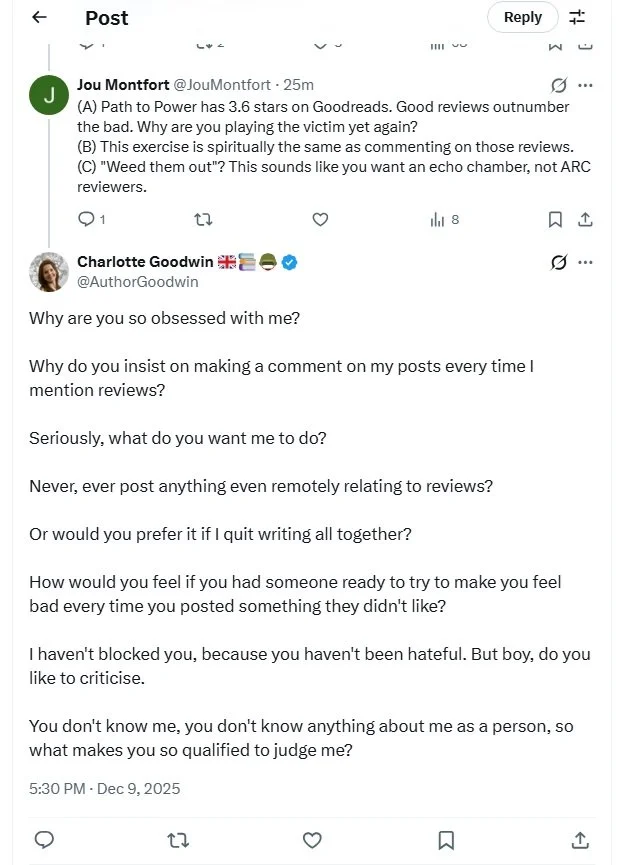
This discussion is ongoing, but the full details are not relevant to this review. You are free to peruse that Twitter thread and judge our respective conduct for yourselves. I will, however, do Goodwin the courtesy of addressing her question.
Ms. Goodwin - I do not judge you as a person. I honestly have zero investment in you. The separation of art and artist matters, and it protects you just as much as it protects me. Furthermore, the way I act towards you is not special, as a glimpse at my other reviews will demonstrate.
Understanding the author can bring clarity to the text. I feel there’s definitely a point where this can go too far, but when it comes to marketing for a book (including, say, a TikTok account, an Instagram, or a Twitter profile that is used for promoting the book), that content is all fair game. The author is choosing to put himself or herself out there in the same line of communication used for the book. This image of the author - which isn’t going to reflect the entirety of the author’s character - is fair game for analysis alongside the book. If the author didn’t want us to understand him or her in this manner, surely he or she would have kept this information to a personal account. That’s why I have so much to comment upon with regards to Rebecca Yarros’s life influencing her work. She shares so many details about herself in the open in the course of marketing her books.
So, Ms. Goodwin, to answer your question, I’m going to divide you into two boxes.
One is Charlotte Goodwin is totality. That’s you, and it’s the person you tell yourself I’m criticizing when I dissect your work.
The other is the Author, the persona attached to this book, a shadow understood only through narrative voice and any professional communications associated with the book (like Twitter, comments made on book reviews, or e-mails sent to a reviewer). This is who I am actually criticizing when I call you out in the middle of a review..
We can criticize the Author, and it should be understood that that criticism does not apply to you, not unless you do something so reckless as to try to assert your personal feelings as a counterpoint to a review. Furthermore, it can be understood that all of this is just my personal opinion, based upon you public actions and private correspondence with me, rather than any sort of legally binding stigma enforced by medicine or law.
All right. Ready?
The Author is a viper.
The Author calls out to the writing community to help her. When they answer her call, but don’t deliver the dose of validation she craves, she turns and bites them.
The Author can’t just ignore beta-reader feedback - she has to go looking for excuses to reject that feedback. She then can’t keep that matter to herself - she has to contact the beta-reader right away to explain why the feedback doesn’t matter.
The Author can’t just ignore bad reviews by people she asked to provide her with reviews. She needs to hype herself up as this person who has grown to the point that bad reviews don’t matter because she doesn’t really care about this book, because the reviewers are “unknown”, and because she’s just going to cull the ARC team and try again (with the implication being that the next group will be an echo chamber).
The Author does not care about her audience. More specifically, she does not care about her paying customers. As we will get into throughout this review, she put less than the bare minimum of effort into editing this book. She expects people to pay money for a hatchet job of the book she previously admitted to having flaws. That would be fine for fiction available for free on her website, but - and I cannot emphasize this enough - she is expecting people to pay money for it. This is immensely disrespectful to her audience.
The Author wants to be seen as a Writer. She shows zero investment in telling a good story. She puts more effort into fighting people in Twitter threads than she has into this book. The image of being a good writer is what matters, not the writing.
And thus, it should come as no surprise that the Author’s handiwork is so poor - because, at the end of the day, the pattern of behavior on display is that the Author only cares about herself, not any of the people who might read her work.
Final Statement to the Author
Ms. Goodwin, I’m only here writing this review because I previously promised my audience that I’d do a comparative analysis of Path to Power to The Queen of Vorn. I was honestly fascinated. How would a re-publication differ from the original? What new perspective would you provide to us about your world and characters? I suppose asking for new content (i.e. wholly new scenes that weren’t merely repurposed versions of scenes in the original book) would be a bit of an ask, but maybe you would make significant rewrites to the various scenes that would shift our perspective of what happened.
Instead, you delivered this hatchet job.
And that would have been the end of it. I was going to put out my 3-part review and wash my hands of you. There wasn’t high reader demand for The Queen of Vorn content, and it’s not like I’m writing these reviews for your entertainment. So, since I didn’t like either version of the book, I figured I’d just keep my promise and move along. No sense in me going on when I have more enjoyable things to read.
Except you had to crash out over a pair of 2-star reviews, and then acted like I kicked your dog when I called you out for that. This behavior is incredibly informative about the artist behind the art.
And now that I’ve shared those insights and applied them to the art … you and me are done.
If you want to prove you’ve grown, walk away. Do not comment on this review. Do not send me another e-mail begging me to read your blog posts about your childhood. I suppose you might pillory me on Twitter, but that would just bring me to the attention of your wider Twitter network, thereby driving traffic to my website, so I’d benefit from that in the long run. (I suppose you might block me on Twitter, but you just set not blocking someone as some sort of moral standard, so blocking me now would also not look great.)
I sincerely do wish that you grow as an author, both in your writing and your online conduct, and find great success. I’m just done being one of the people who gives you that chance. So let’s get this review over with and part ways, moving along our respective paths.