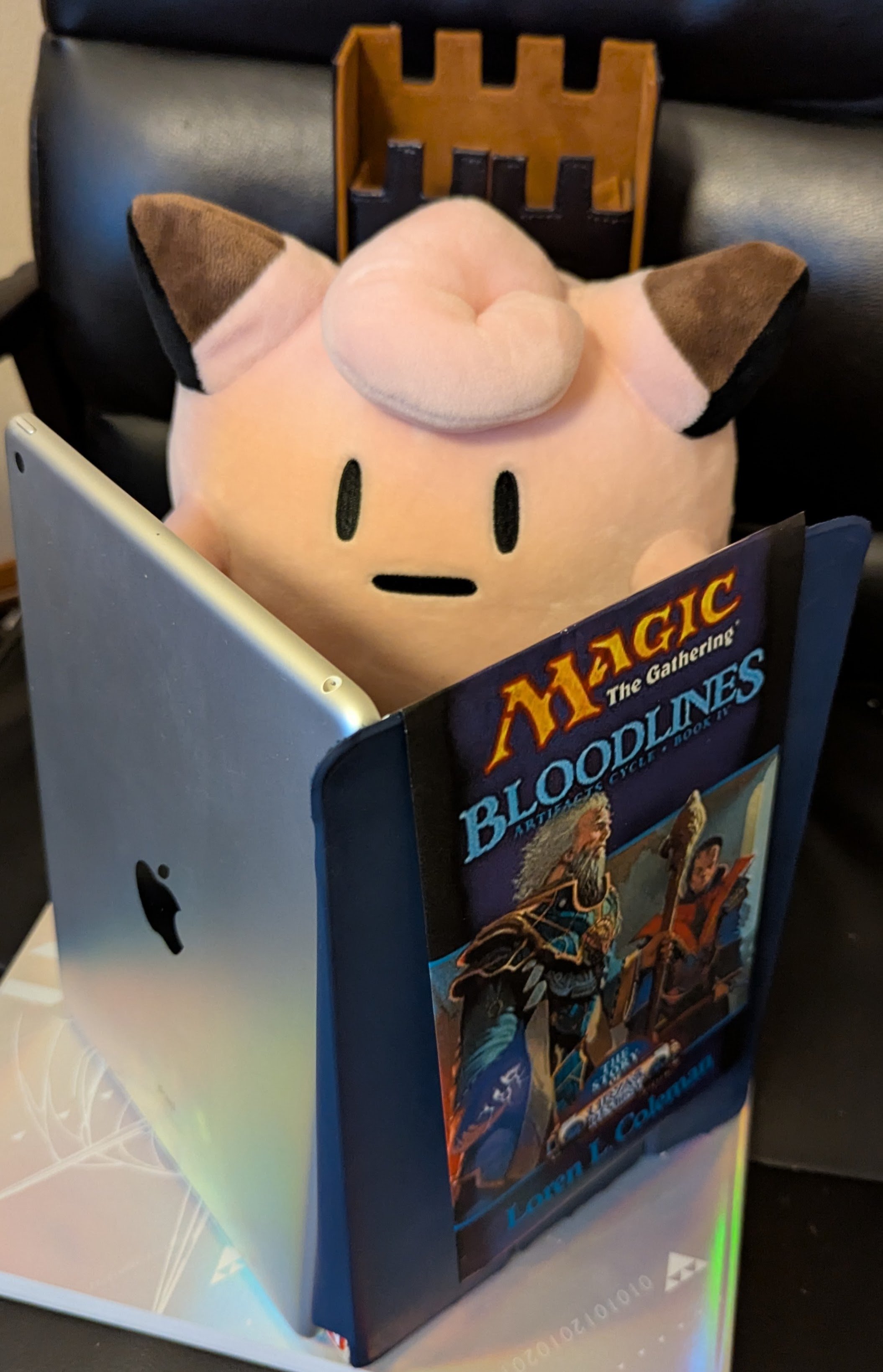
Bloodlines (The Artifacts Cycle, Book 4) (Part 3 - Plot & Theme)
Welcome back, everyone, for the final entry in the exploration of the Artifacts Cycle tie-in novels for Magic: the Gathering (MTG).
This is the third and final part of the analysis of Bloodlines. Please check out Part 1 if you’d like the overview and Part 2 if you want to read about the worldbuilding and characters (I do recommend at least glancing over Part 2 before you read this part, as the analysis of plot and theme lean on some key points in those areas). If you’re all caught up, let’s go for one last ‘walk.
STATS
Title: Bloodlines
Series: The Artifacts Cycle (Book 4)
Author(s): Loren L. Coleman
Genre: Epic Fantasy
First Printing: August 1999
Publisher: Wizards of the Coast LLC
Rating: 6.5 / 10
SPOILER WARNING
Mild, unmarked spoilers for Bloodlines will be provided throughout this review. Heavy spoilers will be confined to clearly labeled sections. I will keep the first paragraph of any given section spoiler-free.
Throughout this review, I will also be providing heavy spoilers for later events within MTG canon. While I will be steering clear of details that would spoil the progression of this book specifically, there is a strong chance that you will figure out certain spoilers if you pay attention to these bits of lore. I’ll confine the heavy spoilers that are relevant to this book into clearly marked sections.
Heavy, unmarked spoilers for The Brothers’ War, Planeswalker, and Time Streams will be provided throughout this review. I will also assume that you’ve already read my reviews of those books, though they aren’t essential to understand this one.
PLOT
Time and Pacing
While Bloodlines follows in the footsteps of The Brothers’ War by breaking the story down into parts, these parts don’t really divide the narrative in the same way. They contribution to the narrative boils to the vibes. Time skips of decades or centuries are either directly references or inferred by generational family ties. Coleman could have gotten the same result by just starting each chapter with a little note to reference what year the chapter starts in.
Also, because I need to mention this somewhere: this book is only 212 pages long (and that’s including the front cover and the pages that break up the different parts of the book). It is insanely short. I feel like a lot of the issues with the characters, not to mention the problems we’re about to discuss for the plot, could have been addressed if the book were longer. We could have had time for slower scenes to properly explore the various ideas being tossed around.
Unnecessary Backstory
I liked the plot of this book.
I also think that, if you were to read MTG tie-in novels just to get caught up on the wider lore, you could skip it.
This book is marketed on the Legacy, and more specifically, the creation of the person who will eventually trigger the Legacy Weapon. It’s effectively 212 pages (yes, this book is very short) is backstory as to why Gerrard Capashen is so good at fighting Phyrexians. I think the lore implications of this are interesting (and we’ll get into those later), but it’s an explanation that takes one short paragraph to deliver. We did not need to read about a long succession of Gerrard’s ancestors or about immortal characters pondering the moral sacrifices of preparing to fight an existential threat for this to make sense. It’s the same problem as, say, using a bonus chapter to explain why Xaden chosen Liam to protect Violet, only this one is blown so far out of proportion that it fills an entire book.
What I find rather ironic is that the Legacy itself gets the very same treatment that the Bloodlines Project could have gotten. It is introduced at the start of the book as a collection of artifacts that Urza is having prepared. It is mentioned midway through the story as something that has been completed, with the artifacts being shipped off for safekeeping away from Tolaria. They then get mentioned again in the epilogue. All we really learn about them is that the Weatherlight is a part of the collectoin and that the person created by the Bloodlines Project will wield them.
The Big Picture
Strange as this may sound, given that every plot thread in this story is touched by the Legacy and Bloodlines Project … this story has almost nothing to do with the Legacy or the Bloodlines Project.
Urza’s decision to pursue these two things is the inciting incident that kicks everything except the Phyrexian plot into gear. The plot threads we’ll get into below are undeniably affected by them. It’s just that very little time is actually spent on these things directly. The Legacy, as we’ve already covered, fades into the background very quickly. Outside of the Bloodlines Project, it is introduced in the prologue, we get told is is suffering setbacks and moral quandaries over the next couple of chapters, and then it also fades into the background, save for moments when we get reminded about the moral quandary. (I’ll get into this more when discussing the theme.)
At the end of the day, the big picture conflict promised by the Premise is just set dressing. It provides understanding for the generational character vignettes.
Phyrexian Schemes
This is a pretty bland villain plot. A high-ranking Phyrexian named Croag is tasked by Yawgmoth himself to kill Urza and to see the completion of the plane of Rath. Croag delegates both duties to Davvol, a collaborator who seeks compleation as a Phyrexian. From there, the two engage in a power struggle as Rath expands and planeshifting experiments are conducted. Eventually, they notice the effects of the Bloodlines Project, tying it to Urza, and seek to destroy his handiwork.
I don’t think this plot is bad. It just reads very blandly. The power struggle isn’t a complex web of intrigue, just two characters whose ambitions are best served by them disposing of one another. The focus on killing Urza also reads like a less interesting version of the conflict with K’rrick in Time Streams. The main thing of value in this plot is the demonstration of the planeshift effect.
The Bloodlines
Keld
In Chapter 1, we are introduced to Gatha as an incredibly arrogant scholar who is assigned to the Bloodlines Project at the Tolarian Academy. He repeatedly engages in unofficial experiments that cost the Bloodlines generations of work. After he’s caught destroying data on his failed experiments, Gatha is reassigned. He responds by stealing his research and a stockpile of slow-time water and leaving the Academy. Eventually, he finds a home with the warlike Keldons and begins genetically engineering their warriors, building both their power and his own over centuries. Eventually, his efforts catch the attention of the Phyrexians, leads to a localized invasion of the Phyrexians into the Keldon homefront to exterminate his creations.
What I find so fascinating about Gatha’s plot is that, in any other story, he would be the villain. He’s an entitled genius who seeks to build his own power and glory. However, even thought we get only sporadic glimpses of his ascent through Keldon society, including his relationship with the “immortal” warlord Kreig (his greatest success, with whom he shares his slow-time water), it’s still fascinating to see how the ripples of Urza’s ambitions with the Bloodlines ripple through this warrior society. I suspect that the impact of this subplot will be see in the novel Prophecies (which I vaguely remember involves a Keldon onslaught stirred up by the Phyrexians).
Benalia
This plot thread is where the generational story is strongest. We bounce through a series of vignettes involving the Capashen clan in Benalia, starting with a marriage engineered by Urza and checking in on generations of Capashens descended from this union. The Phyrexians quickly flag this bloodline as a threat, and make several attempts over the centuries to exterminate it. In each vignette, we see how successive Capashens become more and more deadly in encounters with the Phyrexians. Naturally, this plot ends with the birth of Gerrard.
While it was hard to remain emotionally engaged with this one (due to the constantly rotating cast), I did appreciate this plot. It provides a very interesting progression of power through a family. I now have a new appreciation for why Gerrard is the big hero of the First Phyrexian Invasion.
Yavimaya
This plot was a really strong example of backstory we really didn’t need.
While the Bloodlines Project seeds human populations with heros who can stand up to the Phyrexians, the forest of Yavimaya is undergoing its own preparations for the Phyrexians. The spirit of the forest kicks off a massive cycle of growth, death, and rebirth, evolving its animals and plants into forms capable of fending off metal war machines and accumulating biomass that can be used to rapidly spawn reinforcements. Much of this is down under the supervision of the Llanowar elf Rofellos, who imparts the warlike spirit of those elves upon the forest while its usual defender, Multani, is off on diplomatic missions.
All of this could have been handwaved with a passing statement in dialogue. Coleman tries to do this character arc about Rofellos losing his identity as he connects more and more with the spirit of Yavimaya, but it’s really hard to understand what exactly is happening and why. There’s also some antagonism between him and Multani that’s a little hard to follow. I’m not even sure this gets any sort of resolution by the end. Multani just comes back to Yavimaya and agrees to work with Rofellos on the remaining preparations for the war.
THEME
To cap this review off, I’d like to go into the theme. It falls flat of the emotional weight I assume Coleman was going for, yet it does at least tie the story together.
The theme statement is delivered in the second-to-last paragraph of the epilogue.
Urza Planeswalker focused on his human components as his path to an end product rather than for their own special talents and abilities. Living among them, caring for them as children and often befriending them as adults, the golem instead recognized in each the spirit that defied Phyrexia and promised any form of salvation. Urza had been wrong in that. Perhaps they would not wield the Legacy in its final form and discover how to defeat Phyrexia once and for all time, but one of them survived. How many more might be critical to the future? This was a simple truth, which Karn in his limited memory had recognized where Urza Planeswalker and his millennia of experience had not. Every one of them, bloodline subject or not, was a separate hope for Dominaria—could make a final difference that might stand between life and loss.
What have we become?! (Part 2)
The emphasis on Urza being wrong sounds like it is meant to tie into the moral horror we’ve previously covered. It seems to be saying that Urza is the eugenicist who doesn’t value individuals. He threw away countless lives in skirmishes and schemes, yet any one of them could have made the difference.
Yeah … that doesn’t really work.
As we covered while discussing characters, we are shown almost nothing to point to the Bloodlines Project being problematic. The closest we got was the Metathran issue, but they got swept under the rug really quickly, and this statement isn’t about the Metathran in any case. It’s about the bloodlines where Urza is massaging in Phyrexian genetic material and arranging marriage, but otherwise leaving people alone to live their lives. What’s more, Urza wasn’t just throwing away lives in search of his one perfect specimen. The Phyrexians were the ones culling the ranks.
Also, this is the one place where Karn forgetting things matters. We are explicitly told that his memories wipe after a single generation, so how does he have the perspective to comment on all the humans he’s lived among? He should only remember the last generation, and that’s an insignificant slice of the whole Bloodlines Project.
This just doesn’t land emotionally. It reads more like Karn got drunk one night and decided to post a rank on Twitter.
A Nice Bow on Things
All that being said, I like the broad strokes of this theme statement. It recontextualizes the plot.
Without this theme statement, the plot is rather messy. We have the Phyrexians doing their thing, then a bunch of things happening on Keld, Yavimaya, and Benalia, and then finally some odds and ends on Tolaria. (And I just now realized that, much like Time Streams, the plot of Bloodlines touches upon all five colors of mana.) Sure, we’re getting some interesting vignettes, but it doesn’t feel like the overall story is progresses, and none of the character work is particularly deep.
With the statement, though, there’s a unifying sense of purpose to at least Keld, Yavimaya, and Benalia plots. We are seeing small-scale efforts to prepare for planetwide war with the Phyrexians. We’re seeing how this effort to evolve to meet the challenge is affecting individuals and communities. We’re also seeing how Phyrexia begins to register these small-scale efforts as a bigger threat to its existence than Urza Planeswalker himself and turns its attention into snuffing out this challenge.
I don’t think this negates the flaws of the individual plot lines. Rather, it sends the story on a satisfying note that makes these stories feel much more satisfying in hindsight.
THE INHERITOR
Bloodlines is an okay story, the baseline one would expect for a tie-in novel. If all you are looking for is an exploration of a certain era of MTG lore, I think you might enjoy it. I just recommend tempering one’s expectations. The story makes a lot of promises up front that aren’t followed through on, so if you don’t enjoy the vignettes that it delivers instead, it may not be the most enjoyable read.
Thank you all for stopping by. Please remember to subscribe and share if you enjoy what you read here. Take care, everyone, and have a good weekend.