Moral Support (Chapter 2)
Tamseszéns were an ugly race. Generations in volcanic darkness had left their flesh pallid. They had putrid pits of mud for eyes, and their noses were upturned like pig snouts. Unlike most barbarians, they had healthy teeth, but this wasn’t to their benefit. Those pearly fangs gleamed in the indirect light of the headlamps as they shrieked battle cries that harmonized with their shamans’ chants.
“Fire at will!” Gvish barked.
His squad targeted the most heavily armored barbarians first. Those wearing steel mail or brigandines fell as Kimian bullets punched through their primitive protection. The Rangers swiftly chambered their next rounds and fired again. By the time Tamseszéns closed to the range of spears and swords, twenty of their number lay dead or dying.
That left at least forty.
There was no time to fix bayonets. Gvish tossed the rifle over his head, praying Bracha at least had the self-awareness to catch it, and dismounted his bike. His shamshir sang free from its scabbard. In two smooth strokes, he cleaved through the first spear to dart towards him and opened the spearman’s throat.
His gambeson turned a second spear. This spearman was smarter, leaping back before Gvish could cut him down and allowing a companion with an axe to step in. Gvish blocked the axe with his forearm. Heat flashed through his gambeson, and the carmot mesh down the left side of his body briefly stiffened to resist the impact. Gvish drove his shamshir through the axe-wielder’s woolen armor, seized the axe, and split the helm of the second spearman.
Another fusillade of musket fire roared. A ball bounced off Gvish’s back. Several barbarians fell to friendly fire. In the confusion that followed, their line recoiled from the Rangers and the bikes, just enough to provide a moment to breathe.
This was the way with Tamseszéns. These weren't professional soldiers, just peasants who’d been armed and herded to the Front to die. All they had on their side were zeal and numbers.
That, and daímōn magic.
Gvish risked a glance at the boar-riding shamans. They held their positions, continuing the chant, driving their sacrificial lambs to suicidal fury. The boars remained as still as stuffed trophies.
They must want the bikes … but if their cannon fodder fail, they’ll cut their losses. They’ll send in the beasts to trample everything.
The horde didn’t give Gvish enough time to identify an escape route. With renewed cries, they rallied. A Tamseszén captain burst through their line to lead the charge, barreling straight towards Gvish. This barbarian wore a scavenged Kimian gambeson in the same indigo hue as the shamans. Over it, he wore a black scapular stitched with daímōnic sigils in gold thread. A two-handed executioner’s sword shone in his hands.
Gvish sprang aside, and the captain’s stroke glanced off the motorbike with a metallic shriek. One of the shamans stopped chanting to bark something sharp in the Tamseszén tongue. The captain flinched. Gvish seized this opening, striking at the captain’s head, but he took his right hand off his sword and threw up that arm to block. The shamshir lodged into the carmot-lined sleeve. He flailed at Gvish with the sword, forcing Gvish to tear the shamshir free and spin away.
For a moment, the pair stood frozen, each calculating the stroke needed to defeat the other.
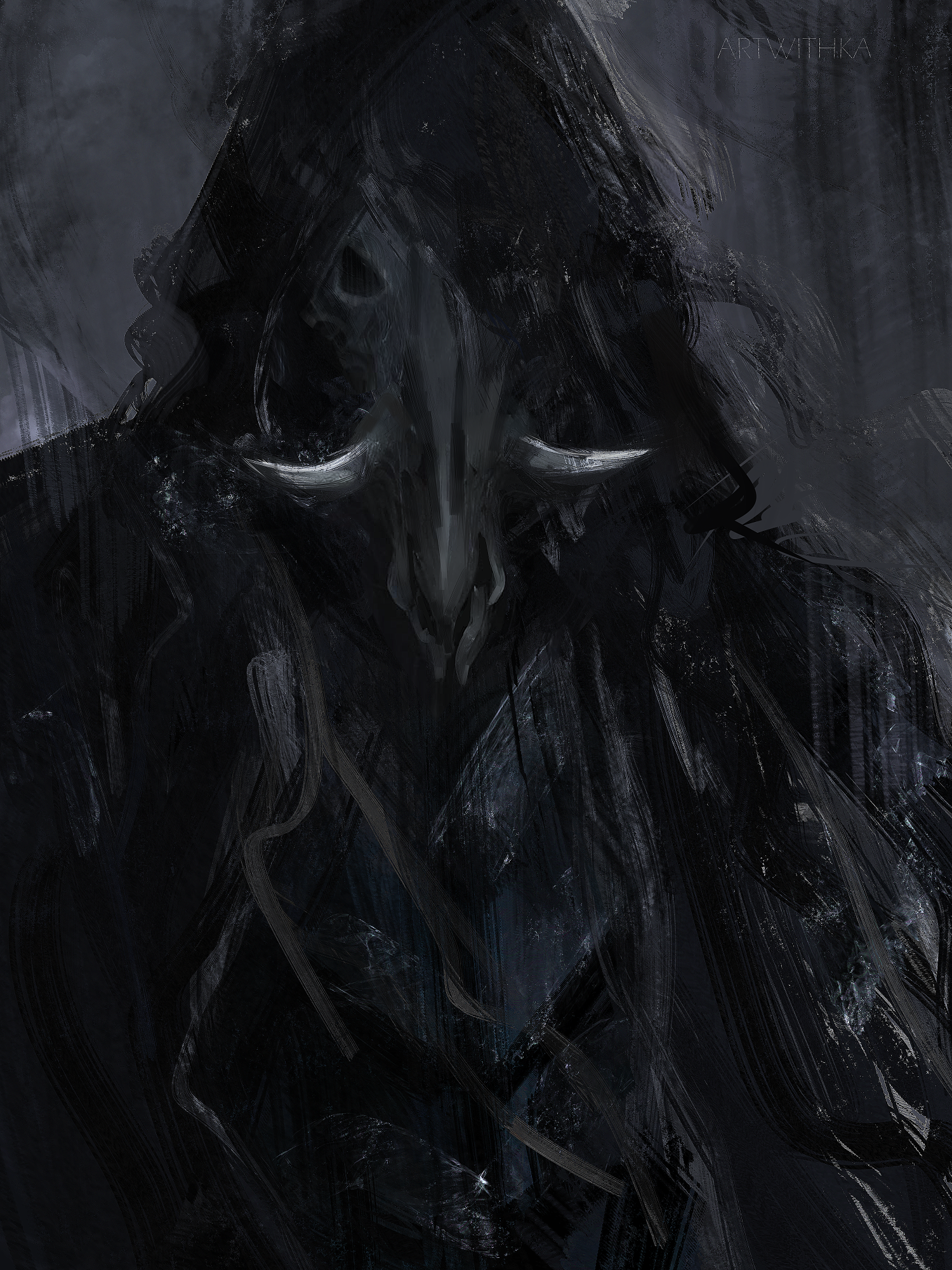
An oily shadow flowed between them.
It happened too fast for either Gvish or the captain to react. One of the shadow’s arms blurred, striking the captain’s head and torso. Cartilage crunched, followed by bone. Carmot squealed as it was struck so hard that it overloaded and shattered like brittle pottery. A wet gurgle emanated from the captain, and he collapsed to the ground.
The shadow pivoted towards Gvish. The motion so was quick, so graceful, that it looked like liquid metal pouring from one man-shaped vessel into another. Now that it faced him, Gvish saw the scarf of gold lamé that it had pulled over its nose and mouth. He also noticed the steel cannister clutched in the shadow’s hand – and that the safety pin had been pulled out.
“Sorry I took so long, Brother,” the shadow said in Habarzelan, dropping the cannister on the ground. “Had to pry the pin out with my teeth.”
Even through the heat of combat, Gvish couldn’t help but bristle at that. You are not my brother, Inquisitor.
A jet of golden fog spewed from either end of the cannister. Gvish tugged a lamé scarf of his own up from inside the collar of his gambeson. Of all the alchemical fumes the Empire had weaponized, this was among the least toxic, but filling one’s lungs with metallic dust was generally unwise.
Bracha continued to move with inhuman grace. As the golden cloud engulfed him, he drew a signal pistol from inside his trench coat and fired it. An orange flare shrieked skyward, bathing the golden cloud in a molten glow.
The cloud smothered the battlefield, and the sounds of violence ceased. When a morality officer decided a fight was over, every Ranger knew to stand down. As for the Tamseszéns, the gold dust disrupted any magic being transmitted through the air, including the power woven into the shamans’ chant. Those who weren’t incapacitated by coughing lost the will to fight once they noticed the casualties they’d already suffered.
Bracha smoothly reached over the motorbike and retrieved Gvish’s rifle from the sidecar. He lobbed it to Gvish. Without another word, he disappeared into the cloud, heading in the direction of the shamans.
With his departure, a sense of pressure eased off Gvish’s chest. Carmot body armor was sensitive to certain magics. The power currently coursing through Bracha’s body was one of those forces.
The pressure was another sign from Truth, Gvish knew. Bracha might call himself a Habarzelan, but he was anything but. It would be better for him if Gvish let him get himself killed.
Archon and Empire. Do your duty for Archon and Empire.
Gvish made sure he had a round chambered before striding after Bracha. His armor squeezed him, confirming that he was hot on the man’s heels.
Bracha stopped at the fringes of the cloud. The boars had tottered backwards to keep clear of the gold dust. The orange light of the flare, blazing high overhead, gleamed dully off the beasts’ glazed eyes. The shamans’ gazes, by comparison, shone murderously.
Bracha hailed the shamans in Tamseszén. Gvish had only a basic grasp of the language. However, he’d been through this procedure with other morality officers on other battlefields. Between that, body language, and common knowledge about the Tamseszéns, it was easy for him to fill in the gaps.
“In the name of the Archon, Father of the Kimian Empire,” Bracha intoned, “I hereby offer you the right to withdraw.”
The shaman who’d rebuked the captain stood up in her saddle. “Withdraw, Infidel?” she spat, eyes bulging. “You trespass in the Gardens of the Laumés, and yet you dare offer us the chance to withdraw?”
Gvish snorted. Tamseszé justified this war by claiming that the Front was sacred ground, an ancient hunting preserve of the daímōn race who had founded their kingdom. He neither knew nor cared if that was true. The monks who now controlled Tamseszé didn’t believe it; if they had, they would have defended the Front when the Empire first claimed it. They wouldn’t have given the Kimians decades to set up very profitable logging operations.
“Once you have departed, we will conduct ourselves around this obstacle,” Bracha was saying, ignoring the shaman’s objection as blithely as he did Gvish’s boundaries. “You have the guarantee of the Archon himself that your dead will not be desecrated. Once we are gone, you will be free to retrieve your people for a proper burial. Don’t worry about clearing the road. We’ll send a Spartoi back to take care of that.”
The second shaman stirred uneasily at the mention of the Spartoi. The first was undeterred. “You filthy hyenas will leave your steel ponies and your weapons with us. If you do not, we shall deliver the wrath of the Laumés upon you!”
Bracha sighed. In Habarzelan, he muttered to Gvish. “Sometimes I wonder why we bother asking nicely.”
Before Gvish could stop him, Bracha took one exaggerated step out of the cloud.
The boars squealed in terror. Gvish though he caught a golden flame reflected in their eyes before they swiveled away from Bracha and heaved themselves towards the trees. The shamans shrieked some Tamseszén prayer. The boars staggered to a halt, but though the shamans tugged at their reins, they refused to turn back towards Bracha. The first shaman bared her teeth at Bracha and hissed.
Gvish shared with her outrage, albeit for different reasons, but there was little he could do. Bracha was an appointed representative of the Imperial Inquisition. The fact he was a heretic to the Habarzelan creed meant nothing to the wider Empire. Duty denied Gvish the power to call him out.
Bracha’s next words were devoid of emotion. “I offer you mercy because it is civilized to do so. Spurn that mercy, and I have no qualms with letting these Rangers off the leash to finish what you started. You have …” He glanced skywards, to the fading light of at the flare. “… about thirty seconds to make your choice.”
Gvish recognized his cue. He raised his rifle and aimed it at the first shaman’s head.
Hatred blazed in the shaman’s eyes, but she saw reason. “Retreat!” she screamed. “Back to the hold!”
Her mount needed no encouragement. The moment the shamans eased off the reins, both boars barreled back into the undergrowth. Behind him, Gvish heard the scramble of many feet as the surviving Tamseszéns fled. The Rangers let them run. The sounds of their passage swiftly faded into the forest.
Bracha released a long breath … and something else. The magic Bracha had drawn from the land was leaching back into the ground, leaving behind a mere man once more. The pressure in Gvish’s gambeson eased.
The magic itself wasn’t evil. It was a gift from Truth. In the days before the Empire, Habarzelan rabbis had used it to master the arts of metallurgy and build mighty golems to defend the holy city of Ir Habarzel. They'd called it Zraz shel Hitgalot, the Catalyst of Revelation. These days, everyone used the Empire’s name for it – the Kimian Soul.
The Soul was not evil, but making heretical pacts with idols, to wield it in ways no Habarzelan should … that was another matter entirely.
Bracha turned to Gvish. It was a natural motion this time, languid compared to how he’d moved moments ago. He spoke in Habarzelan. “Thanks for the backup, Brother. Are your people well?”
You are not my brother, Inquisitor.
Gvish bit his tongue. That wasn’t the sort of thing that any soldier should say, not even to a morality officer. After all, the Empire’s highest moral imperative was order. If a morality officer damned himself to do his job well, that was no concern of theirs.
That doesn’t mean I need to treat him as a fellow Habarzelan.
Gvish turned his back on Bracha and went to check on his squad.
Thank you all for reading! Chapter 3 Part 1 is now available!
If you’d like to read more adventures from the Kimian Empire, you can find them here!
