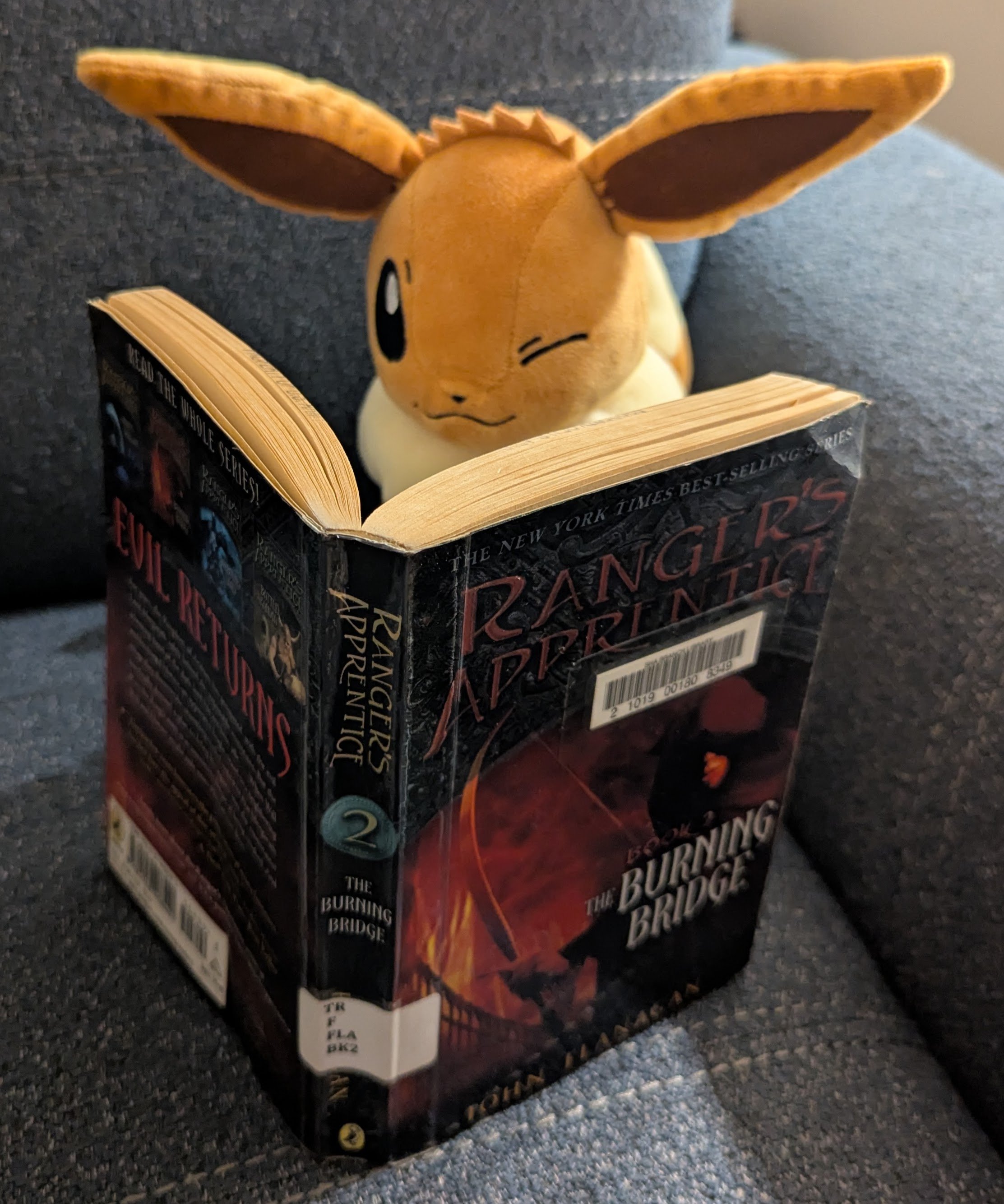
The Burning Bridge (The Ranger's Apprentice, Book 2) (Part 4 - Spotlight on Plot Contrivances
Hello, all. Welcome back to the conclusion of the review for The Burning Bridge, Book 2 of The Ranger’s Apprentice.
We’re going to wrap things up by dissecting the plot contrivances of this book. Please check out Part 1 if you’d just like the overview and Part 2 if you want to look at the worldbuilding and characters. If you want a more general breakdown of the plot, see Part 3.
This is going to be a long one, so I recommend grabbing a snack. When you’re ready, let’s go hunting.
STATS
Title: The Burning Bridge
Series: The Ranger’s Apprentice (Book 2)
Author(s): John Flanagan
Genre: Fantasy (Middle Grade)
First Printing: May 2005
Publisher: Puffin Books
Rating: 8/10
SPOILER WARNING
Unmarked, heavy spoilers for The Burning Bridge will be necessary for this part of the analysis. Additionally, unmarked, heavy spoilers for The Ruins of Gorlan may be used as necessary. I will also assume that you have read the review series for that book, though doing so won’t be necessary to understand this review.
SPOTLIGHT ANALYSIS: PLOT CONTRIVANCE
Definition
Our friends over at Merriam-Webster give a couple definitions for “contrivance”. This one is particularly relevant.
- an artificial arrangement or development
Mistaken identity is used as a plot contrivance in the story.
A plot contrivance occupies a distinct middle ground between a “plot convenience” and a “plot hole”.
A plot convenience is an arrangement or development that is extremely unlikely, but not to the extent that it feels artificial within the narrative.
A plot hole is an arrangement or development or artificial that it damages the narrative.
For an example - well, many examples, to be honest - I’m going to go back to the vault heist in Iron Flame.
The robbery of the vault requires layers upon layers on contrivances. Each of the security measures that Violet and her accessories had to bypass required the designer(s) of said security measure to make a highly illogical, inefficient, and/or counterproductive decision that made said measure seem impressive at a glance but laughably ineffective when one actually stopped to think about it. These individual elements are not impossible, but they are so counterintuitive and self-defeating that they expose the hand of the author, making each one its own contrivance.
In that same sequence, we had examples of plot convenience and plot holes.
The scribe assigned to guard the Archives that night was the one guy who was previously established to sleep while on-duty. This seems unlikely. However, given how riders have regularly assigned duties within the school, it’s safe to assume the scribes have the same system, so there are probably only a limited number of people who might be there on any given night. Even if we rule out the possibility that Violet deliberately chose this night because she knew the schedule and anticipated this guy would be on duty, the odds aren’t ridiculously long. That makes this convenient, but not contrived. (If literally every scribe in the college got rotated through this duty as random, then yes, that would be contrived).
Jesinia, who is a known friend of Violet’s, was able to ask questions about the super-secret vault and yet wasn’t hauled off to be interrogated and executed. This flies in the face of the brutal control over information we were shown earlier in the book, when a rider was executed for requesting access to a report he had no reason to think was classified. This damages the narrative because it flies in the face of elements the author was using the drive up the stakes. Either Jesinia should have been flagged as a threat and executed for asking questions before the heist, or else she should have been the first person suspected of aiding Violet when Violet was caught with incriminating evidence. It’s a plot hole either way.
Applying this to The Burning Bridge, there are some very significant contrivances. They’re not stacked as thickly as the vault heist example, which is a plus. They also don’t open yawning plot holes. Instead, the issue is that the story cannot exist in the form that it does without these extremely artificial circumstances. One of these is also such a contradictory situation that the only reason it isn’t a plot hole is that it involves an internally consistent character decision.
AXES OF CONTRIVANCE
There are three major contrivances within the plot of The Burning Bridge. We’re going to go through them in order of impact.
Evanlyn’s Choice
As previously mentioned when analyzing her characterization, Evanlyn’s decisions within the narrative don’t make a lot of sense. They go against what little characterization she receives. There is one, in particular, that doesn’t hold up, both because Evanlyn should know better and because Will should have called her out for knowing better.
When Will makes the decision to follow the Wargal slave-drivers, he originally plans for Horace to escort Evanlyn back to Araluen. Horace refuses, which makes sense for his character. Will tries to convince him to do it for Evanlyn’s sake, but Horace insists that she can finish the journey alone. At this point, Evanlyn interjects herself into the conversation, arguing that she is safer with them and wants a chance to disrupt the Wargals’ plans.
The problem: Evanlyn knows that she is really Princess Cassandra. She doesn’t have amnesia. She is clearly aware of danger she is in, both in terms of her life and the political situation, since she is hacked off her hair and pretended to be her own servant even when speaking to Rangers (who, remember, are the Special Forces of her family’s kingdom, sworn to protect the realm and, by extension, the monarchs). She is also aware that Gilan left the three of them to bring word of what happened in Celtica to Araluen … which means she should know that her father, the king, will soon believe that she has been captured or killed by the enemy. Even if she assumed she would be perfectly safe, she should know better than to delay her return. The in-character decision for her in this moment would have been to demand that Horace trust the Ranger to handle things alone and to escort her back to Araluen.
Then there’s Will. He does not know Evanlyn is his princess, but he is fully aware that she is lying about her identity and is almost certainly some sort of noblewoman. He lives in a hereditary monarchal system. He shouldn’t need a firm grasp of the political situation or her true identity to understand why it is important that she be escorted back to Araleun. The in-character decision for him would be to call Evanlyn out (or at least think about her being a noblewoman, which he doesn’t even consider in this moment).
Now, if Evanlyn had ended up making it back to Araleun with Horace later in this story, this wouldn’t have necessarily been an issue. What happens instead is that she gets captured alongside Will during the burning of the bridge. This extremely significant event and the dramatic irony associated with it only happen because no one acts in accordance with their characters.
Why is Horace here?
Horace being on this mission in the first place, and thus getting the training from Gilan that allows him to later kill Morgarath, is nonsense.
For the diplomatic mission to Celtica, Gilan needs two people to go with him. This is because of the value the Celtics place on symbolism, particularly the number three. The two people Gilan needs to bring with him need to have some official status within the kingdom. Beyond that, they just need to be warm bodies to fill out the number.
Will coming along makes a measure of sense. He is an official member of the Rangers, bearing the oak leaf sigil that identifies members of their order. Halt’s choice to send Will on this mission also works as a character choice for Halt, in light of his desire to rebuild Will’s confidence after the altercation with Wargals in the opening of the book.
Horace, though, should not be here.
Flanagan tries to justify this as also being a character decision for Halt. There is a certain amount of internal logic to it: Halt wants Will to spent time with a friend, to aid with the confidence-boosting. There are three reasons this simply doesn’t work.
Horace’s “official status” is tenuous, at best. He is a “Battleschool member” - that is to say, a mere cadet in a much larger military. Equating him with Will is like equating a clone cadet to a Jedi Padawan. They are operating is such drastically different spheres of authority that, for Horace to qualify, the whole official status thing needs to be almost meaningless.
Sir Rodney, the Battlemaster of the fief where all our main characters live, has to sign off on sending one of his best cadets away on the eve of war, simply to serve as a warm body to fill a quota. We see later in the story that Rodney is deploying the Battleschool members to the front. Given his mission-oriented focus in the last book (before the bullying was revealed, he was prepared to expel Horace for being a bad student, despite the boy’s obvious talent), it is very hard to buy that he’d agree to send one
This is a diplomatic mission. This book makes a big deal about Halt having personal history with the head of the fief’s Diplomatic Corps, and he is fully aware that Will has a childhood friend who is in the Diplomatic Corps. So why would he not recommend Alyss be send instead of Horace? Sure, she may lack combat skills, but they aren’t anticipating combat, so surely she’d be far more valuable than Horace. (Also, as we’ll get into when we eventually review The Sorcerer in the North, this particular point is strengthened once the concept of the Couriers is introduced to the setting.)
I get that this is all ultimately in the interest of getting Will and Horace on an adventure together. And if that was all there was to it, it wouldn’t be a huge problem. A contrivance confined to the start of a narrative, just to get the ball rolling, is far more forgivable than ones that occur near the middle or end to stretch the drama or resolve problems. It’s just that this particular contrivance also solves a massive narrative problem. If Horace does not come on this mission, he does not train with Will under Gilan. If he does not do that, he does not learn the technique that he ultimately uses to kill Morgarath. This contrivance facilitates a massive shift in direction for the entire series. Him being here needed to be far more justified than this. (Plus, having Alyss be on this trip would negate the contrivances involving Evanlyn, if for no other reason than that Will would have no choice but to bring them both along if he was the only one with the marital skill to protect them.)
The Bridge Is Burning
This is the contrivance that really hurts the narrative.
I’m okay with the fact that Will and his allies are able to set the bridge on fire to begin with. Yes, it only happens because Morgarath’s forces leave it completely unguarded at night (their camp is dozens of meters away, on the other side of a tunnel that does not provide direct line of sight to the bridge), but this terrible decision makes an amount of sense when considering the low intelligence of the Wargals and the Skandians’ unwillingness to do more work than they’re paid for. Once the bridge is on fire, the Skandians respond very quickly, so they redeem themselves in that regard. And it’s not like they left unguarded materials that Will and his allies could use; those had to be scavenged by ripping pieces off the constructed portion of the bridge. While this is a contrivance, it’s relatively small, and so wouldn’t be worth commenting upon in isolation.
As for the bridge itself behind flammable, it is made of “soft pine … perfect firewood” and “tarred cables”. The whole thing was just waiting to go up in flames.
Okay, so Will and his friends walk from the Celtica side of the bridge to Morgarath’s side. There, using boards ripped from the bridge deck and what kindling they could scavenge from the surrounding area, they build bonfires at the base of the pylons holding that end of the bridge. Their thought process is that, even if the whole bridge doesn’t collapse in the fire, destroying Morgarath’s end will make it impractical for the bridge to be repaired. This, again, is fine.
Then the fires start.
After making a huge deal over just how flammable the bridge is, one of the two pylons does not catch fire. We are explicitly told that the fire reaches one of the “tarred cables”, and yet the fire goes out. This means only half of the bridge (lengthwise) is on fire. Will needs to go back across the length that is not on fire is restart and bonfire, otherwise Morgarath could just march troops across.
This is where things fall apart. I’m not a bridge engineer, but anyone who’s passed a high school Tech Ed class knows that this is not how bridges work (not the kind that could be built out of wood and tar with medieval tech, anyway). If one lengthwise half of the bridge collapsed, the remaining bridge deck isn’t going to be viable. The threat of the bridge is neutralized at this point. Sure, maybe Morgarath could move troops along in single file along the bit of deck with the intact pylons and cable, but if moving troops across in single file was a meaningful threat, he wouldn’t have needed the massive bridge in the first place.
Still - fine. Will is a child of his environment. I doubt the Wards had Tech Ed class.
So why not just grab a piece of wood, light it up from the side that’s already burning, and use it as a torch to manually ignite the cable? The cable is flammable. It must be important to supporting the weight of the bridge, or else it wouldn’t be here. Had Will simply done that, he would not need to walk back across and manually reignite the bonfire, and thus, Evanlyn would not need to run to help him.
But then the contradictions start. To jack up the tension, Flanagan points out that, when Evanlyn crosses the bridge to help Will reignite the bonfire, “the weakened bridge structure lurched and swayed”. This is while the fire is still burning. So this bridge is dangerously unstable for an explicitly undersized teenaged boy and a teenaged girl who isn’t described as particularly large or heavy, but Morgarath is supposed to march his army of hulking brutes across it? Why did Evanlyn not stop Will and say, “Look, the bridge is already collapsing, let’s get out of here?”
As with the previous two contrivances, this wouldn’t be a big deal is the impact was isolated. The problem is that is is not. Will and Evanlyn are captured by the Skandians because of this contradictory handling of the collapsing bridge and their inability to think reasonably about this situation. This leads to the dramatic ending of them being hauled off to Skandia while Halt vows to pursue and save Will.
Final Thoughts on Contrivances
Contrivances aren’t the end of the world in fiction. They aren’t great, yet there are scenarios where they’ve forgivable. It’s just a matter of being very careful to minimize the impact of the artificiality and to hide the hand of the author. What hurts The Burning Bridge is that these contrivances are extremely artificial and extremely impactful.
That said, there is a reason why I still rate the book so highly despite how severe these are: the target audience. Middle Grade readers generally aren’t overly concerned about these details. There is a lot more leeway to have things happen Because the Author Said So, provided that the payoff is good enough. Flanagan delivers some very powerful story beats because of these contrivances. I would be a lot less forgiving of this sort of thing in a work written for adults (or even just Young Adult). So long as this series stays in Middle Grade, I think Flanagan can be given some leeway.
That said, it’s generally better not to lean on that sort of excuse. Those of us not writing for Middle Grade - and, preferably, even those of us who are - should strive to minimize contrivance if we can, no matter how good the payoff.
A CHILL IN THE AIR
With that, we come to the end of the review of The Burning Bridge. For all its flaws, I do highly recommend it, especially if you need something for a Middle Grade reader. It is a story that continues to deliver on the sense of danger and adventure of its predecessor.
By the time you read this, I have already read Book 3, The Icebound Land, and written the review. When that review actually gets posted is still up in the air, but it’s my hope to post it in November or December.
Thank you all for stopping by. Please remember to subscribe and share if you enjoyed what you read here. Take care, everyone, and enjoy the rest of your week.