Clutch and Claw (Part 3 - Character)
Hello, all. Welcome back to the review series for Clutch and Claw, the grand finale to Fire and Fang series.
It’s time for us to talk about the foundation of any Romance story: the characters. If you’re looking for just an overview of the book, please see Part 1. If you’re looking for the breakdown of the worldbuilding and the romance, please see Part 2.
If you’re all caught up (or don’t care about that), let’s fly.
STATS
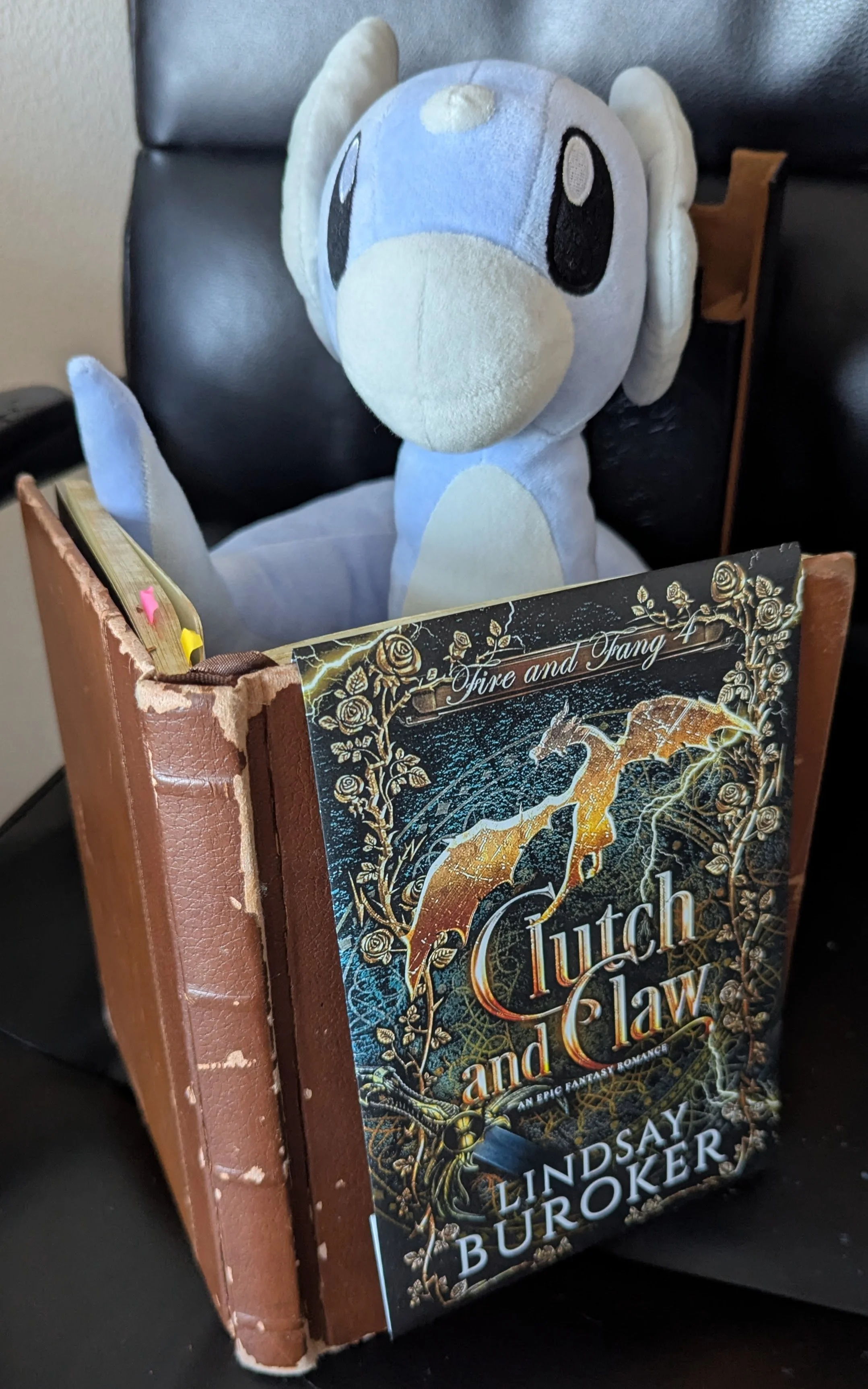
Title: Clutch and Claw
Series: Fire and Fang (Book 4)
Author(s): Lindsay Buroker
Genre: Fantasy (Romantasy)
First Printing: March 2026
Publisher: Self-published to Amazon
Rating: 3/10
SPOILER WARNING
Mild spoilers for Clutch and Claw will be included throughout this review, through I will keep the first paragraph of each section as spoiler-free as possible. Heavy spoilers will be confined to clearly labelled sections.
Heavy, unmarked spoilers for the previous three books in the series - Sky Shielder, Red Dragon, and Game of Captives - will be provided throughout this review. I’m also going to assume that you’ve already read the reviews for those books, though it isn’t necessary to do so to understand this review.
CHARACTERS
Syla
End of the Journey (Heavy Spoilers)
I wouldn’t quite call what Syla has had in this series an “arc”. She makes peace with taking the throne fairly early on in the series. Fighting to take it back after a couple doesn’t tell us anything new about her. The idea of her being a Chosen One is also an extension of her being moonmarked, meaning that diving deeper into this idea doesn’t fundamentally change her interactions with others. Syla remaining static across this book is therefore not surprising.
That being said, Syla’s static nature doesn’t come across as laziness on Buroker’s part. Her decision to maintain her original values while working to take back her throne sets the tone for the type of ruler she wishes to be. At the end of the book, when her (surviving) enemies acknowledge her as their rightful queen, there’s still a sense of payoff. Syla is rewarded to maintaining her original characterization.
Not a Bloody Daydream
In the review of the Magic and Majesty anthology, I commented upon the fact that two of the stories, “Fate of the Nightbloom” and “The Gryphon Key”, read as if the author has fantasies about murdering people and facing no accountability for it. Their protagonists are hand-held into the decision to kill, the murder victims are made as cartoonishly evil as possible, the hand-held protagonist is forced into the deed by circumstance, and then the protagonist is framed as the true victim in all of it. It all feels engineered to allow the protagonists to kill while not being held accountable by either the narrative or the audience.
The assassination subplot of Clutch and Claw has a real risk of going that direction. Syla’s enemies are rather conveniently being picked off in situations where she has plausible deniability. She also insists that she values human life and the rule of law and would never want to harm her enemies (with one exception). When the reveal of the assassin comes, it absolves Syla of any tangential consequences.
What, then, is the difference?
Well, for starters, Syla ACTUALLY values human life. She is not introduced to us by pulling a knife and threatening to mutilate a character over mean words. She does not live within a delusional bubble wherein everyone who doesn’t fit her desired mold is associated with a wife-beating turbo rapist. We are repeatedly Shown that Syla is compassionate towards even her enemies. The only person she expresses a desire to kill is Jhiton, and given Jhiton’s role in the death of her family and his multiple attempts to kill her, this is an exception that doesn’t break her characterization. When an assassin starts killing her enemies, Syla’s horror and her desire to prevent more death therefore comes across as completely sincere rather than a fascade.
Then there are the consequences. Syla does not want her enemies dead. She has other means to deal with them within the laws of her kingdom. In fact, she doesn’t want to kill them because it will send the wrong message to her people about her fitness to rule. Stopping the assassin is necessary to prevent more hardships down the line.
On top of these two points, there is the simple matter that Syla already has the power to kill many, many people, yet rarely chooses to do so. She has Wreylith. It would be very easy for her to take back her throne by slaughtering her way through her own people, or even just to invalidate all fights in this book by summoning Wreylith to annihilate the soldiers loyal to her usurper. Instead, she repeatedly begs Wreylith to it kill her subjects and insists that she can retake the throne peacefully.
I don’t think the assassins subplot is well-written. I actually do think Buroker was using it to deliberate weed out Syla’s enemies, albeit for utilitarian reasons. I am merely bringing this up to point out that Buroker managed to erase Syla’s enemies and keep Syla’s hands clean without either breaking character or churning out unhinged nonsense.
I Didn’t Vote for You
I disagree with the framing of a certain point within the narrative of Clutch and Claw that relates to Syla’s character. My disagreement does not, in and of itself, mean the writing is bad. That’s part of the reason I want to cover it - subjective reactions and objective quality to coexist. Not liking a writing choice does not automatically make it bad, just as liking a writing choice does not automatically make it good.
With that established: I do not believe Syla is in the right in this whole usurpation business. She should not be queen. Frankly, I think Fograth, Syla’s cousin Relvin, and their military allies could do a better job. She should just save the kingdom and go off to a Happily Ever After with Vorik.
Of course, within the world of Fire and Fang, my opinion is objectively wrong. Syla literally has Divine Right to Rule on her side. Even outside of any Chosen One business, she has the moonmark and is of the royal bloodline. Fograth and his military backers don’t. If Relvin were the one on the throne, fine, but he is just a collaborator. Fograth himself respects this fact, because he tries to arrange a marriage with Teyla and thus legitimize his claim via marriage to a moonmarked person who is relatively high up in the pre-existing succession order.
Strictly from a character perspective, though, Syla has demonstrated that she is not suitable for the job. She has no idea what she is doing. I don’t just mean in terms of not being trained for the duty (something set up all the way back in Sky Shielder). I mean that, when she discovers that she has been overthrown, her plan is to win back popular support by reclaiming Harvest Island, ignoring the fact that attempting to reclaim Harvest Island was the very thing this coup exploited. Her refusal to use force against the soldiers loyal to her usurpers, while admirable, also shows she is unable to unwilling to do what is necessary to decisively assert her authority and thus spare her people from needless conflict. Literally the only thing going for her is that she only wants the throne because of a sense of obligation to Divine Right to Rule, and she could easily satisfy that by helping Fograth arrange a marriage to any moonmarked woman who would choose him willingly.
Buroker tries to give three reasons why Fograth is a bad ruler. One of these will need to be covered in the plot analysis, and it ultimately loops back around to Divine Right to Rule. The other two only condemn Fograth morally while doubling down in his greater competence.
Syla condemns the fact that Fograth is motivated by ambition. The thing is, ambition is actually not an inherently bad trait for a leader to have. Ambition can drive a leader to accomplish great works that benefit those he or she leads. Sure, this can go wrong (Hitler’s megaprojects weren’t exactly great for the German economy), but the same can be said for a ruler with no ambition who only sits in the big chair because the gods say she should and who doesn’t take any risks to improve the lives of her people.
Fograth is rounding up moonmarked people, with a clear intent to kill as many of them as possible. This is pretty evil, yet it makes practical sense. He doesn’t need the dozens or hundreds of moonmarked heirs scattered throughout the Garden Kingdom population to keep the shielders running, but any one of them has a stronger claim to the throne than he does. Eliminating all moonmarked persons except his bride and future heirs shuts down a succession crisis.
Despite my disagreement with the story’s framing of the situation, I don’t view this as a literary flaw. This is Syla’s (and Vorik’s) story. Of course the narrative is going to side with her. Syla’s judgment and decisions also read like natural extensions of her character. The framing is natural extension of that characterization.
Vorik
I wish I had a lot to say about Vorik. The thing is … his story ended in Game of Captives. He made his decision to openly side with and support Syla. Everything we see him do in this book, from protecting Syla from the forces of her usurper to challenging one of the stormers chiefs for the leadership of a tribe, is the inevitable consequence of that decision. There was some potential for him to suffer internal conflict over killing Jhiton at the end of the last book, but he learns of Jhiton’s resurrection fairly early in the story, so that gets shut down quickly.
I’m not saying Vorik is badly written in this book. His story just doesn’t offer much to comment on. This is really Syla’s book, and Vorik’s role is to be the MMC working alongside her towards their Happily Ever After.
Jhiton (Heavy Spoilers)
It’s hard to comment on Jhiton, too, but for a different reason than Vorik. The issue is that it’s unclear, post-resurrection, how much agency Jhiton actually has. The storm god seems to be puppeting him, yet the opening chapter is in Jhiton’s POV, so we know he is aware of himself and at least somewhat onboard with helping the storm god overthrow the Garden Kingdom. We get scenes where Jhiton seems to be resisting the storm god’s influence, but it’s not clear if this is meant to be him fighting to keep the storm god from taking over or if it’s a, “The real you is in there somewhere,” situation.
The really strange thing is what happens after the storm god is defeated. Jhiton is spared after the storm god is defeated. Fair enough - Syla and Vorik don’t know how much agency he has, either, and Syla seems like someone who’d believe Jhiton’s pinky-promise to cease hostilities against the Garden Kingdom if there was any chance it really would lead to peace. The weird bit is that Syla then asks Jhiton to become the new leader of the armed forces of the Garden Kingdom. He never redeems himself or earns her trust. She just offers him the job as if she wasn't wishing his death before he became a meat puppet.
Maybe Buroker was leaning into the idea of new beginnings for everyone after the war. If so, it doesn’t feel earned. We needed to see Jhiton change as a character for this to land right.
Fograth & Relvin
I have to list these two together because Fograth is not a character. He was barely introduced in Game of Captives, and we get no characterizatiin for him here beyond, “Willing to overthrow obviously unqualified royal heir.” As for Relvin, he stopped being a character after Red Dragon. Even then, he was just a conniving weasel.
I feel like this whole coup plotline would have worked better if these were just one character. I’m not sure why Buroker didn’t commit to just using Relvin alone all the way through, or else swap Fograth out for one of the military leaders who was already antagonistic towards Syla in Red Dragon.
Dragons (Heavy Spoilers)
The dragons in Clutch and Claw are actual characters. I don’t just mean the named ones. Buroker manages to give clear desires and motivations to even the nameless hordes.
When the summoning of the storm god begins, it’s not entirely clear which dragons are involved. My impression was that it was the wild dragons only, not any stormer dragons. This makes sense. The storm god hates humanity, while stormer dragons aid humanity.
However, when Vorik wins leadership of his tribe in a duel, the truth comes out. Multiple stormer dragons are prepared to kill him on the spot. They utterly reject his proposal for peace with the Garden Kingdom. Their god is coming to wipe out the shielders permanently and open up the islands for them to hunt, and they are not going to let talk of peace get in the way of that.
On the flip side of things, the dragons willing to oppose the storm god aren’t doing so for ideological reasons. Wreylith wants the shielders to remain in place to protect her exclusive hunting rights. Vorik’s dragon is just following Wreylith’s lead because he is smitten with her and because she is carrying his offspring. Other dragons who side with them are personally attached to specific humans or dragons in this side.
Is this particularly deep characterization? No, but it is an effective. It takes everything previously established about dragons and applies it to the game-changing arrival of the storm god. This isn’t the faceless Empyrean, actively working against their stated goals and motivations to enable the plot to happen. This is a faction with easily understood motivations doing exactly what one would expect of them in this scenario.
THE BIG FINALE
Next Wednesday, we’ll bring this review to a close by analyzing the plot of Clutch and Claw, as well as doing a final retrospective for the series as a whole.
This aspect of the narrative is where my complicated feelings come into play. Conceptually, this is a pretty solid finish. Buroker ties up the major lose ends and delivers payoffs to things she has clearly had in mind since Red Dragon. In execution, though, it is horrendously rushed. Despite Buroker’s best efforts, one book simply was not enough to bring things to a proper resolution (at least, not with the pacing she chose), so most of the emotional weight that this finish is supposed to have isn’t earned and never materializes.
Also, if you’re looking for more Romantasy adventures, Volume II of my serialized necromancer story, A Chime for These Hallowed Bones, kicks off this Friday, September 11th! Now’s a great chance to catch up on Volume I over in Tales of the Five Worlds!
Thank you all for stopping by. Please remember to subscribe and share if you enjoyed what you read here. Take care, everyone, and enjoy the rest of your week.