Clutch and Claw (Part 2 - Genre, Prose & Tone, Worldbuilding, Romance)
Hello, all. Welcome back to the review series for Clutch and Claw, the grand finale to Fire and Fang series.
Last week, we covered the overview of the book, as well as a rather lengthy breakdown of the content warning. This week, we’ll get into the meat of the analysis. I encourage you to read Part 1 if you haven’t already, since that is where I sum up my complicated feelings about this book.
If you’re all caught up (or don’t care about that), let’s fly.
STATS
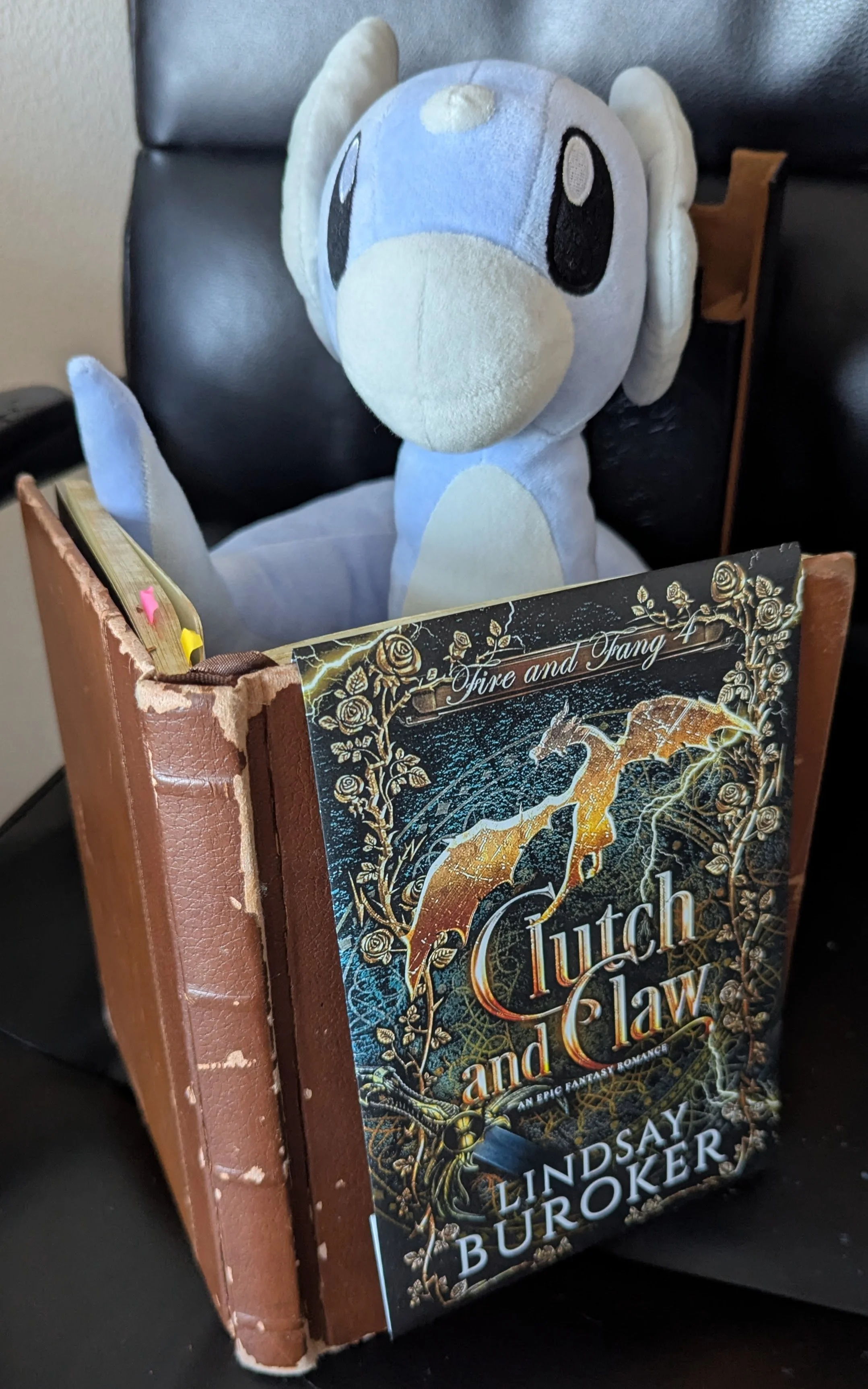
Title: Clutch and Claw
Series: Fire and Fang (Book 4)
Author(s): Lindsay Buroker
Genre: Fantasy (Romantasy)
First Printing: March 2026
Publisher: Self-published to Amazon
Rating: 3/10
SPOILER WARNING
Mild spoilers for Clutch and Claw will be included throughout this review, through I will keep the first paragraph of each section as spoiler-free as possible. Heavy spoilers will be confined to clearly labelled sections.
Heavy, unmarked spoilers for the previous three books in the series - Sky Shielder, Red Dragon, and Game of Captives - will be provided throughout this review. I’m also going to assume that you’ve already read the reviews for those books, though it isn’t necessary to do so to understand this review.
GENRE
The Fantasy aspect of this Romantasy are cut and dry. We are seeing how this war of dragons and divine magic comes to a close.
The Romance aspect is more complicated. In isolation, this book is not a Romance. Syla and Vorik’s relationship does not drive the plot. However, this book is the finale of a series which has thus far, has been driven forward by their relationship. This perspective shows that the events of this story are a consequences of choices made as a result of the relationship. In other words, this book counts as a Romance because it is a continuation of a Romance story.
PROSE & TONE
I won’t beat a dead horse here. The prose is still filled with repetitive details. It’s also still a story founded upon very serious subject matter that undermines itself with excessive quipping. To name just a few examples off the top of my head:
Life-or-death duels to determine the fate of the stormers and the course of the war are leavened by cute moments of stormers indulging in sweets and jams.
Syla and Vorik banter during what is supposed to be a series rescue mission.
A literal god is coming to kill them all, but Syla finds time to quip with Wreylith about whether her salves are slimy.
Credit where it is due, though: Buroker reins the humor in a bit. It’s not quite as pervasive as the previous book. She even lampshades the humor. The results of this are mixed, yet they do help balance things out a little bit.
WORLDBUILDING
Buroker continues to work within previously established boundaries in this book. There are only two elements that are distinct enough from previously established lore to discuss them as new additions to the story.
Dragon Pregnancy
Thanks to the scene we’re not going to explore further, Wreylith is now pregnant via Vorik’s dragon. This doesn’t significantly impact the story overall, but it does color Wreylith’s behavior throughout the book.
The two main manifestations of the pregnancy are Wreylith’s cravings and nesting instinct. Wreylith has always been very motivated by food, but now, instead of requesting Garden Kingdom livestock, she begins hungering for seafood. This is used for some mild humor throughout the story. She also spends a lot of time searching for the perfect cave in which to establish her nest. This serves as a convenient excuse to have Wreylith be absent so action scenes can happen.
Also, it is mentioned that, because Wreylith is a red dragon, some (but not all) of her hatchlings will be red (with the implication being that the others will be green, like their father). This acknowledges that dragon color is hereditary. Since dragon color is this setting is purely aesthetic, this doesn’t impact anything, but it is nice to get some explanation for how it works.
The Gods Will It (Heavy Spoilers)
Given the point I am going to make at the end of this section, it may be a bit silly to say that anything in this section can truly be considered a heavy spoiler, but the story does treat these things as twists.
The opening chapter of this book is the storm god raising Jhiton (who, remember, Vorik killed at the climax of the last book) from the dead and tasking him with bringing about the final downfall of the Garden Kingdom. This is only the start of the divine intervention in this book:
The ritual being performed by the dragons in the volcano is to summon the storm god.
When the storm god arrives, he hurls lightning bolts that punch holes through the Castle Island shielder so that dragons can invade it. He also fires bolts to protect dragons from shots by the weapons platform.
Syla is able to recharge the weapons platform by tricking the storm god into striking it directly with lighting.
By praying to the gods who like humanity, Syla is able to make contact and unlock an upgrade to the weapons platform, gaining the ability to fire it remotely at a significant distance.
The shielder (or the gods speaking through the shielder) give Syla and Vorik clear instructions on how to give Vorik’s dragon permission to move in and out of the Castle Island shield.
These are multiple, literal (in the case of the divine artifacts, exceedingly literal) cases of Deus ex Machina. I did a whole post on how introducing divine intervention into Onyx Storm further damaged the entirely of The Empyrean. Here, though, it all makes perfect sense.
The involvement of the gods has always been integral to this setting and to the framing if the narrative.
This setting is a Death World because of the storm god’s experiments.
The other gods created the shielders and other divine artifacts to protect humanity.
The moonmarks were bestowed upon Syla’s bloodline by the moon god, serving not only as a means to control divine artifacts but also a sign of her family’s (and, by extentjon, her) divine right to rule.
Everyone within the world accepts that the gods are real and respects their authority. The only issue that anyone takes on faith is whether or not the gods allied with humanity will ever return to the world.
This is just the background information. Red Dragon featured some sort of automated security for the storm god's laboratory that manifested as an holographic avatar, with the possiblity of the storm god being alerted to the intrusion at least being left open. In Game of Captives allowed Syla to astral project to Vorik to find the stolen shielder ingredients, and then Jhiton was protected by a mysterious lighting bolt that intercepted a weapons platform shot. Jhiton and Vorik also discussed the possiblity that Syla might be a divinely anointed Chosen One, meaning the stormers could be risking the wrath of the human-allied gods by fighting against her.
When Buroker opens this book on an act of divine intervention, this isn’t a paradigm shift. It’s escalation of the stakes along a previously established path. It makes complete sense. That’s why I was mixed on saying this section has any heavy spoilers in it. Even before the narrative acknowledged that the storm god was getting directly involved, the groundwork was there for him to be the one to resurrect Jhiton. It was laid for the dragons to summon him. And while the recharge and upgrade for the weapons platform come across as ass-pulls to allow Buroker to write herself out of a corner, they do feel like natural extensions of the previously established elements. The issue was the timing of these developments.
Is this perfect? No. The gods are not characters, nor are the limits of their powers established. The limits on their intervention are unclear. Still, this has always been a setting where divine intervention was on the table. Buroker has simply chosen to wait until this book to openly apply it.
The Side Effects of Syla’s Healing
Since Sky Shielder, we have been reminded that Syla’s healing had the side effect of her enthralling those it is used upon, bending their will to he favorable towards her.
With this finale, I can comfortably say that this detail has been completely irrelevant to the series.
I feel like Buroker conceived of this side effect for Sky Shielder and only really thought through the broader implications of the narrative when she got to Red Dragon. It made some sense in that first book. This rule discourages Syla from just using her healing at will (since she's not comfortable with magically enslaving her patients), and it also lends an edge to the seduction (since Syla could, in theory, have decided Vorik was so dangerous that enslaving him with the only option).
Since that first book, though, Buroker has gone out of her way to negate any impact this might have on the narrative. Anyone Syla heals is either has too much mental fortitude to be influenced or else is already so favorable towards her as to make the influence a moot point.
For example, in Red Dragon, Syla recruits a prostitute to spy on treacherous military officers. The narrative frames this woman’s undying loyalty to Syla as being a result of this side effect. The thing is, Syla saved this woman as she was dying of a venereal disease. She kept this woman’s children from being orphaned. There’s never a point where the prostitute’s loyalty is tested, not even when she returns to the narrative in this book to feed intel to Syla. It really seems like nothing would change if Syla’s magic were rewritten to drop this influence element.
The side effect is not a bad concept. It’s a Chekov’s Gun that managed to go this entire series without being fired.
ROMANCE
The Romance elements of this book are rather interesting. Buroker does what so many other Romantasy authors seem petrified of doing: she allows the relationship to evolve.
Game of Captives ended the Will They Won’t They phase of Syla and Vorik’s relationship. Vorik committed to siding with Syla, even if doing so put him at odds with his own people. With this conflict settled, Syla then turned her attention fully to reclaiming her kingdom and ending the war.
This is the part when one would expect forced relationship drama to step in. Many stories introduce an alternative Love Interest to compete for the Main Character’s affections. Others have the couple break up off-screen and then spend the sequel reuniting. We saw Yarros stumble through two books of manufactured conflict to pretend like Violet and Xaden’s relationship wasn’t already settled, cycling through a whole series’ worth of contrived conflicts in Iron Flame and then putting all the focus on Violet not having a fulfilling sex life in Onyx Storm. Runebreaker ended on the threat that Bondbreaker will be about Aelie and Kairos struggling to get Skype to reconnect.
Buroker does … none of that.
Syla and Vorik are in a mutually supportive relationship from the very first page. There’s some initial mistrust on Syla’s end, but it’s not the inane bleating about trust we saw in The Empyrean and Runebreaker; she merely has a brief period where she isn’t 100% on Vorik’s loyalties, which makes sense given that they were on opposite sides of a war … let’s see … less than a week earlier. This passes very quickly. When conflict does resurface, it’s because Vorik wants to go back to the stormer tribes to negotiate peace of Syla’s behalf, and Syla doesn’t want him to go because of the obvious threat this decision poses to his life. Rather than fighting about it, though, they communicate like mature adults. Syla eventually admits that he’s right and lets him go, though not without giving him the support that she’s able to give (baked goods, because of course, there’s the whole stormer sweet tooth thing going on).
This is meaningful character growth. Sure, neither party is actually changing, but their relationship is evolving. The drama shifts from, “Will these two make it work?” to, “Will these two be able to overcome external threats and settle down together?” It’s very similar to Luna and Duncan’s situation in Triumph of the Wolf, albeit without the drama built around them finding a moment to have sex.
The only two things I have to criticize about how the Romance elements are handled end up doubling back and strengthening the overall narrative.
We previously covered in the genre discussion how, taken out of context, this book would not be a Romantasy, as the Romance does not drive the story in this particular book. That said, we also covered how this book continues the previous Romance. This book may not be built upon longing, confusion, and baiting pornography (even if there is pornography), but it is following the chain of events set into motion by Syla and Vorik choosing each other. This is something that an overwhelming number of Romances seem hellbent on avoiding. While I’m going to fault the execution of this chain of events when we discuss the plot, the fact Buroker did it at all is honestly a breath of fresh air.
Buroker never actually resolves the issue of why Syla and Vorik love each other and are in a relationship. It’s like they just looked at each other and decided that the sex is good enough to settle down and figure out the rest later. On the flip side of this, though, because she writes the pair as a mutually supportive couple through this book, it is completely believable that they would stay together. They finally have a sense of chemistry outside of sex now that they are no longer being torn between sex and their obligations.
I haven’t been a fan of how this relationship has been handled across the series. Buroker choosing to write it this way in the final entry of the series makes up for all my previous misgiving. Instead of writing a couple in a toxic relationship held together by sex, she pivoted into a dynamic that truly feels like it will survive beyond Happily Ever After.
REAL CHARACTERS
Next Wednesday, we’ll be discussing the characters of Clutch and Claw.
I’m going to level with you up front: this is Syla’s book. Most of what I have to say is purely about Syla. I’m not saying Vorik isn’t important to the story, but there’s very little to be discussed in terms of his characterization.
However, another point we’ll discuss are the dragons. See, Buroker has always written her dragons as actually characters (instead of being large dogs with projected personalities, as we see in The Empyrean). In this book, though, she manages to take a very large number of dragons who have had barely any presence in the story and manages to portray them all as characters. They are what the titular Empyrean should have been. We’re going to dive deeper into why that is.
Thank you all for stopping by. Please remember to subscribe and share if you enjoyed what you read here. Take care, everyone, and enjoy the rest of your week.