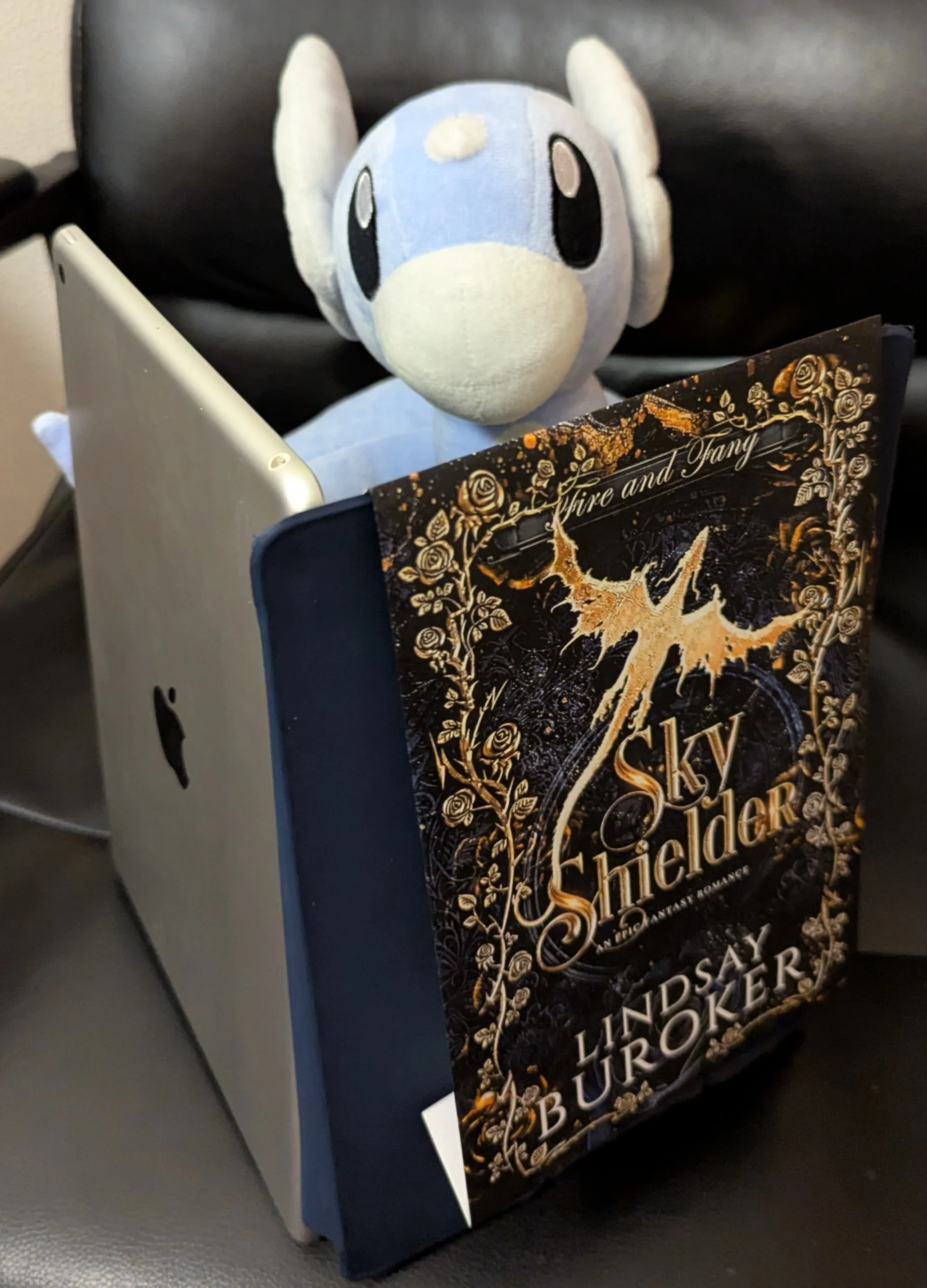
Sky Shielder (Part 3 - Derivation)
Hello, everyone. Welcome to the third and final part of the review of Sky Shielder.
This part will focus exclusively on holding Sky Shielder up to The Empyrean, the series that it is very clearly a derivative of. If you’d just like a general overview of the book, please see Part 1, while Part 2 provides a deeper analysis of the book’s qualities.
All right. Mount up on your dragons, everyone. Let’s fly.
STATS
Title: Sky Shielder
Series: Fire and Fang (Book 1)
Author(s): Lindsay Buroker
Genre: Fantasy Romantasy
First Printing: October 2025
Publisher: Self-published to Amazon
Rating: 5.5/10
SPOILER WARNING
Mild spoilers for Sky Shielder will be included throughout this review, through I will keep the first paragraph of each section as spoiler-free as possible. Heavy spoilers will be confined to clearly labelled sections.
In the course of comparing this book to The Empyrean, I may need to provide heavy spoilers for elements from Fourth Wing, from Iron Flame, and from Onyx Storm up through Chapter 56. These heavy spoilers will not be marked.
DERIVATION IS NOT A DEATH SENTENCE
To preface this part, I’d just like to reiterate the a work being highly derivative is not a bad thing. Christopher Paolini wrote a beloved fantasy series where several foundational elements are very clear copy jobs of other popular media, and that turned out great. Even the derivative elements of The Empyrean weren’t a deal-breaker during the first half of Fourth Wing.
When it comes to derivative works, what’s important is whether:
The author understands the elements she’s working with.
Whether the final product needs to rely on the thing it’s copying to survive.
In the case of Paolini and the Inheritance cycle, he did understand what he was working with, and he crafted his derivative elements into a cohesive whole that stands on its own. In the case of Yarros and The Empyrean, she rams derivative elements into her work with no care for how they actually function within her story and in a manner that shows, at best, only a passing familiarity with the things she’s copying.
Buroker is far closer to Paolini than Yarros.
THE MARKETABLE POINTS
All right, to kick this off, let’s go over the list of obvious derivative elements that appear in the marketing and / or make themselves evident before the plot even gets off the ground. These are the same as the elements that I listed in the introduction to Part 1. Just to refresh your memory, that list was:
Dragon riders
A kingdom shielded from the supernatural evils of the wider world by magical wards
Said magical wards are a driver of the plot
A female MC who is not particularly physically capable and has a talent for working with poisons
A male LI who is a morally gray, brooding bad boy with a softer side of the MC to coax out
Dragon Riders
This goes far deeper than just the existence of dragon riders. Buroker’s riders share multiple elements in common with Yarros’s. While we could shrug off some of these as elements copied from Pern or the Inheritance Cycle (which was also copying Pern), there are also details that fit The Empyrean but not those other works.
Dragons communicate telepathically, and dragons bonded with riders tend to only with their own riders rather than speaking with all humans.
Riders are bonded to dragons.
Riders can develop powers and some sort of physically identifying mark as a result of their bond.
Riding is done bareback.
In addition to enduring extreme G-forces, riders engaged in aerial combat are shown jumping onto one another’s dragons to duel each other with blades.
Dragons have colors with no clear rules as to how those colors work.
A dragon can have multiple riders over its life.
Dragons operate within a military hierarchy that was clearly designed for and by humans, despite the fact they only take orders from other dragons.
While this is a pretty blatant copy-paste, Buroker’s riders have a few key differences that demonstrate she has a far better grasp of both what she’s copying and how it fits within her own world.
No Death Bond
In The Empyrean, riders die with their dragons (unless, you know, they “chose to live” - believe me, we're going to be getting into that this Friday, when we do Chapters 53 through 56 of Onyx Storm). Dragons can also apparently die with their riders after they’ve bonded with a certain number of riders. This mechanics was very clearly copied from Pern and/or Inheritance and was used in multiple unearned bids to ratchet up tension. It falls flat because of the multiple logical contradictions Yarros introduced whenever Violet, the “rational woman” chosen by her dragon for her “intellgience”, thinks she or her dragons can just ignore the rule.
This is a lesser copy of what both Pern and Inheritance did. In both those cases, the death of either a dragon or rider will trigger the death of the other … via suicidal depression. Pern plays this very straight, with only a few humans and no dragons ever pulling through this. As for Inheritance, this is used to generate tension during the early parts of Eragon, but once Paolini establishes that Brom outlived his dragon by a century, he stopped trying to milk this as a potential threat to Eragon’s and Sapphira’s survival.
Buroker dropped this mechanic. No risk to riders from the death of a dragon is established, riders die with no indication of any threat to the dragon, and we know that Wreylith has outlived at least one rider by hundreds of years. The threat of mutual death doesn't serve her narrative, so she didn't waste time with it.
Colors
This one is straightforward: there is no established power scale linked to the colors. That means there are no contradictions in the handling of such a power scale (believe me, that’s going to be important when we get to the climax of Onyx Storm). Much like Inheritance, colors are merely a trait of physical appearance that dragons might take pride in for themselves or admire in others.
Bareback Riding / Aerial Combat
At the start of the book, this detail seems to be just as messy as what The Empyrean did. We are told about riders needing to use their thighs to clamp onto their dragons and needing to find minute fingerholds among the dragons’ scales. Then Buroker establishes two other details to correct this: the physicality of riders who draw power from their dragons and the ability to stick to dragons with magic.
First, the physicality. We are shown Vorik pulling off superhuman feats of athleticism that would severely injure or kill normal people, and the story acknowledges that these are remarkable. It is not hard to believe that such an augmented human could remain on a dragon during the maneuvers pulled in this story.
Then Buroker introduces the ability of riders - or, for that matter,vanyone with magic - to magically adhere to dragons. This is explicitly acknowledged as something Vorik can do. What’s more, there is a scene midway through the book where Syla and her aunt use their own magic to stick to Wreylith, though they don’t manage to do so for very long.
These elements make all of the aerial combat so much more believable. It’s like Buroker read the books of The Empyrean, acknowledged the problem, and decided to be proactive about correcting it in her own work. It's not a perfect solution, given that we are told that not every rider gains the magic that Vorik does, but it is better than nothing. More thought was put into this than into the thing it was derived from.
The Protected Kingdom / The Wards Plot
Much like Navarre in The Empyrean, the Garden Kingdom in Sky Shielder has a magical barrier is tailored for the plot of this book. It keeps out magical creatures, rather than shutting down certain types of magic, but the effect is the same. This shield is powered by an ancient magical artifact that is destroyed by an infiltrator. Restoring the shield is a key plot point.
On the plot side of things, Sky Shielder handles these things better than The Empyrean, but this isn’t really because of the elements themselves. It’s more a matter of narrative focus. Sky Shielder is simply not bloated with irrelevant drama in the same way as The Empyrean. Buroker also doesn’t drag things out by lying to the audience about mechanics and then projecting her dishonesty onto her characters. This book is about restoring the shield, rather than the shield being a side quest.
On the worldbuilding side of things, if I had not read Onyx Storm, I would say that Sky Shielder handles the existence and mechanics of the shield just as well as The Empyrean. However, with all the retcons Onyx Storm introduced to make venin a threat inside the wards and to pretend Violet is amazing for endangering millions of people so that her friend group could still sleep over, the shield on that story is now almost pointless. Sky Shielder keeps things simple and consistent. The barrier keeps the magical creatures from physically entering the protected area, but their riders can still use magic inside. Dragons are even capable of flying over the shield and dropping objects through it from a great height.
Female MC
The two main factors to consider here are how the physical deficiencies of the MC are addressed and how her medical knowledge is utilized.
Fit for Duty
The Empyrean plays with Violet’s size, EDS, POTS, and lack of training as things that should effect the story. The issue is that Yarros toggles realism and chooses power fantasy over stakes and tension. Violet’s physicality never truly holds her back from being an over-the-top action hero. The utter ridiculousness of what happens on Unnbriel kills this idea completely. There was never any value in giving Violet these disadvantages outside of milking unearned tension and hammering in that she is Yarros’s self-insert.
Syla, by contrast, is not a warrior. At no point in the story does she become one. She constantly needs to rely on others (especially Fel and Vorik) to fight and overcome physical obstacles on her behalf. The closest she comes to holding her own in a fight is learning, via stressful situations, that her healing magic can be weaponized. Even then, she doesn't get a huge amount of mileage from it.
At most, the closest Syla comes to feeling like a power fantasy character are the mentions to her weight. Multiple references are made to her being what some might call “curvy”. This doesn’t detract from the story in any way. Syla being overweight makes sense given her background, and the way this is dismissed reads as her simply being desirable regardless.
Master of Poisons
Much like Violet, Syla is a master of medicines and poisons. The difference is that, unlike Violet, Syla was trained for this. Yes, Violet is book smart, and some of her understanding of poisons can be explained by her having the right reading material on hand, but Syla spent years training and living in a temple where she worked as a healer. Her power doesn’t just comes from her magic, either - she’s trained as a surgeon (such as they are within the tech level of this setting) and knows how to make medicines. So whereas Violet suggesting she could develop an antidote to the serum in Iron Flame is utter nonsense, Syla never claims to be able to do anything that isn’t at least plausible for someone with her background.
There’s also the matter of presentation. Violet’s understanding of poisons is often played as a “Gotcha!” moment, with Yarros whipping out information that was either not previous set up or lazily aftshadowed in order to make it seem like her main character is smarter than the audience. By contrast, when Syla needs to poison someone (and I mean actually poisons someone, not just deliberating using a poison that is conveniently at hand), the mechanics of that poison are established well in advance, and the audience gets to see her make the decision to pack that poison in her bag for future use.
All of which is to say that, whereas Violet tries and fails to be Maomao from Apothecary Diaries, Syla succeeds at it.
Male LI
Vorik is not the Shadow Daddy archetoye that Xaden is, but he is still the physically overwhelming, ruggedly attractive, morally ambiguous hero seen in so many bodice ripper Romances about tough barbarian types. That's where the similarities end. Whereas Xaden embodies the worst qualities of a faction of “egotistical assholes” and has no redeeming traits, Vorik is an honorable man who tries to be polite to people even as he is plotting their downfall. Whereas Xaden dooms millions because he’s too self-righteous to accept any oath forward but his own while also refusing to accept the responsibility of his choice, Vorik is exposing the Garden Kingdom to danger because it really is the obvious path forward for him. Whereas Xaden liking chocolate cake feels slapped on to give him anything relatable, Vorik’s love of sweet foods is integrally connected to his background and his motivations.
In other words, despite being written as the love interest for a Romance that doesn’t even try hide that it is pornography, Vorik is a better-written love interest than the male lead in a story that tries to pretend that it isn't.
OTHER POINTS
While reading through the story, there are a few other derivative elements that become apparent. While I’m inclined to think that these might just be a coincidence, rather than deliberate derivation, I feel the discussion is still worth having for the sake of completeness.
Lust, Not Love
Much like The Empyrean, the Romance in Sky Shielder is purely about sex. Even Pern, which presents dragon rider wyrs as Free Love communes where rape is condoned so long as dragons are involved, had more depth to its romantic relationships.
Interestingly, I should be able to say The Empyrean did things better than Sky Shielder. Prior to Onyx Storm, Yarros has least tried to pretend that there was more to Violet and Xaden’s relationship than just sex. Emotional conflicts were set up. The problem is that none of these conflicts were paid off in anything resembling a satisfying manner, and then Yarros gave up and just made the relationship about sex in Onyx Storm.
So, while I don't like what Buroker did in Sky Shielder, especially since Magnetic Magic did things better … This is actually the better version of things, at least in terms of objective literary analysis. She doesn't waste the audience’s time. What’s more, because the idea of seduction is made part of the character’s goals, she managed to get the sex to do at least some work to drive the story forward.
So, yeah. The unapologetic pornography ultimately ends up being the better-told story.
Rival Love Interest
While Captain Lesva is not exactly a deep or nuanced character in Sky Shielder, she is far more effective as an antagonist than Cat is in The Empyrean.
Yarros couldn't make Cat an actual threat. She was quick to write off Violet’s jealousy, and she made Cat’s goal purely about stealing Xaden from Violet, despite the fact that Xaden was not interested and Cat openly flouted what she was actually doing. It was hard to take her seriously even when Yarros pretended she was an obstacle.
Lesva wants to have sex with Vorik again. That’s certainly made clear fork the beginning. She has no problem channeling that frustration into catty remarks about Syla’s weight. However, while those remarks make Syla feel insecure about her body, that is not the actual threat Lesva poses. Lesva is a rabid dog who wants to steal the glory of Vorik’s mission out from under him, and she has no qualms about attacking or torturing Syla to get what she wants. That is the true threat that Lesva poses.
It’s entirely possible this dynamic may shift and get worse in Sky Shielder’s sequel. For now, though, Lesva is a superior rival to Cat. Buroker utilizes Lesva in a way that makes her a genuine threat to Syla and Vorik getting together, rather than wasting the audience’s time by going through the motions.
Modern Mindset
Much like in The Empyrean, the world of Sky Shielder is one with very modern sexual attitudes and gender dynamics. Syla is established as having some sexual history before Vorik, with the implication being that the only reason that she didn’t have more was that she avoided people who might want to take advantage of her magic and bloodline. Buroker also goes out of her way to establish that contraceptives and abortion drugs are easily accessible. The way that sex is discussed also feels very modern, like casual sex is just something everyone does in this world. On the gender side of things, it’s made clear that the royal power can pass to men or women with equal ease, to the point that I still can’t keep straight which of Syla’s parents was actually the one who came into the throne by blood instead of marriage. (Her mother was the queen at the start of the book, but it’s implied that her father previously held the throne, meaning that he was the one who actually inherited the position whereas her mother merely shifted into it.)
This is a fantasy world that’s barely cracked gunpowder and still relies upon monarchy and political marriages to run its government. This mindset doesn’t make a lot of sense. Yes, there are exceptions and unspoken cultural norms across history that could justify this, yet the way these particular elements are incorporated into this particular world feels very much like something from our world, rather than sliding into these things naturally due to in-world circumstances.
A good example of coming into these things naturally would be The Will of the Many. This world is extremely egalitarian in the upper echelons, where everyone has access to enough Will to negate physical disparities, but where the lower ranks still clearly emphasize the value of men for physical labor while women are prized for their ability to have children. The gender dynamics flow from the magic system. Now, if we later find out that the Hierarchy allows for contraceptives and abortion, that would NOT fit naturally in the world. The law of Birthright would not allow these things. There’s a passing statement in The Will of the Many about homosexuality being a crime against Birthright, with the implication being that sex that won’t produce children (and thus more Will for the Hierarchy) is illegal. The idea that the Hierarchy would apply Birthright broadly enough to punish homosexuality and yet permit interference with reproduction is ludicrous.
All this is to say: the modern mindset of Sky Shielder did damage my immersion, much like the modern mindset in The Empyrean did.
…. but …
The issue is not nearly as severe as what we got in The Empyrean.
See, the issue in The Empyrean is that Yarros goes out of her way to establish a world in which such attitudes should not exist. Rider training favors male candidates, something Yarros emphasizes when she makes a big deal about physical disparities between the sexes and the different attitudes of male versus female riders towards violence, yet she tries to pretend that women are not only allowed to participate (despite other bans in place to prevent needless death) but also makes women equal to men in every engagement. Emphasis is put on the importance of riders having children, and the rider leadership turns a blind eye to the sexual hedonism inside the Riders Quadrant, yet “no one” wants rider cadets (who, bear in mind, are all at least 20, and thus are very much adults with their own agency) to have children. In short, she presents a world that should be the farthest thing from egalitarian and sexually permissive, because those should not be winning strategies.
Here in Sky Shielder, though? There’s not actually a clash between the modern mindset and the setting. The Garden Kingdom is a land of peace and plenty, and for at least the dragon riders who get magic from their dragons, said magic would eliminate gender disparities. This is simply not a world were egalitarianism or modern sexual attitudes can’t work. The issue is purely that the framing makes it seem like characters came out of the world of Magnetic Magic rather than living in this one.
All this is to say that, even in this aspect, Buroker has a better understand of what she’s doing than Yarros does.
THE BETTER STORY
Sky Shielder may be the indie knockoff of Fourth Wing, but it is far and away the superior story. Any derivative elements are handled in a way that not only shows a greater understanding of these things but also feels as if Buroker is actively trying to solve problems Yarros chose to ignore. If Buroker were the one getting the fame and praise that is now being heaped on Yarros, I would be far less jaded about Romantasy than I am today.
On that note, I do plan to continue to the sequel of Sky Shielder, Red Dragon. Based upon Buroker’s updates, I don’t believe it will be out before this post releases. I will most likely get to it in the New Year and spread out the review across consecutive Sundays.
THE WRONG CHOICE
Speaking of Yarros’s baffling writing decisions, this Friday, December 5th, we will discuss Chapters 53 through 56 of Onyx Storm. These chapters are a transition from the action set piece in Chapters 50 through 52 to the climax of the book. While they are mostly filler, there is one very frustrating element that stands out of me. Yarros has spent a great deal of time setting up the consequences of a rider losing a dragon, but now, she has to pay them off. Her way to addressing the issue is utterly embarrassing.
Thank you all for stopping by. Please remember to subscribe and share if you liked what you read here today. Take care, everyone, and have a good week.

