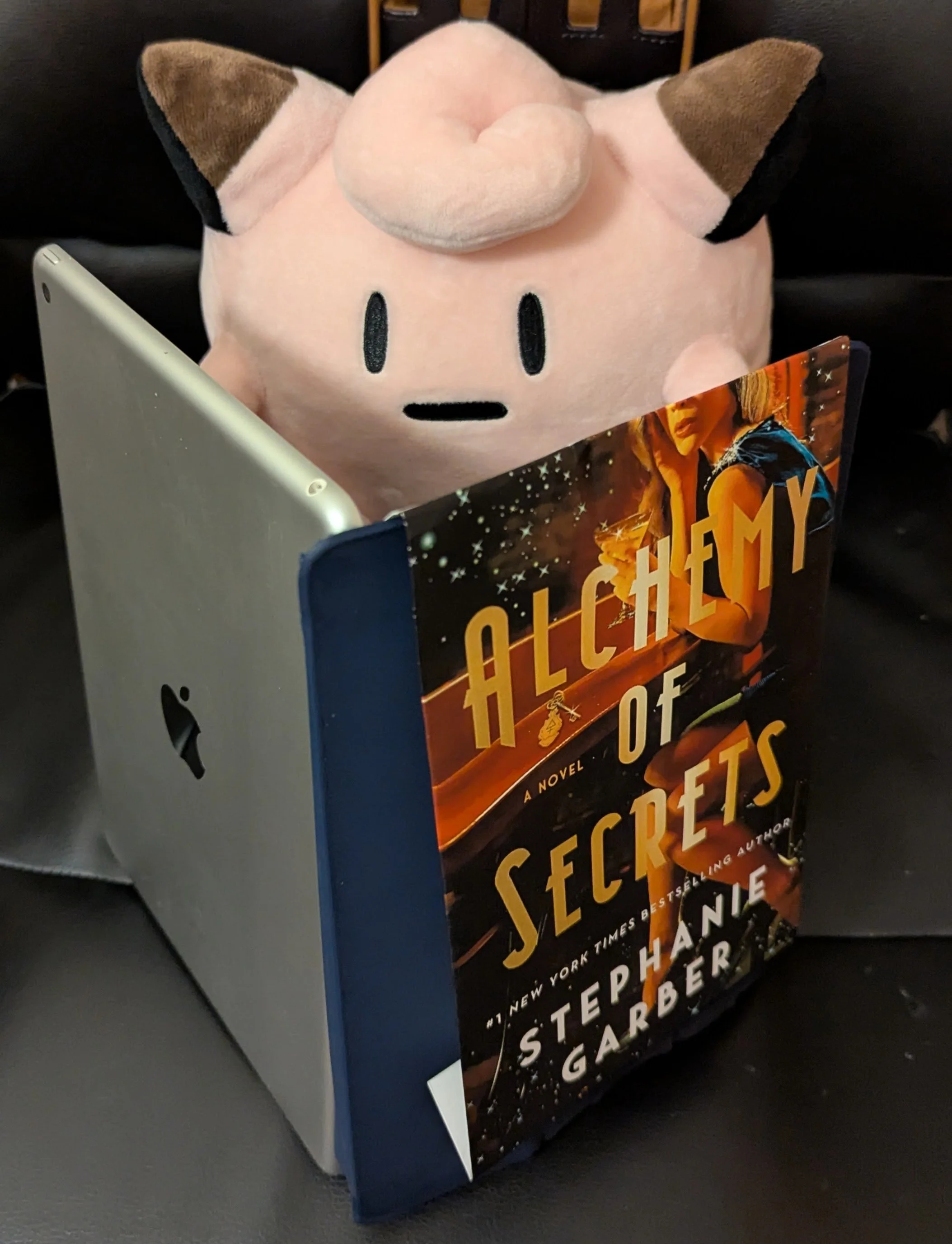
Alchemy of Secrets (Part 3 - Presentation & Conclusion)
Hello, all. Welcome to this final part of the Alchemy of Secrets review.
This part will dissect the prose and structure of the book, including its use of interlude chapters, before giving a final conclusion for the book as a whole. If you’re just looking for a high-level review of the book, please see Part 1. If you want to see the analysis of the plot, worldbuilding, and characters, please instead see Part 2.
Let’s dive in.
STATS
Title: Alchemy of Secrets
Series: N/A, though a sequel is in the works
Author(s): Stephanie Garber
Genre: Adult Fantasy (Urban)
First Printing: October 2025
Publisher: Flatiron Books
Rating: 5/10
SPOILER WARNING
Mild spoilers for Alchemy of Secrets will be included throughout this review, through I will keep the first paragraph of each section as spoiler-free as possible. Heavy spoilers will be confined to clearly labelled sections.
PROSE
Written for YA
One of my biggest gripes about Alchemy of Secrets is that it is a YA book pretending to be a book for adult readers, and that masquerade undermines the text.
As I’ve said at least once already in this review, there is nothing inherently wrong with YA books or YA prose. It’s important to write for one’s target demographic, after all. However, for this same reason, I also believe that the prose associated with YA books should stay in the YA genre. Adult readers are not the same as teenagers.
A Lack of Subtlety
In Caraval, I defended Garber’s decision to beat us over the head with reminders of the things Scarlett was obsessing about. This obsession felt true to Scarlett’s character, plus the reminder was helpful for keeping track of where Scarleet stood (or, at least, thought she stood) as she wandered through the funhouse that was Legend’s great game. It was also something that’s a little more forgivable in YA, where there tends to be less subtlety.
in Alchemy of Secrets, Garber also beats us over the head with reminders of the things Holland is worried about. Unfortunately, none of the three variables that applied to Caraval apply here.
Whereas Scarlett is an extremely anxious person, Holland is not characterized in this matter. Yes, she’s in over her head, but even with this panic, she is far more composed. When she dwells on things as a means to remind the audience of them, it doesn’t read like she’s fixating on things that are mostly out of her control. At best, it reads like Garber has failed to filter Holland’s stream of consciousness.
We’ll get reminded about information regardless of whether or not there’s been any development to justify the reminder. The most glaring example of this is a multi-chapter scene of dialogue at the one-third mark. Holland starts reminding the audience of things that were discussed or that we were reminded about earlier in that same scene. At one point, she reminds us of a line that was said only a few pages (in-world, only a few minutes) earlier, with the reminder framed as if it was something she’d been told hours earlier.
Because this book is not YA, spelling out everything that Holland is thinking or feeling (versus only the most essential details) takes ideas that could be experienced through implication and instead holds the audience at a distance by just Telling us them. There’s nothing wrong with Telling to emphasize something of critical importance, of course, but when every thought process is spelled out and when reminders are reiterated ad nauseum, the weight of such emphasis is watered down to the point of uselessness. It’s also a bit patronizing to read, if I’m to be totally honest. It’s like Garber things her adult audience has no attention span.
What makes this all the more glaring is that the most emotionally effective aspect of the narrative is the one thing Garber doesn’t explain until the very end of the book: Holland’s episodes of bleeding and hallucinations. Yes, I did tear into this element in Part 2, yet I feel it does serve as a good example of what could have been. How much more emotionally rich could this narrative have been if Garber had been willing to leave even more elements unexplained for longer than a few pages?
The Wrong Pace
On a related note to the lack of subtlety, key beats within this story (or, at least, things framed as key beats in the story) are rushed through without any emotional weight. Back in Part 2, I talked about both the rushed manner in which Holland’s character motivations are wrapped up and the fact that the romance doesn’t feel earned. This is mostly an issue with plot and character, but I believe this YA writing style is also a contributing factor.
As I read through the book, I found myself wondering how much more satisfying some of these story elements would be if the narrative were ground down into a fast-paced YA book. The romance elements would feel like an emotional whirlwind rather than forced, awkward kisses. Those half-hearted attempts at resolving her motivation could at least be handwaved away via head canon.
I’m not saying that YA narratives are inherently lower quality, nor am I saying that making this book YA would automatically make it good. What I am saying, though, is that there are parts of this book where it reads like like a novel for adult audiences and more like a YA book with filler pumped into it. it takes shallow elements of the story that might be forgivable in a fast-paced story and makes them feel inadequate.
Humor
Garber takes multiple stabs are levity throughout this book. I don’t know if her goal was to make Holland quippy or just to lighten the tone. Whatever her intention, I don’t think it succeeded.
Much of this is just that I didn’t find the humor all that funny. I could see what Garber was trying to go for with her various jokes. They just didn’t land for me. It ended up being cringey rather than funny.
Even if I had found these funny, though, I’m not sure they would have benefitted the narrative. Garber goes out of her way to make the story tense, particularly with this hallucination scenes. If she really wanted to reduce the tension, she could have just dropped the hallucinations. Injecting all this lighthearted comedy into the narrative just creates tonal confusion.
Lying to the Audience (Heavy Spoilers)
At a couple of points, Garber outright lies to her audience to generate tension.
The most glaring example of this is the end of Chapter 12. Holland goes to the Professor’s house to Gabe to see if there are any clues about the Heart there. At this point, Holland (and the audience) knows that other people are hunting after the Heart and that her life is in danger. Then the chapter ends on this cliffhanger:
“You don’t need that,” Gabe said, as Holland retrieved the key.
“I told you we’re not breaking in,” she argued.
“We’re also not the first ones here.” He pressed two fingers against one of the Professor’s French doors, easily pushing it open.
A second later, all the lights switched on.
And then, everything was chaos.
What does this imply to you? Because to me, it implies that they were attacked by people hiding inside the house. Why else say “and then” there was chaos unless there was a chain of cause and effect, which only makes sense if the set-up threat of being attacked had manifested?
Except … no. That’s not the case at all. Chapter 13 will reveal that the “chaos” was that the Professor’s office had already been ransacked and that Holland was just looking at the damage. The sudden switching-on of the lights isn’t even acknowledged until a few chapters later, when it’s explained that Gabe can manipulate electronics with his magical ability. The scene is so calm that one might be forgiven for thinking an entire chapter had been skipped.
The same thing happens in the cliffhanger for Chapter 30. Garber has a cliffhanger that points to a specific character being the Devil all along, only the opening pages of the next chapter all but erase that idea. I could almost write this one off as justified misinformation, except Garber puts so much emphasis on this being a big reveal before immediately walking it back. There’s no narrative value to the moment. It’s just there to get a knee-jerk reaction from the audience.
What shocks me about this is how brazen it is. Did Garber not think anyone would notice the incongruities here?
STRUCTURE
Hatchet Job
Even outside of the lies told to force cliffhangers, this book has a major issue with chapter endings.
Not counting the interlude chapters or the epilogue, there are 55 chapters in this book - but, given how the chapters are paced, there are maybe 20 chapters worth of content. Garber only got the chapter count as high as she did by breaking chapters are arbitrary points, like this is some lazily written TV show that terminates scenes mid-conversation to manufacture drama rather than letting characters finish what they’re talking about. The only difference here is that Garber then does go on to show what the characters are talking about, thereby retroactively devaluing the false cliffhangers she created. By the midpoint of the book, I was so tired of this that nearly every chapter ended had me rolling my eyes. It’s just like those weird section breaks we saw in The Eye of Minds, only inflated to the scale of whole chapters.
Seeing this after the bizarre density of cliffhangers in Onyx Storm (particularly in the stretch from Chapter 29 through Chapter 37) and the false cliffhangers in Murtagh, I find myself wondering: is this some sort of mandate that traditional publishing is forcing onto their authors? Like, are they demanding shorter chapters and an overabundance of cliffhanger endings? Onyx Storm and Murtagh just read like manipulative writing, yet here, it really reads like longer chapters were arbitrarily chopped into smaller pieces. Until I have more to go on with this idea, I’m going to assume Garber is also engaged in manipulative writing. It’s just I’m getting a little weirded out that this keeps happening in newer Fantasy books.
Interlude Chapters
Across the first third of the book, there are six interlude chapters. There’s also a seventh at the midway point. There interlude chapters are all linked to Folklore 517, the class Holland took that lead her to the Professor.
The first serves as a prologue and sets an expectation for the book’s tone by introducing Folklore 517 as a concept.
The next four cover specific urban legends that are relevant to the plot of the book in one way or another.
The sixth and seventh seem to record how the fallout of the hunt for the Heart affects the ongoing classes, though without any confirmation as to when these chapters take place, they could just be random events inserted into the narrative for vibes.
It’s also worth noting that all these chapters are written in the second person and never give a name for who “you” are supposed to be, embedding the reader into the class as a nameless student.
I really like these interlude chapters. I feel like they were a clever way to feed the audience exposition. You all may have noticed from “The Unbottled Idol” that I like to use epigraphs to feed the audience exposition that I don’t want to bog down the pace of the narrative. This is an expansion on that principle, one that requires greater investment for greater reward.
However - and I can’t emphasize this strongly enough - that sixth interlude chapter is at the one-third mark. It’s sandwiched between Chapters 12 and 13 out of 55. That last interlude is between Chapters 22 and 23. Without them, a lot of the eerie vibe that this story started on fades away, and not in a manner that feels like a natural evolution of the narrative. It suddenly feels like the vibe only ever existed in the first place because of these interlude chapters.
What’s more, much like Holland’s hallucinations, there interlude chapters ultimately are only here for the vibes. Yes, they feed the audience exposition, but Garber makes all of that exposition redundant by having a character repeat the same information when it becomes relevant later in the narrative. There was no need to write whole scenes, to describe environments and build up tension, just to deliver this information.
I can’t help but wonder if Garber thought the interlude chapters would be a fun idea but ran out of gas. That is to say, she only really had a plan for the first five interlude chapters, but then she ran out of plot-relevant folklore to share and wrote herself an exit. While I’m happy she didn’t follow Yarros’s model of just ramming irrelevant filler into the epigraphs at random, the actual solution here would have been to just cut all of the interlude chapters after the first one.
What Do We Pay You People For?
Also, about that interlude chapter between Chapters 22 and 23 …
In at least the e-book version on Amazon, this chapter has no heading.
It is very clearly meant to be its own chapter. There are page breaks into it and out of it, the same as all the other chapters in this book. There’s simply no heading. It’s not even like this is justified in the narrative, as all of the previous interlude chapters had headings, even the ones that introduced and canceled Folklore 517. All of those headings began with “Folklore 517”. In this chapter, “you” are trying to figure out what the class was canceled in this chapter, so why wouldn’t there by a “Folklore 517” heading on it?
It’s common knowledge at this point that trad publishers are skimping on (or overworking) their editors, but are they not cutting corners on basic formatting, too? How did no one catch this? Even if this is Garber’s mistake, not the publishers, surely someone would have asked if this was indeed intentional, right?
I EXPECTED MORE
I’m not going to pretend that I expected Alchemy of Secrets to be the next The Will of the Many. My expectations were not excessive. If anything, I limited myself to hope and curiosity. I thought Caraval was good, even if I didn’t enjoy it, and I wanted to see if I could connect to work that was actually aimed at my demographic.
All the same, I found myself very disappointed by Alchemy of Secrets. At a conceptual level, this should have worked for the same reasons that Caraval did. In execution, though, it took the flaws of Caraval and amplified them, then added a new flaw by applying a YA writing style in a manner that really doesn’t mesh well with the effort to be a more mature story.
I do plan on reading the sequel (assuming it is released), but not because I’m actually looking forward to it. I want to see if Garber can find her footing and correct these problems. If she doesn’t, or if they get worse, I want to assess why that is. Since no release date for the sequel has been posted as of the time I’m writing this, I can’t really give an estimate of when that review will be, but I do plan to try to follow the example of this review by reading the book and getting the review out quickly, rather than months after the fact.
That’s all for Alchemy of Secrets. Thank you all for stopping by. Since my next project for Tales of the Five Worlds is still under development, I plan to use the next few Tuesdays to cover another indie project, Lindsay Buroker’s Sky Shielder. I hope you’ll join me on Tuesdays from November 18th through December 2nd for that review. In the interim, we’ll be wrapping up the review series for The Will of the Many this Friday, then doing the Chapter 16 Bonus Chapter for Fourth Wing on Sunday.
Thanks for stopping by. Please remember to like and subscribe if you enjoyed what you read here. Take care, everyone, and have a good week.